
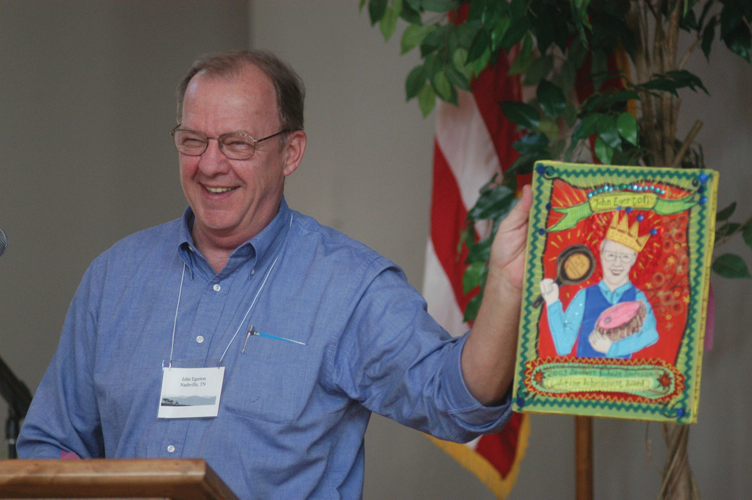

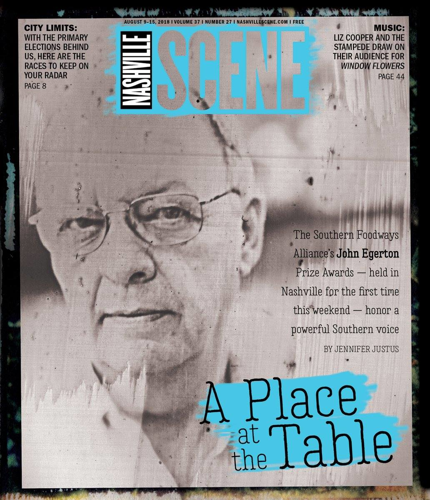


John Egerton holding the Southern Foodways Alliance Lifetime Achievement Award in 2003
Late Nashville writer John Egerton probably wouldn’t have liked all this attention.
According to his son March Egerton, John kept a bust of Robert Kennedy — his grand prize for winning the Robert F. Kennedy Book Award — on the back of the toilet in a room also papered with rejection letters. A favorite from The Washington Post simply read: “No, I’m afraid not. Thanks for sending it, though.”
Notoriously humble (and happier giving close-talking encouragement to others than basking in the spotlight), the journalist, author and activist had many accomplishments of his own — all while slipping more assists toward the goal than we’ll probably ever know. Egerton passed credit and praise to others and rooted for the underdogs and the underserved. He worked behind the scenes on projects like the Civil Rights Room at the Nashville Public Library downtown as he whispered guidance to those in his wide-reaching orbit to be better and to believe in the best parts of themselves and this region.
It’s a wonder, then, that he even allowed a prize to be named in his honor. But since 2009, the Southern Foodways Alliance — an organization Egerton helped found in 1999 — has presented $5,000 in Egerton’s name to an organization that addresses issues of race, class, gender, and social and environmental justice, through the lens of food.
“I’m still flabbergasted he let us do it,” says John T. Edge, director of the SFA, which documents and explores the diverse food cultures of the changing American South. “It was antithetical to him to let us put his name on something.”
But as Egerton needled Edge and colleagues to keep pushing toward a better South, Edge made a deft move in turning back to him for help in creating the prize. Because when someone asked Egerton for help, he had a hard time saying no.

March Egerton
“If we’re gonna do this, we need you,” Edge recalls saying. “Your blessing, your brain power, how to do this and who should be honored and how we define activism. … How do we celebrate those actively working to fix this busted wagon?”
Egerton helped shape the awards during the first few years. He died at age 78 in 2013, but the award and his work carry on. Rather than continuing to host the ceremony at the SFA’s annual symposium in Oxford, Miss., the group will bring the festivities to Nashville this weekend — to a city where Egerton left a lasting, powerful impression.
“This is so singularly important to the organization, it should be stand-alone and should reside in Nashville, where John worked and lived most of his life,” says Edge. The ceremony — which will include a panel discussion with Edge, author Alice Randall and Chuck Reece, editor of The Bitter Southerner — will be free of charge at the Nashville Public Library downtown. “John did his best work in Nashville, and now we attempt to pay back that debt in his city and remind people about his life in a moment when we need him.”
Back in 2004, the SFA symposium marked the 40th anniversary of restaurant desegregation. As part of the program, attendees listened to the father of Denise McNair — one of the four young girls killed by terrorists in the 16th Street Baptist Church bombing in Birmingham, Ala., in 1963 — while gazing upon one of her shoes. Edge called it one of the “most poignant, hard, beautiful, moments I’ve witnessed at an SFA event.” Then the group spent the evening at Freedom Creek in Alabama. The SFA had partnered with a blues festival there with the aim of helping cook and bringing a crowd.
“[Egerton] stepped to the stage between breaks,” Edge recalls, “and recited James Weldon Johnson’s ‘Lift Every Voice and Sing’ in this full-timbre, gorgeous, full-of-heart moment from the stage. There was so much belief in his face. Here he was, a white guy taking the stage at a black blues festival, expressing his love for black people and all Southerners. His books, activism and journalism were brought to life at that one moment onstage. It was John.”
Earlier in his career, Egerton wrote for the Southern Education Reporting Service (and its successor, Race Relations Reporter), which tracked integration efforts after Brown v. Board of Education in the 1960s. He later embarked on a freelance career writing magazine and newspaper articles and several books that often focused on race relations and social-cultural issues.
Frank Sutherland, who began working at The Tennessean at age 17 before becoming editor many years later, covered civil rights at the same time as Egerton. The two men became friends. “He and I wound up at a lot of demonstrations together,” says Sutherland.
Sutherland says the first word that comes to mind when considering Egerton’s influence is “civility.” “He had the way of talking to people who had different opinions than him and having reasonable conversations,” he says.
Nashville writer Margaret Renkl is the former editor of the Nashville Scene’s books page and currently writes a weekly column for The New York Times. She worked with Egerton through her role at Humanities Tennessee’s literary-coverage site Chapter 16, and she too recalls how he was out of step with the shouting and condemning frequently present in contemporary rhetoric. “He was bone-deeply kind,” says Renkl. “He was such a good listener, and he wanted to hear all sides.”

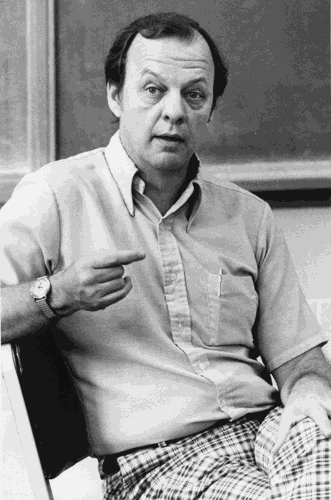
Egerton in 1982
Egerton kept diverse company, including W.O. Smith, the jazz bassist who played with Dizzy Gillespie and started the W.O. Smith Music School for low-income families. Smith and Egerton also were members of the Wednesday Night Club, a social group founded in the 1960s that intentionally included an equal number of white men and black men. “We’d meet at someone’s house each month to discuss social issues and eat and drink,” Sutherland says. People from different backgrounds and political leanings were invited with just a couple rules: No talking about what you did for a living, and keep it civil.
Fellow journalist and Wednesday Night Club member Dwight Lewis recalls telling Egerton about a family meal in his home state of Alabama that happened after the decoration of gravesites on Memorial Day. Egerton said he’d like to join him. One of Lewis’ relatives greeted the two men, perplexed as to why Egerton was tagging along to this family affair: “Here’s Dwight,” the woman called out, “and he has this white man with him.”
It seems that food provided Egerton another way of listening and staying curious — and a way to teach us how to listen to one another across the table.
Egerton wanted to sit at all types of tables, and he preferred the Formica-topped ones in home kitchens and meat-and-threes over the highfalutin kind. Those experiences helped lead to his 1987 book Southern Food: At Home, on the Road, in History, which is considered a masterwork for its cultural study through food.
“That’s where the stories got told,” Renkl says, noting that this is where the seemingly different areas of Egerton’s work converged. Egerton himself explained it this way in the introduction to Southern Food.
“Not infrequently,” he wrote, “Southern food now unlocks the rusty gates of race and class, age and sex. On such occasions, a place at the table is like a ringside seat at the historical and ongoing drama of life in the region.”
Egerton’s son Brooks says his father was surrounded by good cooks — though he wasn’t the family cook himself — and came to recognize the power of food. “When he started to research it, he learned more about it as a door or a window into other cultures and the dream of the common table.”
But even as he encouraged, listened and ate, Egerton did not romanticize. He urged against complacency and toward working for a better South and a better Nashville, specifically. A year before Egerton’s death, The New York Times’ Kim Severson wrote about Nashville as an “ ‘it’ city.” Egerton wasn’t having it.
“People are too smug about how fortunate we are now,” he was quoted as saying in the piece. “We ought to be paying more attention to how many people we have who are ill-fed and ill-housed and ill-educated.”
But that doesn’t mean he had grown to dislike the place. For him, loving something meant holding it accountable, says Renkl. “That’s what made him a gift to this city.”
Indeed, the Times article — which included comments from former Mayor Karl Dean as well as Jennifer Nettles of Sugarland — closed with another Egerton quote that held out for the city’s promise: “I love the rhythm of this town and the pace of it and the tone of it. I think Nashville is a big unfinished song.”
Egerton’s message to keep working positively toward a better future while looking out for the underserved and neglected remains relevant.
“In this moment, when the whole world is rightly in love with Nashville, he would be critical of Nashville,” says Edge. “He would want to talk about gentrification, racial inequality, income disparity. He would do it with a ham biscuit in one hand and a whiskey in the other.”
Author and Vanderbilt writer-in-residence Alice Randall put it another way for Chapter 16 in a remembrance after his death.
“There wasn’t an inch or an acre of the South that John didn’t know something good about,” said Randall. “He always used his knowledge of the good to make it possible to stare unblinking at the bad as he did his level best to dismantle it.”
The John Egerton Prize honors those working toward a better South from the ground up. This year’s winners include The Neighbor’s Field in Comer, Ga., a project assisting former refugees practicing sustainable agriculture, as well as Fresh Future Farm, an urban farm and grocery working to improve food access in North Charleston, S.C.
Chuck Reece, who sits on the awards committee, edits The Bitter Southerner, a past recipient of the John Egerton Prize. The award granted the publication its very first funding, and since then it has been called “a kind of kitchen-sink New Yorker” for the South by The New York Times, and has won a James Beard Award for its food coverage. “It was a stunning honor,” Reece recalls thinking when he won the Egerton Prize. “Now we’ve got something to live up to.”
While Egerton’s influence will carry on through the awards, we also have the stories he told about the people and food of this area, as well as his vision.
“John never quit worrying about the South,” says Edge. “The questions he asked over a lifetime of writing, he never got to answer. He just kept asking questions. The South is a process, not a product. There’s not an end point here.”
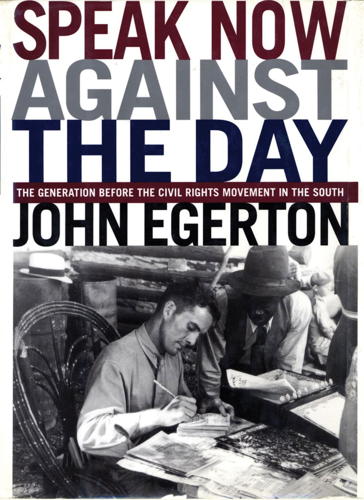
If you pull a certain copy of Egerton’s Speak Now Against the Day from the shelves of the Nashville Public Library, you’ll find Egerton’s handwriting in the front. A note to the late Mary Jane and Albert Werthan (of Werthan Mills) reads in part: “eternal hope for the Good South of our dreams. John Egerton May 14,1995.”
Tyler Brown, who worked for many years as the executive chef at the Hermitage Hotel, remembers meeting Egerton at an SFA event through his friend, chef Sean Brock of Husk. By day, Brown prepared meals for hotel guests at white tablecloths, but Egerton soon had him bouncing down Tennessee backroads on a quest to perfect sock sausage and old-fashioned beaten biscuit with an antique biscuit brake — learning together, listening, but also looking more deeply at the stories these foods conjure.

“We were riding in the car up in Lebanon,” Brown recalls. “We had just gone to see this guy who puts up country hams. I was asking [Egerton] about his civil rights work. He said, ‘I think the most important thing is to never sweep anything under the carpet. It’s important to respect everyone’s point of view, and food seems to be a place in my life where I’ve been able to bridge those gaps — breaking bread and being around the table where people are disarmed and enjoying the bounty.’ We don’t have to shy away from the tough stuff, we just have to show respect.”
Brown paid his respects to Egerton at the ceremony celebrating his life by making beaten biscuits with country ham — just the way Egerton showed him.
“It was sort of paying forward and saying this won’t die,” Brown says. “I heard you. I got it. As many do. This is something that will be part of my quiver forever. And thank you.”




Post a comment as anonymous
Report
Watch this discussion.
(0) comments
Welcome to the discussion.
Log In
Welcome to the discussion.
Keep it clean. Please avoid obscene, vulgar, lewd, racist or otherwise abusive language. Comments featuring hate speech or threatening or violent content will not be tolerated.
PLEASE TURN OFF YOUR CAPS LOCK.
Be truthful. Don't knowingly lie or mislead.
Be proactive. Use the “report” link on any comment that violates our comment policy.
Share with us. We'd love to hear your feedback.