
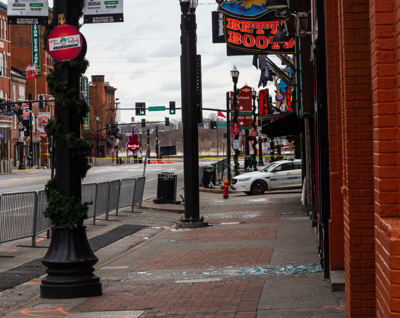


Lower Broadway days after the Christmas Day bombing
“When there’s a tornado or fire or hurricane, there is a disaster recovery plan,” says entrepreneur and philanthropist Marcus Lemonis about the Christmas Day explosion that gutted Second Avenue. "But there isn’t a playbook for this."
The federal government has not yet issued an emergency declaration for Second Avenue, though Gov. Bill Lee requested that the feds do so on Saturday. That means there is not (yet) FEMA money to aid those who lost homes, businesses or employment as a result of Friday’s bomb. However, there is aid out there, and some of it is available immediately.
Lemonis, the CEO of Camping World and host of CNBC’s Streets of Dreams documentary series, is just one of the people pitching in to help out. His aid comes in the form of forgivable loans — up to $100,000 — for those who own businesses in the area. There are between 39 and 41 businesses in the affected area. Lemonis himself put up $500,000 to the Nashville 30 Day Fund; the rest is coming through other donations.
Lemonis says he was moved to help when he saw the footage from Christmas Day, and that he has a soft spot for Nashville. His Camping World corporation is headquartered in Bowling Green, Ky., just 65 miles up the road, and the Streets of Dreams episode about Nashville airs on Tuesday. What's more, Camping World sells one out of every four RVs in the U.S. “When I saw that an RV was used to blow up a part of town I am so fond of," Lemonis says, "I was overwhelmed.” He came to town this week and met with business owners (at a distance) to help them with business plans for moving forward. So far the 30 Day Fund has received inquiries from 31 area business owners.
It isn’t just the business owners who need assistance. The employees of those companies — estimated to be between 1,000 and 2,000 people, according to the Nashville Convention and Visitors Corp — need help, too. Both the Community Foundation of Middle Tennessee and the United Way of Greater Nashville work with other nonprofits to provide aid. That group is called the Nashville/Davidson County Voluntary Organizations Active in Disaster, and includes The Salvation Army, Second Harvest Food Bank of Middle Tennessee, Catholic Charities of Tennessee, Conexión Americas and others.
Brian Hassett is president and CEO for the United Way of Greater Nashville. He says the idea of that coalition is that there is a central intake process. Just call 211 — yes, that number is up and working — and you’ll talk to someone who will take your info and share it with the right partner organizations. That will depend on the type of aid you need, be it immediate gifts cards (cash Visa or Kroger) to buy groceries or future rental assistance. They will walk you through what kind of documentation you need, such as a pay stub from an area business or an ID with your address. The line is staffed by United Way call-center workers who speak a number of languages.
While charitable giving has been down this year — in-person fundraising events such as golf tournaments and 5Ks have of course been canceled — United Way has received several large gifts in the past couple of days, including from the HCA Foundation, CoreCivic, and former Sen. Bill Frist, to aid in these newest relief efforts.
This Friday, January 1, at 1 p.m. food and essential kits will be available at a “Nashville Strong” drive-thru event at the Community Resource Center, at 218 Omohundro Place. The essential boxes include items like hygiene products and diapers. In addition, Lutheran Disaster Response will be there for those who need on-site counseling.
“This Friday box of groceries isn’t going to get you very far, but we see it as a New Year’s Day act of support," says Amy Fair, vice president of donor services for the Community Foundation. "We are turning the page of 2020 all together." As of Wednesday morning, the Community Foundation had received 680 donations from 32 states, Canada and Germany, ranging from $5 to $10,000, for its Nashville Neighbors Fund, created to help after Friday’s bombing.
If your office was in the affected area and what you need is a new place to work, check out the offer from Kenect: free co-working space, with parking, while you figure out what’s next. There are also deals on short-term apartment rentals. “Nashville is a strong, tight-knit community, and when disaster strikes, we come together to help one another, and that’s what Kenect is here to do,” says executive director Avi Niego.
As it did after the tornado, the NCVC is helping to raise funds and connect those in need with donors. (For example, Lemonis originally offered a reward for information on the bomber, but when the FBI determined that wouldn’t be necessary, the NCVC worked with him to develop the new plan.) After the tornado and during the pandemic, the NCVC has helped distribute $1.45 million in aid, says Deana Ivey, executive vice president and chief marketing officer of the NCVC. Given that many employees continue to be out of work or on reduced schedules due to the pandemic, more aid will be needed.
The mutual aid that we’ve seen this year continues with the latest tragedy. The Nashville Community Fridge has free food available for those in need, no questions asked, on Dickerson Pike (at Drkmttr) and Buchanan Street (at Elephant Gallery). There are a number of GoFundMe campaigns for employees for different businesses, including for Chef Jess Lambert at etch restaurant, and for employees of the Beer Sellar and Buffalo’s Nashville.
Many of the affected businesses, and therefore their employees, were in the hospitality industry. There are additional means for support for that sector, including the Tennessee Action for Hospitality efforts with Affordable Housing Resources that our own Chris Chamberlain wrote about earlier today. And earlier this week I wrote about free meals for out-of-work touring music professionals.
If you have been affected by the bombing and could use someone to talk to, take MHART up on their offer of four free therapy sessions. (More on MHART from contributor Hannah Herner here.)
If you are in a position to make a donation, give wherever you are most comfortable giving, says the United Way’s Hassett. Just remember that every gift counts. A $10 donation, for example, can feed hundreds at a food bank. Options include the United Way Restore the Dream Fund, the Community Foundation’s Nashville Neighbors Fund, the Nashville 30 Day Fund and the Community Resource Center. If you specifically want to help the homeless in the area, Room In The Inn and the Mental Health Cooperative offer outreach to that community.
In addition to monetary donations, the Community Resource Center will accept goods to help with cleanup, such as gloves and brooms. You can also stock the Nashville Community Fridges. If you want to help and aren’t in a position to give financially, sign up with Hands On Nashville and they’ll let you know when they need volunteers.
“The one thing about Nashville is that everyone wants to rush to help their neighbors," says the Community Foundation's Fair. "We’ve seen it time and time again."


Post a comment as anonymous
Report
Watch this discussion.
(0) comments
Welcome to the discussion.
Log In
Welcome to the discussion.
Keep it clean. Please avoid obscene, vulgar, lewd, racist or otherwise abusive language. Comments featuring hate speech or threatening or violent content will not be tolerated.
PLEASE TURN OFF YOUR CAPS LOCK.
Be truthful. Don't knowingly lie or mislead.
Be proactive. Use the “report” link on any comment that violates our comment policy.
Share with us. We'd love to hear your feedback.