

When you think about it, any whiskey that is less than 100 proof is actually more water than alcohol, so when Coloradan distillery owner Jess Graber brags that his whiskey is better than yours because it’s made with mountain spring water, it makes you think. We here in the Kentucky/Tennessee whiskey belt like to think that our limestone filtered water table is the best for making brown likker, but a certain beer out of Golden, Colo. has been trading on their H20 for decades.
Graber actually got started distilling decades ago as a (ahem) hobbyist. Known as the guy who always had some good hooch stashed away, Graber moved from Missouri to Colorado to become a mountain man and volunteer fireman. When he got there, he discovered some half-empty kegs of a popular local craft beer from Flying Dog and took it upon himself to running them through his “hobby” system instead for just distilling sugar shine like he had been doing in the past. After playing around with this for awhile, he decided to go legit and actually open up a distillery next door to Flying Dog in Denver.
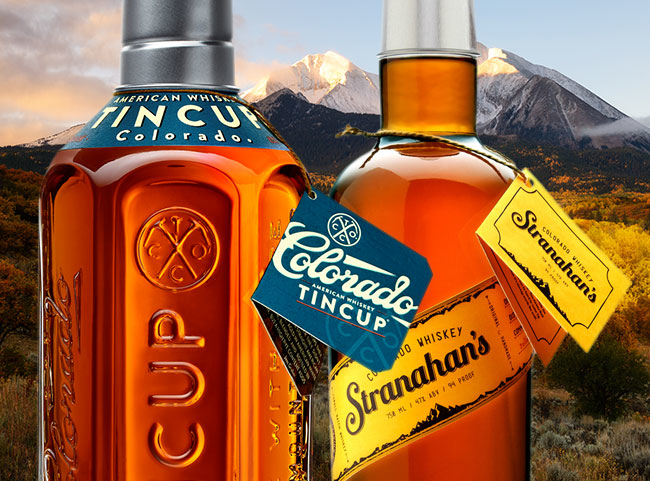
I had the chance to sit down with Graber and his master distiller Rob Dietrich to talk about the results of their efforts, Stranahan’s Rocky Mountain Single Malt Whiskey and Tincup Mountain Whiskey. These aren’t new products to Tennessee. In fact they were in the market for a minute before demand outstripped production and they retreated back to their home market from 2008-2012. Once the company was acquired by Proximo Spirits in 2010, they were able to expand their manufacturing capabilities to ramp up their production.
Now you’ll see Stranahan’s and Tincup in bars and liquor stores all over town, and Tincup will be a sponsor at the popular Musicians Corner music series in Centennial Park. So what are these products and why should you care about them?
Stranahan’s original whiskey is an American single malt, made from barley that is reminiscent of that original beer-based distillate that Graber played around with years ago. This makes sense since there’s not a lot of corn grown in Colorado, but there is that certain large brewery that is one of the largest importers of barley in the world. The remodeled distillery has multiple stripping and jacketed spirits stills that allows them to produce thousands of gallons of whiskey a week that are placed into new white oak barrels to age from 2-5 years before blending.
Some interesting facts about their operation include the detail that they do not chill filter their products, allowing for a nice viscosity to the mouthfeel of Stranahan’s. Combined with the delicate floral, citrus and honey notes on the nose, it makes for a delightful drinking experience. Since the climate of Colorado isn’t nearly as hot or as extreme as Tennessee and Kentucky, there’s not nearly the concern of evaporative loss during aging. Instead of losing “the angel’s share,” Stranahan’s actually increases in proof during aging, and the barrelhouse is climate-controlled to add humidity so that the barrels don’t dry out. Barrels of various ages are blended and then the whiskey is cut to 94 proof using that lovely Colorado water. The result is an extremely smooth single malt that is surprisingly fruity, but without the sweet burn of a higher proof bourbon. Retailing in the mid-$50 range, it is priced like a good scotch at most liquor stores.
Stranahan’s also releases a few other products including the distiller’s select of the best of the four-year-old barrels under the Diamond Peak brand for about $15 more per bottle, but that is a lot harder to find. Even more rare is Snowflake, a whiskey that is finished in used wine, sherry, cognac, rum and tequila barrels that is only released one day a year in December for sale at the distillery. You might as well just forget you ever heard about that one.
On the volume side, Tincup is Graber’s consumer play. Made primarily with purchased whiskey from a large distillery, Graber adds 4 percent by volume of Stranahan’s spirit to the final product, not unlike how the sour mash process includes some backset of previous distilling runs into the new mash. The whiskey cannot be called a bourbon because of this addition, and Graber is fine with that since he wants to create a unique product. TINCUP is named after a tiny mining town in the Colorado mountains at the 10,000 foot elevation level. Wild and rustic, (Graber claims “they shot two sheriffs in a row!”) the town and the whiskey are meant to represent Colorado lifestyle. Or as Graber told me, “We want to market it like we’re the REI of whiskey.” I’ll buy that.
And indeed I will buy Tincup, because of all the purchased whiskey products that I have tasted that come out that same large Indiana distillery, Tincup has perhaps the best value/taste ratio I have experienced. Priced in the mid-$20’s for 750 ml and also available in handles, Tincup has a very high ratio of spicy rye in its mashbill, close to ⅓. This makes for an excellent mixing whiskey for simple cocktails or highballs. They even make the claim that the intentional hexagonal design of the bottle means it won’t roll too far down the mountain if you knock it over. Makes sense to me.
For a nice everyday whiskey, Tincup is worth your consideration. It is in stock at most larger liquor retailers around town. If you try it out, share your impressions in the comments below.



