
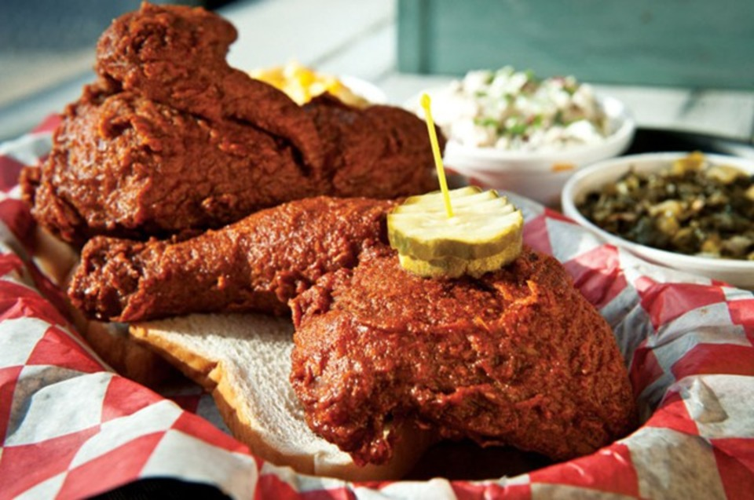

It’s been quite a few days for George Embiricos, who published a piece for Food Republic titled “Meet the Man Who Launched the Nashville Hot Chicken Craze,” a profile of and interview with Hattie B’s John Lasater. (Full disclosure: I have written occasionally for Food Republic and have worked with Embiricos on a few articles, but we’ve never met.)
The original article was posted on a closed Facebook group dedicated to hot chicken where it immediately stimulated a conversation among frequent commenters who took umbrage at a headline claiming that Hattie B’s “launched” anything. Within two hours of posting, the first calls of cultural appropriation appeared in the comments, where they were discussed along with people’s personal preferences of one particular restaurant over another and how Hattie B’s had managed to be so successful. Eventually Embiricos entered the fray and explained his point of view and acknowledged some shortcomings in the piece. Then the group pretty much moved on to other topics within a day.
But now the discussion has moved into the open, including here at the Scene, where Betsy Phillips criticizes Embiricos and Lasater for failing “to acknowledge the fundamental reason Hattie B’s is more successful than the older hot chicken joints just feeds into the same old racist dishonesty we love as a country.”
In my opinion, Embiricos’ piece is not a bad piece; it has a bad headline and a few awkward phrases in it that I imagine Embiricos wishes he could rework. It doesn’t read like it intends to be the complete history of Nashville hot chicken. It’s an interview and a profile of a Nashville chef who happened to be in New York City as part of an invitation to cook at the James Beard House, which Embiricos attended as a member of the media. Embiricos also happens to be a former Nashville resident and fanatical lover of hot chicken.
People give credit to Rachel Martin’s Bitter Southerner piece, which addresses the history of hot chicken in parallel with stories of race relations in Nashville as a more effective article. If that’s what you’re looking to learn about or to discuss, I suggest reading the whole post.
Both elements of Martin’s narrative were instructional, but I don’t personally believe that she made the connection between them in the way that she intended. Just because nobody she knew had ever eaten hot chicken when she lived here for grad school in the mid-2000s doesn’t mean that no white people ate at Prince’s. She could have seen lots of us there if she had looked for us, and not just Mayor Purcell. (Plus, when she finally did get up to Prince’s, she ordered it mild, so I can’t consider her a completely trustworthy hot chicken expert. Just kidding. Sort of.)
While the Embiricos and his editor at Food Republic need to take full responsibility for their headline, what if they had included one more word? What if it read “Meet the Man Who Launched the National Nashville Hot Chicken Craze?” Go back and read the article again with that headline in mind.
The post never claims that Hattie B’s invented hot chicken. On the contrary, both Embiricos and Lasater explicitly give the credit to Prince’s when the author writes, “Prince’s Hot Chicken Shack may have created hot chicken in the 1930s, and institutions like Bolton’s Spicy Chicken & Fish may have helped preserve the tradition over the years, but Hattie B’s has made hot chicken cool.” And also when the chef says, “Prince’s is the godfather of hot chicken, and we can only tip our cap to them and pay them a visit here and there.”
I don’t especially like the assertion of saying Hattie B’s made hot chicken cool, but that’s a quibble over word choice. What I think is missing in the article’s defense of its thesis, and in many readers' knee-jerk reactions bemoaning the Columbus-ization of a dish invented and locally popularized by black businesses for 80 years, is that Hattie B’s has definitely been instrumental in spreading the gospel of hot chicken beyond Middle Tennessee. This is not because it’s now being cooked by white people, but because they have come up with a wildly successful business model. Here’s how:
As a food writer and member of the Southern Foodways Alliance, I often hear when visiting chefs are coming into town. Five years ago, these culinary tourists almost always made the pilgrimage to Ewing Drive to experience Prince’s, the original exemplar of the genre, and (I’ll say it out loud) still the best hot chicken in town. In the quest for authenticity, the chefs endured the inconvenient eccentricities of the ordering process at Prince’s and the quirky and uncomfortable interior of the funky chicken shack with its limited seating and often interminable waits.
But after Hattie B’s opened in 2012, I almost immediately noticed that out-of-town chefs were favoring the Midtown location in lieu of a trip to visit Ms. André. There were a lot of reasons why they were making this switch. First of all, it’s certainly more convenient for a chef doing a Nashville “dine around” to stick closer to where the rest of their eating destinations are located. Lasater dubiously referred to this as opening in a “good area.” Did he mean a “good spot,” as in location, location, location? If he had said that, it wouldn’t have fueled critics who think he meant white Nashville vs. black Nashville.
Secondly, John Lasater comes from a culinary background, which means his version of hot chicken is a bit “chef-ier.” And I’ll bet he probably loaded them down with his version of hot chicken because chefs love to try to bury other visiting chefs under a mountain of food.
As Betsy pointed out, other conveniences at Hattie B’s include the acceptance of credit cards, a kid’s menu and local beer. But the overwhelming factor that visiting chefs have noticed is that the owners — Lasater, Nick Bishop Sr. and Nick Bishop Jr. — have figured out a way to make a whole lot of money selling hot chicken. Unconfirmed sales figures I have heard are staggering, in the eight-digit revenue range annually for two locations. I would wager that Hattie B’s sells more chicken out of their two Nashville locations than the rest of the hot chicken joints in operation before them combined.
Does this mean that they invented hot chicken or that their version is superior? Not at all. But it is the factor that makes restaurateurs who come to Nashville on research trips sit up and take notice. This is what convinces them to add a hot chicken dish to their own menu or even open up their own fiery poultry emporium.
And it’s not just chefs who take the Hattie B’s experience home with them. Regular tourists flock to both Nashville locations, because they are easier to find, the chicken isn’t quite as spicy, and if you’re on a Pedal Tavern, it’s a long-ass trip up Dickerson Pike. If 10 tourists a day visit “the locals’ choice” at Prince’s, then I’d guess at least a hundred go to each Hattie B’s location daily. This becomes the standard by which these visitors remember and judge hot chicken, for good or for bad. Those restaurateurs who were considering opening their own spot, or featuring a hot chicken special on their current menu, are emboldened by the fact that customers in Louisville or Brooklyn actually know what to expect from the dish after returning home from Nashville.
Anecdotally, about five years ago, Amerigo introduced a hot-chicken-pasta weekly special to great success at their Midtown location, long before Hattie B’s opened. When they tried to add it to their menu just a few miles away in their Cool Springs location, more than half of the dishes were sent back to the kitchen with complaints that it was “too hot.” Amerigo management temporarily abandoned the dish for their Williamson County patrons until their palates caught up with the craze for hot chicken. So you can imagine what the return rate would be at a restaurant in, say, Massachusetts, if diners had not become aware of what was really in store for them if they order Nashville hot chicken.
Add these elements together and there’s a clear case to be made that Hattie B’s has indeed “launched” the Nashville Hot Chicken craze, but nationally, not locally. Embiricos was cognizant of this because he has eaten at six or seven hot chicken joints locally as a student at Vandy, and as a visitor since graduation, but also at a half-dozen or more other hot chicken restaurants in cities outside of Middle Tennessee. He even tracks the growth of new Nashville hot chicken spots outside of Nashville, although even he admits that this map is probably 10 to 12 new openings behind. He just should have made that explicit in his title and in his thesis if he wanted to be more accurate.
Something else to note: Hattie B’s benefits from an excellent business model run by Bishop Sr., a man who has a lot of experience opening and running multiple restaurant locations from his time as an executive with Morrison’s Cafeteria. Plus, Hattie B's has a pretty strong PR effort to spread the good word of what they have been accomplishing as they look to grow their business into new regions.
Not every story about hot chicken needs to be a definitive history of the genre. Where Embiricos ran into trouble, though, was when that headline was combined with an interview that never mentioned race at all. It could be read as whitewashing hot chicken, something I don't believe Embiricos or Lasater ever meant. It’s probably worth mentioning, as well, that a Nashville editor might have raised some of these issues, while Embiricos’ editor, working out of Manhattan for a national food site, didn’t see some of the landmines here.
It also could have been the fact that Embiricos had already written a more comprehensive article on the history of hot chicken and Prince's role as the OG in his piece last year where he accompanied local chef Matt Bolus to two NYC hot chicken joints. Linking back to that piece or quoting from it might have provided some context for people coming to the new piece cold.
I think it’s fine to acknowledge Hattie B’s role in popularizing our local specialty dish, and by extension the city of Nashville. I just wish he’d inserted that one word “National” into the title, and that people were actually reading beyond the headline. It’s not Embiricos’ responsibility to defend himself in the comments of his own article; in fact, some consider it bad form as a writer. But he did elaborate on his position in response to the Facebook thread when his article was first posted:
“The fact is that there is only one fact, and that’s that Prince’s created hot chicken. There’s no disputing that, whether you’re a lifelong resident, transplant, tourist or chef. And no one is disputing that! I personally, as a Nashville transplant, have the utmost respect for the institution, for inventing a dish that I absolutely love more than life itself, just like many of you. I still get goosebumps whenever I dine-in there, which is quite frequently.
“Apart from that, all we have is our opinions. At no point do I — or anyone in the article — declare one restaurant better or superior to another. On the contrary, the article speaks to how tight-knit the Nashville hot chicken community is.”
Considering the traffic that Embiricos’ original article and Betsy’s response have driven, the hot chicken community isn’t just tight-knit. It is also organized, motivated and not afraid to speak out when they perceive a slight. I guess it should come as no surprise that hot chicken would be such a hot-button topic.



