
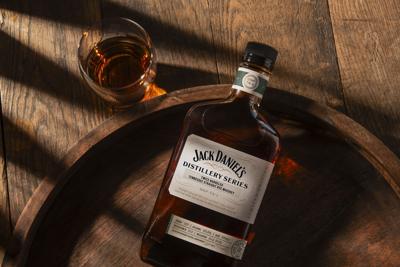

Through the years, I’ve shared many of Jack Daniel’s Distillery Selection series releases, but it’s hard to believe we’ve reached No. 13 already. The series of limited-release 375-milliliter bottles highlights the choices of the distillery's production and tasting employees, and No. 13 is the offering by taster Jason Marski.
He has chosen a unique edition of Jack Daniel’s relatively new Straight Rye Whiskey with the added benefit of two passes through new charred American white oak barrels. Because the traditional rye mash bill at Jack is 70 percent rye, 18 percent corn and 12 percent malted barley, it has a lower rye content than many other rye whiskeys, especially the offerings from powerhouse mega-distillery MGP that distills many brands of 95 percent rye.
The result is a whiskey that doesn’t exhibit the strong spicy characteristics that personify (whiskify?) many popular rye whiskeys on the market. To make this a feature instead of a bug, Jack Daniel’s has chosen to give this particular rye two passes through new barrels, and initial aging followed by an additional two-and-a-half years in a second barrel.
So it’s understandable that this rye is more about wood than spice. The extra pass through new charred oak contributes a lot of extra color to the rye, resulting in an appearance in the glass that’s almost as dark as molasses. If you’re a fan of wood, this is the rye for you, and the fact that it’s new oak instead of just spending a decade in the same barrel keeps the oak contribution from devolving into the cedar-shavings character that some other whiskeys display after that long in the same barrel.

Ford Fry’s Germantown establishment does a classic cocktail the classic way
Personally, I had a little difficulty thinking about how I would best use this rye whiskey. It’s a little tannic for a straight pour, although the finish is quite long with a nice minty character. I added an ice cube to my glass to open it up a little, which was helpful in cutting the heat of the 107-proof rye, but didn’t do much to release many aromas or new flavors.
In my head, I started to think of mint tea from the combination of wood tannins and that hint of mint, but to be honest, I really don’t like mint tea. But then I thought of julep variations, maybe some sort of smash cocktail with a dollop of fresh fruit preserves. Now we’re talking! Another idea I had that I might suggest would be to use this as a base for a (admittedly really boozy) Sazerac so that cocktail’s sugar could balance out the wood, and the anise flavors of the absinthe could play with the mint. And the spicy Peychaud’s bitters could contribute the extra spice I was looking for in the whiskey. Yeah, that’s the ticket!
So now all I have to do is head to the liquor store and buy some absinthe and Peychaud’s since it’s been a few years since I stirred up a Sazerac, but I’m optimistic! Anybody wanna go in halfsies on a bottle of Pernod?



Post a comment as anonymous
Report
Watch this discussion.
(0) comments
Welcome to the discussion.
Log In
Welcome to the discussion.
Keep it clean. Please avoid obscene, vulgar, lewd, racist or otherwise abusive language. Comments featuring hate speech or threatening or violent content will not be tolerated.
PLEASE TURN OFF YOUR CAPS LOCK.
Be truthful. Don't knowingly lie or mislead.
Be proactive. Use the “report” link on any comment that violates our comment policy.
Share with us. We'd love to hear your feedback.