

When New York gallery ZieherSmith hosted its first summer pop-up in Nashville, Art in America critic Naomi Mishkin described it as a "seemingly peculiar locale." That was in 2011, and a lot has changed since then. For starters, the Chelsea gallery is now Zieher Smith & Horton, the result of a merger with Horton Gallery that allowed them to add, among others, Trudy Benson to their roster of artists. But more than that, in the past few years Nashville's art community has gotten less and less peculiar: The Frist organized the first major retrospective of artist Carrie Mae Weems; Sherrick and Paul Gallery has gotten national attention for exhibitions that include works by Katy Grannan, Vivian Maier and Barry McGee; Wedgewood-Houston has exploded with independent galleries and events; and all signs point to more progress on the way. Still, Andrea and Scott Zieher's yearly sojourn to Nashville, a place they call their home away from home, remains a highlight of the city's summer art schedule. This year, they've chosen the empty building on Third Avenue South in downtown Nashville to house their group exhibit Summer Reading.
Nashville-based painter Karen Seapker has four paintings in the show. Seapker worked out of New York for years, but her work came to Andrea Zieher's attention after a studio visit to Seapker's East Nashville workspace last summer. Seapker works with a vibrant palette she says is based on naturally occurring colors — think of all the shades of pink and orange you might see in a sunset. With all that color, her lines remain extremely clean and considered. In "Slink," a single brushstroke sweeps across the canvas in a loose line that fills the space just enough to maintain compositional balance, but leaves tension in all that leftover negative space where light seems to emanate from the wash of background colors in an otherworldly Rothko style.
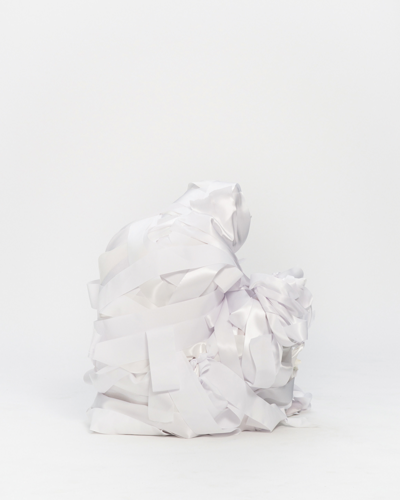
Vadis Turner and Hayley Green's three photographs are stunning in the front room of the Third Avenue building. Turner is a recent Nashville transplant, but she's shown work locally at both Rymer Gallery and TAG. Her work has typically been fiber-based — twisted ribbons and cloth woven around canvases that play with ideas of abstract painting and traditionally female-centric work, but in ways that recall both Christo and Judith Scott. The photographs in Summer Reading are a departure from that work, but it's a departure that is extremely organic. Turner has photographed similarly wrapped subjects — in this case a woman, though her presence isn't immediately discernible as such. The thick white satin ribbons are wrapped around her posed body — lying on her side in a fetal position, or sitting with her arms around her knees — against a white backdrop.
Elijah Burgher is a Chicago-based artist who exhibited work in last year's Whitney Biennial. His two prints on display in Summer Reading, both created this year, call back similar elements to that work — namely sigils, which the artist collapses into cut-paper stencils and printed-over patterns that hint at occultism but also the ritualistic practice of printmaking itself. The prints are titled "BotD 2" and "BotD 37," a code Burgher has invented that stands for the imaginary cult Bachelors of the Dawn.
Dario Robleto's massive diptych is formally arresting and conceptually profound. Robleto, a Houston-based artist, has shown work in Nashville before — his "Defiant Gardens," a funerary wreath made from cut-paper flowers, hair and wartime ephemera ("thread and fabric from soldiers' uniforms of various wars, carrier pigeon skeletons, excavated shrapnel and bullet lead from various battlefields" and more), was a highlight of Cheekwood's stellar 2013 exhibition More Love: Art, Politics and Sharing Since the 1990s. But this work is nothing like that. "The Sky, Once Choked With Stars, Will Slowly Darken" features two 44-by-44-inch archival digital prints that, at a distance, look like paintings based on Hubble Space Telescope images — a red atmospheric haze blurs the golden sphere in the top right corner of one of the prints, which moves from pink to orange to brown. But Robleto has appropriated the images from album covers and photographs of musicians— in this case Sun Ra and John Coltrane — performing in jazz clubs; he then isolated the stage lights so they appear celestial.
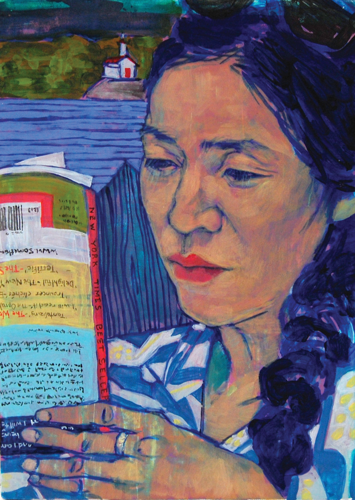
The small painting by New York-based artist Hope Gangloff hangs on a wall by itself in what seems to be the most literal interpretation of the show's title. In "Syrette," a woman with dark braided hair reads a copy of a book that upon close inspection is clearly upside-down. Gangloff's sinewy multicolored brushstrokes read almost like pencil marks, and a recent New York Times review that compared her work to that of Van Gogh and Egon Schiele seems absolutely on the nose. The cartoonish wood grain of the fence post, the tiny Grandma Moses church in the background, the blue tangle of acrylic paint that signifies Syrette's black hair — all of these unexpected elements make the 14-by-12-inch work one of the exhibition's strongest images.
If you think about it, an unfurnished building with tons of art on the walls is a pretty good metaphor for summer in Nashville. The partitioned streets crowded with tourists are like empty rooms in a home filled with strangers, and if it weren't for air conditioning, we'd probably all stay home. Luckily, the gallery owners at Zieher Smith & Horton have chosen to come out again, and this exhibit is one of the best group shows you're likely to see in Nashville this season. Here's to next summer.
Email arts@nashvillescene.com



