
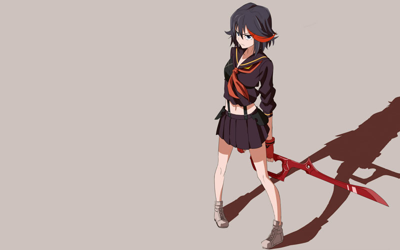
At this weekend's Middle Tennessee Anime Convention, expected to draw more than 6,000 people to the Sheraton Music City and the Nashville Airport Marriott Friday through Sunday, there will be panels about a show that has been embraced for its strong women heroes and themes of female empowerment. There will also be panels about a show that consists largely of cartoonish near-naked babes, with upskirt photos to satisfy the horndogs at home.
The odd thing is, they're the same show.
Is Kill la Kill just another serving of sexualized, objectified women for men to ogle? Or is it a literal cartoon of the least appealing aspects of male desire? That argument has raged ever since its first season premiered overseas in 2013, followed by Adult Swim airing episodes on its Toonami programming block in February.
Produced by the Japanese animation studio Trigger, Kill la Kill has prompted angry exchanges back and forth online between those who consider it a satire of what anime's least demanding male viewers want, and those who think it does nothing more than give it to them. And they're not always the camps you might expect.
"Here's an easy way to understand how mixed-up people are about Kill la Kill," Aja Romano wrote on The Daily Dot last year. "On the typically female-dominated, proto-feminist, anti-objectification Tumblr, one user posted a controversial but popular argument that the show is actually about female empowerment. When typically male-dominated bastion of 'men's rights' Reddit got hold of it, they summarily rejected the argument. ... Tumblr defending a show while Reddit calls it sexist? What is this madness?"
Concerns about sexism and sexualized violence in anime are nothing new. According to Kevin McNulty, coordinator of the animation program at MTSU, anime studios over the years have developed "a somewhat unfiltered avenue" to get product to fans. Compared to the tentacle-rape extremes of the hentai that arrived in the U.S. almost 25 years ago, Kill la Kill looks pretty tame.
What seems different about this argument is whether Kill la Kill knowingly makes fun of the same thing it delivers: the give-the-people-what-they-want pandering commonly referred to as "fanservice." The question even fans end up asking themselves is, "Are rape jokes and the blatant in-your-face display of women's bodies OK if they're delivered in air quotes?"
The setting is Honnouji Academy, a fictional Japanese high school. It is dominated by its fearsome, privileged student council, which wears uniforms with special powers and the ability to oppress the school's students and staff and their families. The heroine, Ryuko Matoi, a lower-class transfer student, searches for her father's killer, who wields the other half of her scissor-shaped sword. After finding a sentient sailor uniform — which literally strips her and forces itself on her, in a scene played for laughs — she uses her newfound abilities to confront the upper-crust council leaders in their fight club and liberate Honnouji Academy from the fascists' iron grip.
That means lots of fights between barely dressed schoolgirls shown in seizure-inducing graphics. The cleverest idea in Kill la Kill is a kind of thematic pun on the similarity between "fashion" and "fascism,"and there are echoes of The Hunger Games in the show's costumes that double as eye candy and weapons, in its literal class warfare, and above all in its focus on a young female protagonist who challenges a corrupt system. (The voice artist who dubs Ryuko for the U.S., Erica Mendez, is one of MTAC's featured guests this weekend.)
At the same time, Katniss Everdeen was never depicted virtually bare-breasted, framed so that her skimpy panties peek from beneath her almost nonexistent skirt. The costumes themselves are a sort of assault, something Ryuko must submit to or fail. Depending on how ironically you read the show, Ryuko is either a compelling subject or a commodified object.
"Honestly, I don't fully understand the Japanese obsession with fanservice. I don't enjoy it, and I know many people who refuse to watch shows with it. I really don't know many people that do," says Tyler Hampton, a Kill la Kill fan and MTAC volunteer. The distinction, Hampton suggests, is that the show introduces its female characters as badasses, powerful and independent. Fans argue that the show is criticizing society while making it difficult to view these women solely for their bodies.
"I think, more than anything, Kill la Kill is kind of making a joke about it," Hampton says. But can a show function as both a satire and the thing it is satirizing?
"We're expressing a desire for mature development, reasonable depictions of women and men, because there's also much protest out there," MTAC media relations manager John Robbins says. "And so I think it's good for genders to be able to be free of a lot of stereotypes and things like that and being able to say, 'Hey, we want more diverse characters, we want characters that speak to us.' "
So there may be room at MTAC this weekend for those on either side of the Kill la Kill debate. And if they can't agree, there's an easy way to settle the dispute ...
Email arts@nashvillescene.com



