
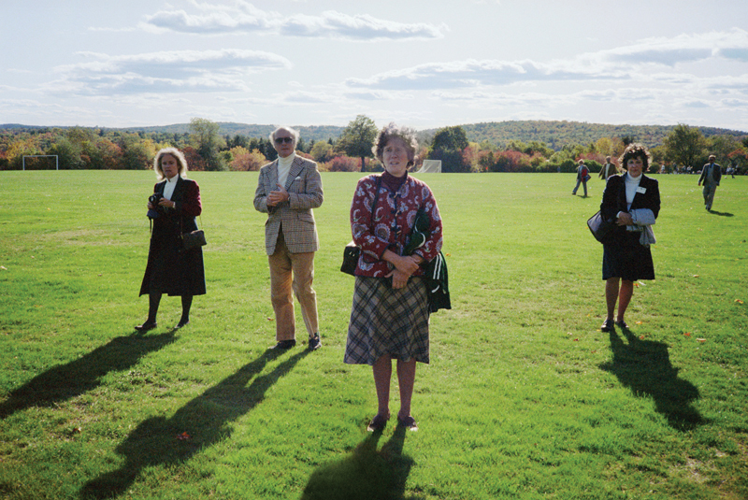
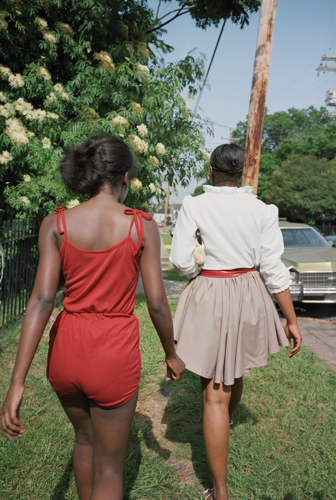
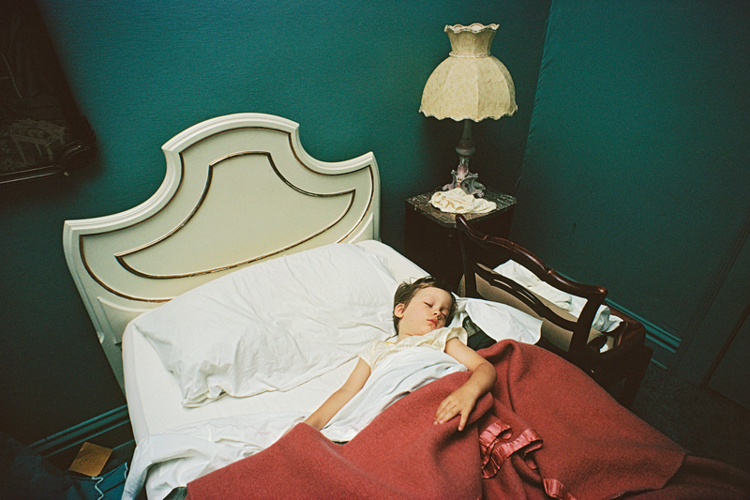

Where is the child whose tricycle has been left behind? What is the man waiting for, perched on the edge of the bed? The photographs of William Eggleston capture the frailty and intrigue of the world with an open-ended narrative style that is intensely personal — and unsettlingly exposed. There is an almost palpable sensation of loneliness, alienation and mysterious absence.
The current exhibit at the Frist Center for the Visual Arts is not a retrospective, but a selection of iconic and new Eggleston photographs. The iconic images are taken from projects such as the Southern Suite and Troubled Waters portfolios, and many were made famous by their inclusion in Eggleston's groundbreaking 1976 show at the Museum of Modern Art — the first major art exhibit that featured color photography. At the time, many critics saw color photography as banal, and called the work boring. It's hard to imagine the use of color in photography causing such a stir, and harder still to imagine that Eggleston, now considered one of the finest photographers of all time, was ever an underdog.
Eggleston photographs the American South with a detachment that is more sophisticated than ironic. An untitled photo from 1981 shows an electric organ flanked by parlor chairs. The composition of the shot is stark, and calls attention to the small imperfections of the room, like the one bent slot in the air-conditioning vent, the cord haphazardly winding toward the wall outlet, the slightly worn chair cushions, the blankness of the wall. The room's sole decoration is a pastoral landscape in a gaudy gilded frame that hangs tidily above the organ. The photo is shot from a low angle, looking up at the furniture as though from the floor, as if the photographer himself were engaged in an act of worship. The room seems to be an altar to traditional Christianity turned cliché, religion fancified through contemporary interpretation. For its seemingly simple subjects – an organ, a few chairs and a small, framed painting — Eggleston's photograph speaks volumes.
To underscore his status as one of the most influential artists of our time, the exhibit includes interdisciplinary components — a collection of LPs and CDs that have used Eggleston's photographs as cover art, with offerings from Big Star, Alex Chilton, Spoon, Silver Jews, Joanna Newsom and Primal Scream, and a documentary titled By the Ways: A Journey With William Eggleston. Vincent Gérard and Cédric Laty's film is artfully arranged, but Eggleston's words are difficult to decipher at times, and his voice becomes more of a soundtrack than a narrative, a twangy alcohol-laden hymn that adds another layer of old-world grandeur to his tall, lean frame.
The last two rooms of the gallery house a selection of work shot in the 21st century. These photos are more dramatic than those first groundbreaking shots, and show Eggleston's expanded range in both scale and location.
An untitled photograph from 2002 contains the brief description "Motel, Wildwood, New Jersey." In this shot, empty space is the focal point — not compositional emptiness, but real-life empty space: the flaccid American flag directly in the center of the frame, the conspicuous absence of people in an already transitory place, the moon lighting up the sky while fluorescent lights in the pool fill the motel-space with an unearthly glow. The photo dramatizes the conflict between the manmade and the natural, the indoors and the outdoors. Eggleston has been called the photographer of suspense, but his photographs show more than uncertainty — there is action that has already happened, and action that hasn't happened yet.
Wandering even further from his roots as a photographer of the South, Eggleston's newer work includes a duo of photos from St. Petersburg, Russia. "Untitled (Sign Factory, Pin-up Posters, St. Petersburg, Russia)" is a picture that contains many other pictures. A collection of sleazy pinups hang on the walls of a Russian sign factory. Eggleston's photograph reads like ethnographic research — a document of the things people collect, and the strange ways they display them. A battered boombox sits dumbly beneath the naked women, and a power box with cords splayed out in every direction is the centerpiece of the shot. Compositionally, Eggleston treats the cords and the porn with equal weight, as if this were a portrait of the corner of a room, and the nude images had just happened to be there. But there is also an almost sacred element at work. The pinups seem omnipresent, and several of the posters are reverentially framed, treated with a curious respect as though they were shrines to womankind, or at least to sex. This empty room recalls Eggleston's earlier shot of the electric organ, and shows the viewer that through Eggleston's lens, everything is holy.
Email arts@nashvillescene.com.



