
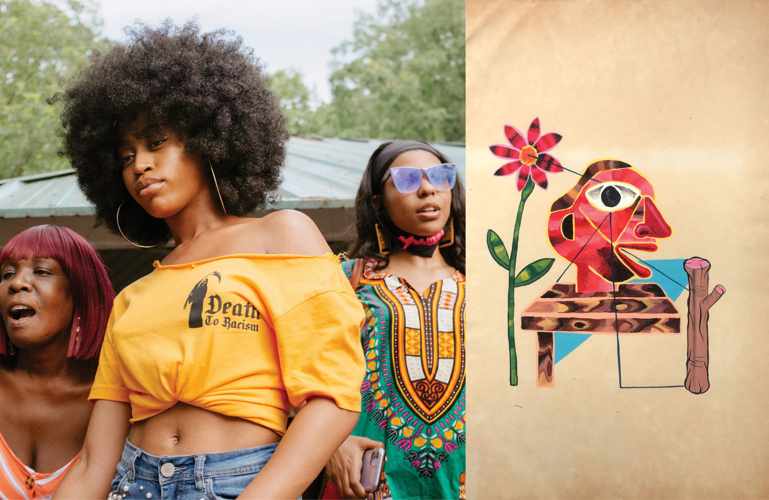
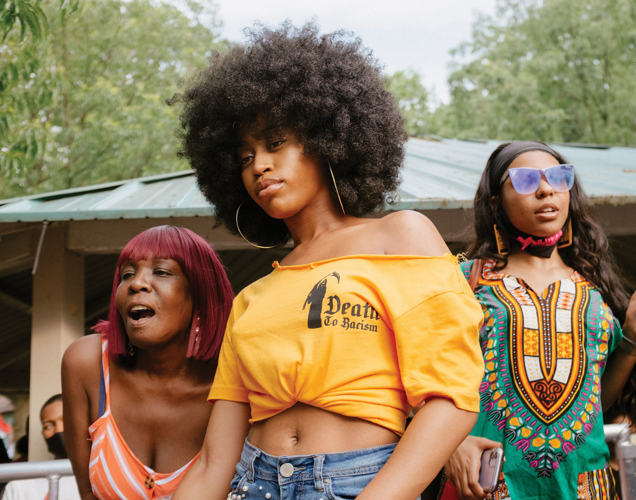

"Women at Malcom X Park for Juneteenth, Philadelphia, 2020," Marcus Maddox
In a video from the virtual exhibit Heed, presented by David Lusk Gallery, Rob Matthews says that one of his rules for making art is this: Only make art about things that are more important than art. The distance between art and everything that’s more important than it has grown exponentially since early March, when a tornado devastated neighborhoods throughout Nashville just days before the COVID-19 pandemic shut everything down. Then, of course, came protests against police brutality and an invigorated movement to end systemic racism and white supremacy in the wake of George Floyd’s death at the hands of Minneapolis police. As a result, even as the systems that have supported the art community have been hit by the pandemic, art’s role as a catalyst for cultural change remains more important than ever. In Nashville, artists and galleries are depending on collaboration and creativity to survive.
The most visible example of that collaboration is the Nashville Gallery Association’s series of virtual art crawl videos, which combine short tours of current exhibitions that mimic the experience of the monthly Art Crawl. Some of the most successful elements of the virtual crawls are the fun and lighthearted contributions from the Julia Martin Gallery. In the gallery’s June virtual crawl installment, artist Marlos E’van’s hand-painted T-shirts were presented in quick succession on various models, and it was as playful as an early ’90s MTV promo.
Other galleries’ presentations are more straightforward, like Channel to Channel’s June virtual crawl tour of Pockets of Real Passion, a group exhibit that made brilliant use of the space by hanging works directly on top of a geometric installation of artist’s tape. That installation’s artist, gallery curator Dustin Hedrick, gives a succinct and thoughtful — if slightly dry — walk-through of the work.
A preview of Lusk’s Heed show, which features work from Matthews alongside new work from Ashley Doggett, Maysey Craddock and Leslie Holt, incorporates video elements from each of the artists. Doggett’s contribution includes vintage home movies of Black women celebrating, shots of her studio and current paintings, and photos of palatial museum interiors. In her voiceover, Doggett is a casual but confident speaker, and her newest paintings — sexier and more colorful than her earlier work — are strong enough to make you overlook the elevator music that plays in the background.
The ever-increasing appreciation of genuine human interaction thanks to social distancing means that in the virtual art crawl, relatability is key. Still, a little showmanship goes a long way. Attention spans are waning — the first virtual crawl video has more than a thousand views on YouTube, but at press time, the second crawl has fewer than 300. With figures like that, artists and galleries who want to succeed need to treat the virtual crawl more like a supplement than a replacement.
But what can galleries do in the meantime? Tinney Contemporary has put its in-person exhibition schedule temporarily on hold, refocusing its attention on virtual exhibits and viewing rooms — these might not replace traditional viewing experiences, but they certainly show a graceful transition. Jeff Scott’s creepy, atmospheric photographs in The Surveillance Series are paired with deeper dives into the work, like quotes about specific pieces, that wouldn’t be available to general audiences in the brick-and-mortar space. The claustrophobic, noirish aspects of the photos fit the moodiness and paranoia that many of us are feeling, especially as they’re transmitted via computer screen.
While exhibitions can certainly be enhanced by virtual elements, if the current shifts in gallery life are any indication, we may be in the beginning of a long-term institutional overhaul. A recent installment of Art in America’s advice column “Hard Truths” made a series of memes that mock artists and gallerists who need a more robust virtual presence. In one, Bernie Sanders is once again asking “for you to update the website and tighten your Instagram game.”
Would Rob Matthews’ message about only making art about important things be more effective with a bit of polish? Perhaps. There will likely be plenty of time for us to improve our skills at virtual communication, and we could all benefit from investing in some good audio equipment and some YouTube tutorials. But the truth in his statement — that the only art worth making is about more than itself — should be adopted by artists and gallerists who hope to make the most of this moment of reset.
Nashville isn’t a town in which most artists can make a living strictly from gallery sales, but nevertheless, buying art has become an urgent act of community service. Several galleries are opting to showcase art at lower price points, utilizing the ease of virtual transactions to make it all but irresistible to purchase something new. Zeitgeist had so much success with works on paper by Brady Haston that the gallery had to restock halfway through the exhibition. Zeitgeist’s collection of carnival-colored paintings by Alex Blau are just as strong.
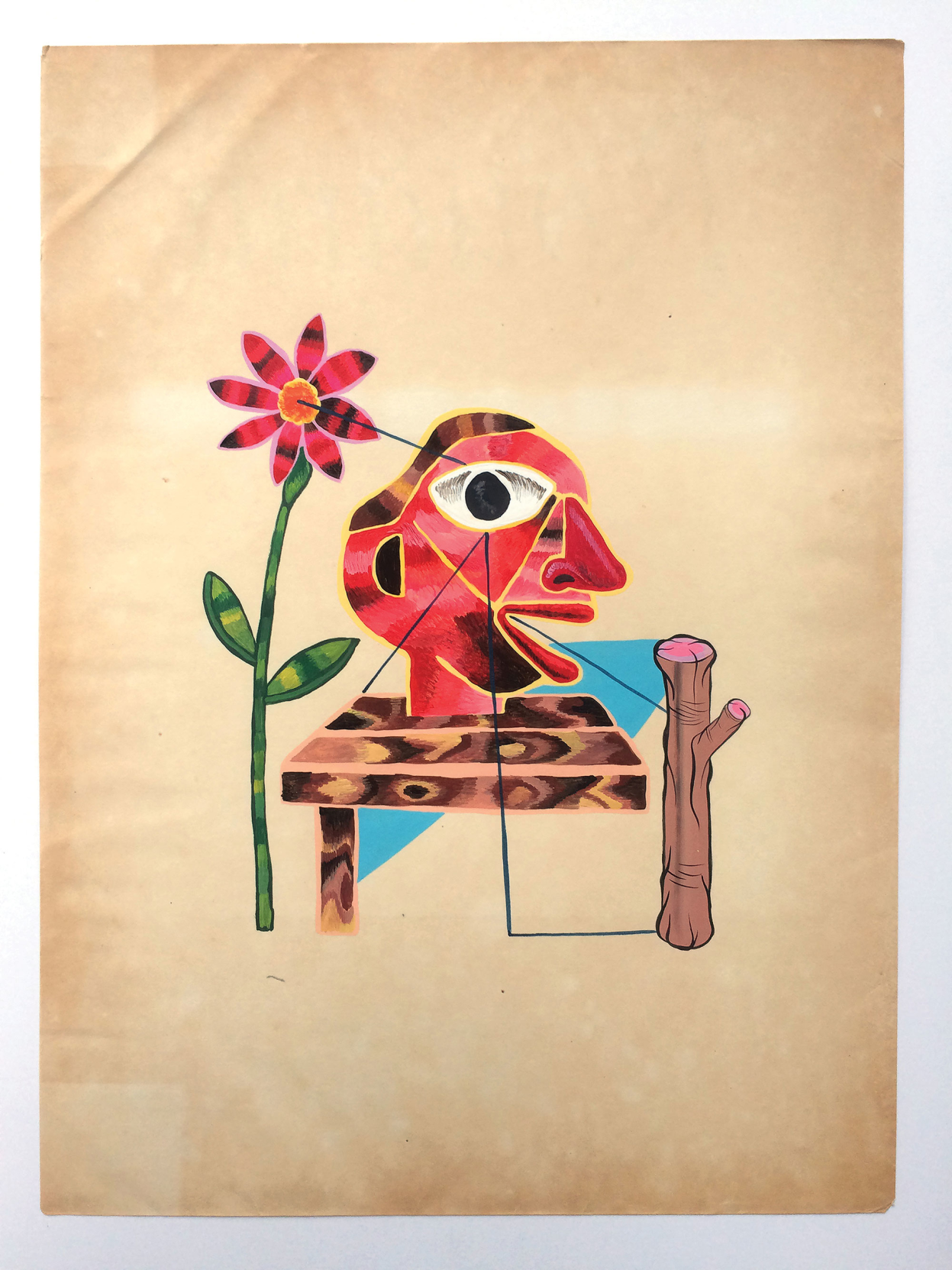
"Untitled," Mark Mulroney
Julia Martin Gallery has taken a similar approach, and the gallery’s website offers a large array of works by mixed-media artists Mark Mulroney and Elise Drake — many of which are less than $200. At The Red Arrow Gallery, around 100 affordable works, including several pieces by local favorites John Paul Kesling and Dana Oldfather, are available to purchase. It’s as if these galleries have made a virtual flat file of work by artists whose more expensive canvases may be out of reach for everyday audiences — it’s art-fair work at craft-fair prices.
Artists and curators are programming exhibitions around contemporary events, and those are on view at several spots in town, most expansively at Red Arrow. Gallery owner Katie Shaw has organized Breathless, an ambitious group exhibition of work made since March. Photographs by Marcus Maddox — some of which were taken at recent Black Lives Matter protests — ground the show in reality. Installation shots of the exhibit show large-scale mixed-media work by Jodi Hays and an installation of a suspended bike by Desmond Lewis sharing space with the Maddox works. The scope of the Breathless exhibit — which includes work that’s thematically linked to the March 3 tornado, the COVID-19 pandemic and the nationwide proliferation of racial injustice — is both wide-ranging and hyperlocal, and is a good example of how a gallery can act like a microcosm of the community it represents.
Unrequited Leisure has been noticeably nimble in its reactions to both online-only viewings and the growing awareness of systemic racism in the gallery world. This month, the gallery is handing over its curatorial reins to Omari Booker, a Black artist and educator. Booker, whose painting was also on display in Pockets of Real Passion at Channel to Channel, guest curated a selection of video works by dancer and choreographer Dorese Brown and visual artists Elisheba Israel Mrozik and Aaron Mrozik. In Booker’s curatorial statement, he says it’s hugely important to investigate the history that created our current circumstances. The exhibition is called What Could Happen?, a reference to spiritual teacher Orland Bishop’s statement, “History is not only what happened, but what could have happened and didn’t.”
Art is always about taking another person’s perspective and trying it on for size. Artists — as well as the galleries, curators and critics that connect them to their communities — should all be reconsidering their own long-held assumptions about the world in which they create. By reframing our collective uncertainty about what the future holds, we have the chance to rethink our expectations of the art around us. What happened to all those barriers — racial, virtual, economic? What could have happened, but didn’t?



Post a comment as anonymous
Report
Watch this discussion.
(0) comments
Welcome to the discussion.
Log In
Welcome to the discussion.
Keep it clean. Please avoid obscene, vulgar, lewd, racist or otherwise abusive language. Comments featuring hate speech or threatening or violent content will not be tolerated.
PLEASE TURN OFF YOUR CAPS LOCK.
Be truthful. Don't knowingly lie or mislead.
Be proactive. Use the “report” link on any comment that violates our comment policy.
Share with us. We'd love to hear your feedback.