
Vodka Yonic features a rotating cast of women, nonbinary and gender-diverse writers from around the world sharing stories that are alternately humorous, sobering, intellectual, erotic, religious or painfully personal. You never know what you’ll find in this column, but we hope this potent mix of stories encourages conversation.
I thought I’d be better at cleaning out my childhood home. As an avid estate sale shopper, I understood the bearish economics of trash and treasure. My weekly rounds to liquidations of midcentury ranch houses had taught me that even prized brown furniture or Blue Willow china can become a white elephant. So when Mom decided to leave her home of 50 years, I thought I’d be immune to the sentimentality that would project false value onto her trousseau. I would empty that house like a boss.
From the moment I had a home of my own, I trawled estate sales. I sourced everything my family needed — furniture, tools, art, bikes — for pennies on the dollar. And while my empty nest now needs nary a home good, the thrill of the hunt still makes my heart race.
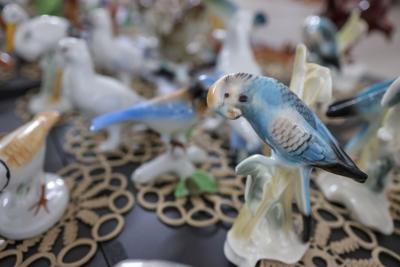
An estate sale is not a Walmart. You can’t count on it for a shopping list. But humans are predictable, so you can make assumptions. For example, in a dwelling occupied by the same owner since the Eisenhower administration, there will be a workbench in the basement, holiday kitsch in the attic and a toilet-chair in the garage. If the owners had children, the kitchen will stock an arsenal of single-use gadgets received as desperate gifts. There will be artifacts of the Lucite era. There will be porcelain songbirds.
It’s these patterns that seduce me to estate sales. Even now, when I need nothing but to cull my own possessions, I crave the anthropology, the universality, of an estate sale. Familiar caches of empty Cool Whip tubs and tepid triumphs of fourth-place ribbons remind me that I’m not unique. My belongings — and by extension my worries — are, let’s face it, basic. Armed with such self-awareness and a roll of contractor-grade trash bags, I prepared to excavate Mom’s condo.
We started strong, 86-ing dog-eared magazines, expired hotel toiletries and VCR recordings of fourth-place finishes. Between Goodwill runs and Poshmark postings, we efficiently moved assets to higher value.
There were moments of hilarity, like when my brother found our baby teeth. We added the tiny, bejeweled boxes to our respective “keep” piles, until my biologist sister-in-law said Hell No We Don’t Keep Teeth.
And there were discoveries of heartbreak, like the three-word farewell Dad scrawled to Mom the day he died.
There were infuriating piles of 20th-century tax forms and photograph negatives, a creepy stuffed Santa strangled by nonfunctional twinkle lights, and — mea culpa — an armory of single-use kitchen gadgets. There were also treasures of adorable provenance: glass fruits purchased on a honeymoon, mouse-shaped booties crocheted for grandchildren.
And there were porcelain songbirds.
House wren, warbler, brown thrasher and scarlet tanager had alit on a shelf in my childhood bedroom when Mom absorbed the worldly goods of her own matriarch. Before her stroke, my grandmother Meme had displayed these ornithological objets proudly and spoken of them often — though I suspect neither as proudly nor as often as if they had been authentic “Boehm birds,” by artist Edward Marshall Boehm, whose avian porcelain adorned the White House. Meme really wanted fine Boehm (pronounced “Beam”) birds like Ike and Mamie collected, but a knockoff house wren was the closest she got.
“Don’t you want them?” Mom asked when I proposed to trash the thrasher.
Hell No I Don’t Want the Off-Brand Birds.
“Your grandmother loved them,” she said, crestfallen.
And I loved my grandmother, so before I said things about her counterfeit tanager that I might regret, I ferried the not-so-fine feathered bequest home and displayed it on my dining table — until my kids suggested the flock might go well in the basement, with other dubious heirlooms from their grandmother’s move.
A month later, Mom’s house was empty. She was settling into a beautiful apartment, and I was settling under the albatross of so many porcelain songbirds. That’s when I went back to an estate sale.
It was exactly the kind of sale I love — a time capsule of a beautiful life, a reminder that humans accrue similar stuff and no one can take it with them. I spoke to a woman about my age who was wearing an official-looking apron. It was her mother’s house. I felt a sense of lightness as I perused a Lucite chip-and-dip and electric s’mores maker that were not my burden. I hoped this immersion therapy might help me slough off Mom’s things still stashed in my basement.
Then I saw the porcelain songbirds. Robins and a fledgling cardinal. Six inches tall, pure Hitchcockian horror.
“Nice birds,” I told the apron.
“My grandmother loved them,” she said. Pointing to a $4 sticker on the juvenile red bird’s stubby crest, she apologized: “They’re not real Boehm birds.”
I showed her the goosebumps on my arm and told her about my own faux-and-flightless birthright. Strangers no more, we were sisters in daughterly duty of deaccessioning.
And wouldn’t it be tidy if that’s where the day ended, with a new friendship reaffirming my belief that I need people, not things?
But no. Humans are ultimately unpredictable. I bought her wannabe Boehm birds.
Baby Cardinal and the Robins have joined Warbler & Co. in my subterranean aviary, to plague the next generation whose grandmother loves them.



Post a comment as anonymous
Report
Watch this discussion.
(0) comments
Welcome to the discussion.
Log In
Welcome to the discussion.
Keep it clean. Please avoid obscene, vulgar, lewd, racist or otherwise abusive language. Comments featuring hate speech or threatening or violent content will not be tolerated.
PLEASE TURN OFF YOUR CAPS LOCK.
Be truthful. Don't knowingly lie or mislead.
Be proactive. Use the “report” link on any comment that violates our comment policy.
Share with us. We'd love to hear your feedback.