




"Shawntae the Corporate Attorney," Donna Woodley
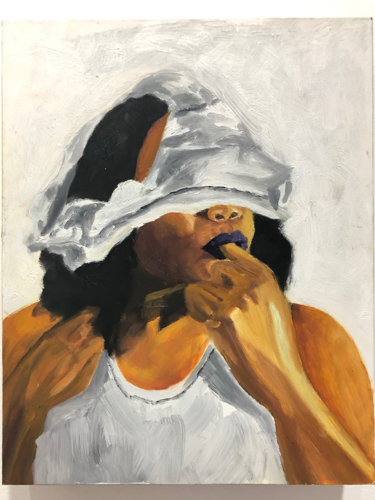
Artist Donna Woodley often chooses a prop as a springboard for a series of paintings. She couches serious subject matter in a playful context to invite you in — and then she hits you with the heavy. In her previous series, Black Women Rock: Painting Black Female Experience, she had her best friends don granny panties on their heads and pose for portraits. The paintings are cheeky and celebratory, but beneath the surface, they challenge the visibility and value that our culture — and the arts — places on women of color.
I visited Woodley in her South Nashville studio space to get a sneak peek of her new series. The Royal Court positions black men as kings — but in place of thrones, they sit on and stand beside toilets. It's a commonplace, accessible object that Woodley uses to explore black masculinity. At 53-by-38 inches, the paintings are imposing and powerful — but they're also inviting.
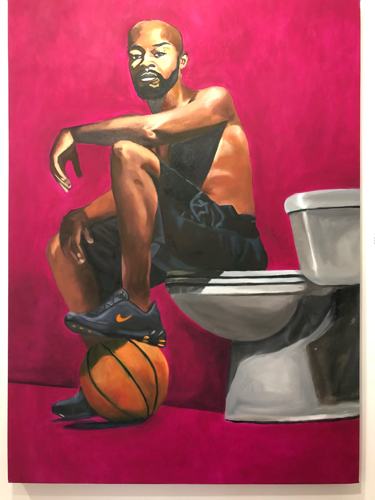
“Sir Brandon the Great” portrays artist Brandon Donahue sitting casually on a toilet in gym shorts, a bright orange basketball wedged under his foot.

"Sir Brandon the Great," Donna Woodley
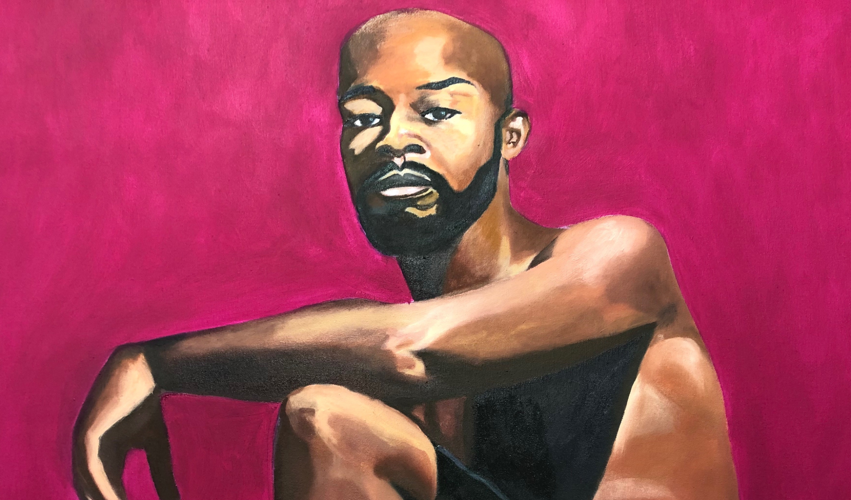
For “King John II,” Woodley painted her physical trainer John Norman, who gave her the idea for the series when he suggested that Woodley paint him as a king. Norman peers over his shoulder in a pose that's knowing and powerful.

"King John II," Donna Woodley
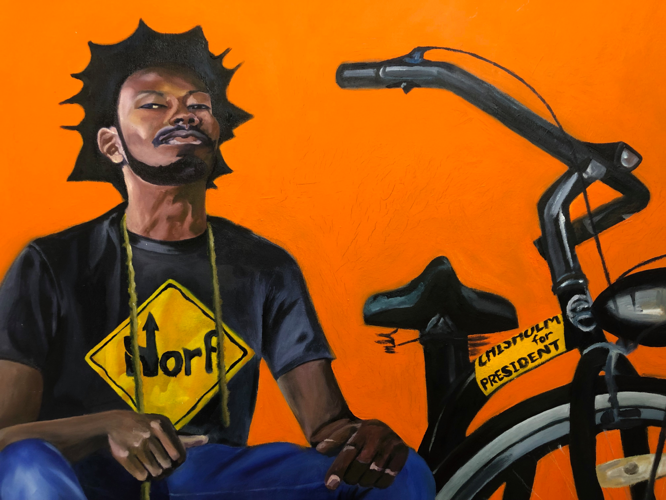
“Prince Joseph III” shows Norf Art Collective’s doughjoe sitting on a toilet beside his bike — a bumper sticker that says “Chisholm for President” wraps around the bike’s top tube. The men in Woodley's portraits exude confidence, poise and integrity. She uses flat, boldly colored backgrounds for each of the portraits, and the men stand out like they’re royalty.

"Prince Joseph III," Donna Woodley
Woodley says she’s been reading W.E.B. Du Bois and thinking about the author’s philosophy of double-consciousness — the notion that black Americans self-evaluate through the lens of others. “It is a peculiar sensation, this double-consciousness,” Du Bois writes in his 1903 opus The Souls of Black Folk, “this sense of always looking at one’s self through the eyes of others, of measuring one’s soul by the tape of a world that looks on in amused contempt and pity.”
The Royal Court has a lot to say about how black men must square away societal expectations and perceptions of self. Keep an eye on Woodley, who is continuing to add to the series — Scene favorite Thaxton Waters is up next.



