


Jared Small’s latest exhibition at David Lusk Gallery is full of surprises, mostly conjured from a combination of unique methods and materials. It’s also the best show I’ve seen by one of the gallery’s standout painters.
I expect architecture and floral still-life subjects from a Small show. This exhibit has these, but it also includes colorful painted portraits that expand the breadth of the artist’s painterly universe, connecting narratives between the works and bringing added depth and personal content to the display. The exhibition’s many strengths are further elevated with a thoughtful, creative installation from Lusk’s Nashville team, which closes the 2022 art calendar with one of its best shows of the year.
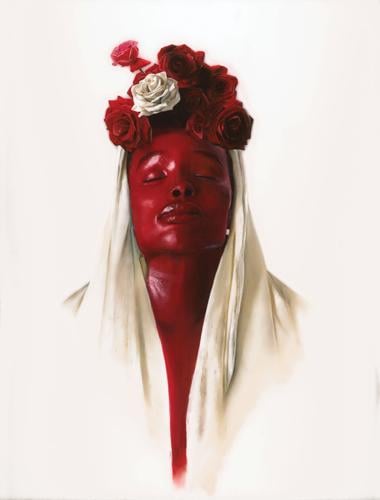
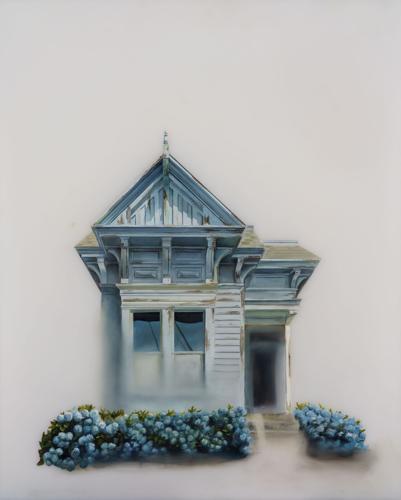
Small generally paints on wooden panels, and flat, pristine surfaces are part of his signature style. But here, he puts oils to clear acrylic plexiglass, and doubles down on the daydream moods his images always inspire. Small deftly details every slightly wilting flower petal, every gleaming green leaf, every peel of paint or spot of rust, every curl of hair in the centers of his images. But all these paintings fade into gooey blurs of pigment and linseed at their edges. The artist regularly utilizes this fading effect and deep shadows to suspend his subjects in surreal, somnambulant spaces.
Some of Small’s stylings resemble contemporary photography. His bouquets don’t populate vases on tables or window ledges in domestic scenes. Instead, they’re isolated in infinitely receding spaces, like the ones we recognize from commercial photography. And many viewers will find Small’s blurred-edged paintings familiar from their own use of portrait-mode filters on smartphone cameras. These materials and techniques — the moods they evoke and the artistic conversations they create — move Small’s work out of the tall, seedy grass of Southern painting and photography’s entropy nostalgia; these painted places are more haunted than sentimental. His flowers are gorgeous and ornate, but like a get-well-soon bouquet, not a prom corsage. Small’s subjects are too complex to be wistful. Too actually wounded to be merely romantic. And his new development of painting on transparent plexiglass is a formal breakthrough that takes his signature look to a new level, making many of his bouquets, front porches and beautiful faces feel like they’re floating in front of the gallery walls with all the delicate materiality of a dream memory.
The exhibition’s architectural and floral paintings find Small continuing to explore familiar subjects across a range of exquisite works: The blurry blue built facade of “Hyde House,” the dilapidated grandeur of “Rosy,” the olive and gold blossoms of “Trumpet.”

Small also includes three portraits of Black women rendered in their title colors: “Silent Roses,” “Fuchsia” and “Soft Blue.” It’s not the first time Small has done figurative work, but it’s the first time he’s incorporated it into his more recent practice, which has been marked by the success of his remarkable architectural paintings. The artist is a native Memphian, and the women in these portraits are all his friends. Small has made many paintings of houses in Memphis — his hydrangeas are as Southern as they are ethereal — and these colorful, costumed images of friends feel like a natural extension of work from an artist who’s made a subject of his everyday surroundings in a particular place. The portraits introduce more directly personal content into the show — but like all of Small’s work, they’re too uniquely stylized and surreal to get tangled in Southern portrait clichés. The works’ vivid colors make their subjects otherworldly, and the clothing and flowers evoke religious and royal paintings.
The Lusk installation takes its cues from the three colored portraits, arranging the show on separate walls of red, blue and pink paintings. There’s also an additional selection of paintings on dark backgrounds that more than stand on their own, and feel deliberately separated from the more colorful sections of the show. The centerline of the installation is loosely implied here, but each colored section includes works of different sizes, hung at varying heights and distances from each other. Like Small’s paintings, the organization feels deliberate but dreamy. Each grouping is more like a cloud formation than a formal gallery layout, and the color coordination makes the paintings’ hues appear even more richly saturated. This exhibition is a great example of how a very strong show becomes uniquely exceptional through the glamour of a sharp-eyed display.
Lusk’s Nashville outpost frequently closes its calendar year with a Small show. It’s happened often enough that I’ve come to think of these exhibitions as something like a holiday tradition. This year, it’s the present you knew you were going to get, but once you unwrap it you realize that it’s even better than you had expected.



Post a comment as anonymous
Report
Watch this discussion.
(0) comments
Welcome to the discussion.
Log In
Welcome to the discussion.
Keep it clean. Please avoid obscene, vulgar, lewd, racist or otherwise abusive language. Comments featuring hate speech or threatening or violent content will not be tolerated.
PLEASE TURN OFF YOUR CAPS LOCK.
Be truthful. Don't knowingly lie or mislead.
Be proactive. Use the “report” link on any comment that violates our comment policy.
Share with us. We'd love to hear your feedback.