


Ian Edward White’s photography exhibition Townes Ferry Pike includes images made over the past four years while the artist has traveled throughout Middle Tennessee — Murfreesboro, Shelbyville, McMinnville, Columbia, Nashville — photographing the beauty in the banal and the marvelous in the mundane. White works in the Southern lyrical documentary tradition, presenting Middle Tennessee as both a real place and a state of mind, shaped by history, nostalgia and personal memory.
The small photos in Townes Ferry Pike hang together in energetic connection, and they read like stills from a short film. With this new show at David Lusk Gallery, White stakes a claim for his take on Southern photography that connects to his forebears as well as his more recent peers.
Like the works of William Christenberry, William Eggleston and William Greiner, White’s untitled images are photography of the everyday. Cars and trestles and rainbows and swimming holes all find their way into his frames. Like many contemporary Southern photographers, White is a realist — even a documentarian of a kind, but one with an eye for stylized composition. White’s images include elements of the actual and the magical, the candid and the contrived. Of course, this is what elevates a picture of a cyclone fence from a mesh of utilitarian industrialism into a web of inspiration. White’s framing positions a tree, a ladder and a black cat into an iconic scene charged with warning. The front door of a house becomes the portal to someplace otherworldly at the business end of White’s focus and flash.

Townes Ferry Pike installation view
In the middle of nowhere, in some woodsy enclave in Murfreesboro, White photographed an arrangement of a bed of grass overlaid with a piece of plywood topped by three bright-green osage oranges in a triangular arrangement. The scene is ritualistic, kind of beautiful in a way. Kind of creepy. Did White construct the scene? Did one of his friends? Did he just happen upon this odd offering? Who knows? Who cares? For all of White’s concentrated capturing of detailed images of spaces and places, he’s also concerned with freeze-framing mystery and composing multiple ambiguities in every picture.
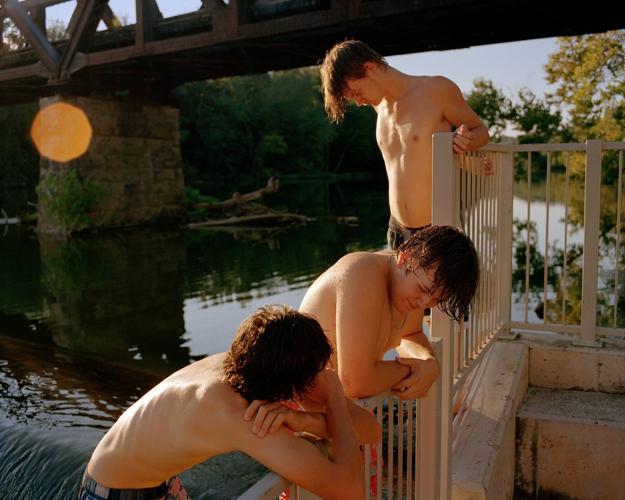
Like his antecedents, White has an eye for the kitsch and charm of Southern sites and locales — storefronts, porches, cinderblock bars and cemeteries. That said, his images of young people in these spaces find Townes Ferry Pike more closely resembling the work of contemporary photographers like Ryan McGinley and former Nashvillian Mike “The Polaroid Kid” Brodie. These artists both broke through with gritty portraits of youthful subcultures — McGinley started out shooting skateboarders, and Brodie documented his community of train-hopping crust punks. White’s subjects are mostly still and thoughtful against backdrops that radiate suburban/rural ennui, but his poetic take on young people navigating distinct locales still shares a kinship with Brodie and McGinley.

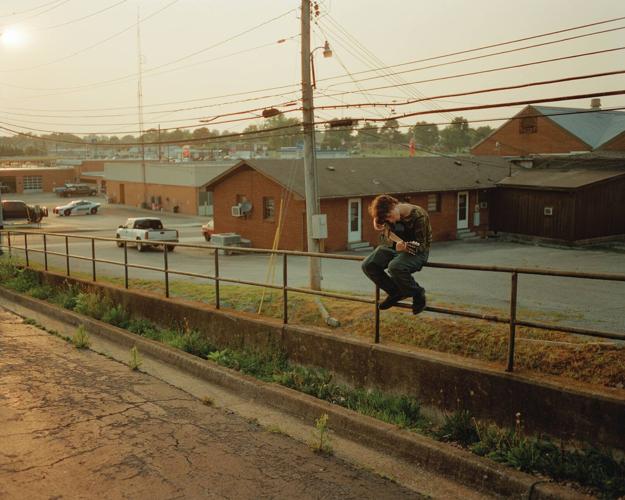
Like his photographs of spaces and places, White’s portraits balance realism with a distinctly stylized approach. As a young man himself, White innately understands that acting out and dramatizing are part of youth culture, and he has an eye for the performative moment that invigorates his frames with character and narrative. A young man sits on a fence playing an acoustic guitar in a springtime sunset. Through White’s lens, he’s the Orpheus of Shelbyville — a hero basking in golden-hour light, fingering an ode to Apollo on phosphor and bronze.
In another image, two young women play with a plastic dollhouse on a wooden table on the back patio of a home in Nashville. One sits on the table dragging a cigarette. The other arranges tiny furniture while wearing a bright-red beret. It’s another image that might be completely spontaneous or totally staged, but it doesn’t matter. The overall effect is sexy and funny and nostalgic, with just enough melancholy to keep things from getting maudlin.
In one of White’s photos taken in Murfreesboro, a tree looms over the edge of a river. The river is sparkling beneath blue skies on a sunny spring day. The left side of the image is framed by green foliage in the foreground, and signs of spring can be seen throughout the picture. The ground, though, is still partially covered by a half-melted snowdrift, and some of the same white stuff is seen clinging to the trunk of the tree. In ancient Greece, liminal spaces — a river’s edge, the transitions of seasons — marked intersection points between the mortal world and the mysteries of the divine and the supernatural. Ian Edward White’s best images capture both the real and concrete as well as the magical and poetic, and both are required to illuminate the complexities of place and people, history and heritage in the communities surrounding Nashville, the Athens of the South.



Post a comment as anonymous
Report
Watch this discussion.
(0) comments
Welcome to the discussion.
Log In
Welcome to the discussion.
Keep it clean. Please avoid obscene, vulgar, lewd, racist or otherwise abusive language. Comments featuring hate speech or threatening or violent content will not be tolerated.
PLEASE TURN OFF YOUR CAPS LOCK.
Be truthful. Don't knowingly lie or mislead.
Be proactive. Use the “report” link on any comment that violates our comment policy.
Share with us. We'd love to hear your feedback.