
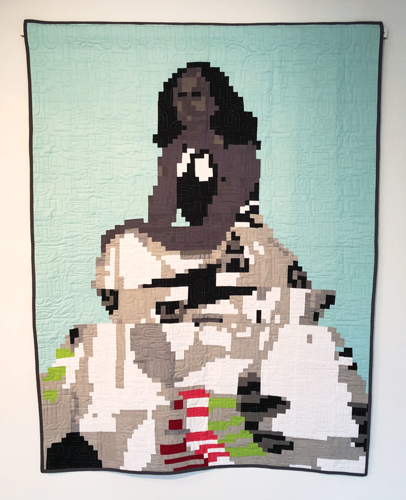


“Black Elegance,” S.H. Collier
Unlike many visual art forms, the fiber arts are not preoccupied with illusions. The process of creation is evident in the visible stitches, hand-dyed fabric and the warp and weft of threads. Textiles are born of need, elevated to become decor, heirlooms and — in The Rymer Gallery’s Dangerously Close to Weaving — art.
But for a long time, fiber arts were relegated to the sphere of craft, not allowed into the canon of fine art, a symptom of the attitude that fine art is the realm of men. While fiber arts are not the exclusive territory of women, their associations with the home and the use of reclaimed domestic materials mark such works as feminine by societal standards.
When artist Pam Marlene Taylor presented her senior project to her professors at Tusculum University, one called it “dangerously close to weaving.” It’s women’s work, her professors said. They warned her not to pursue that path, saying it would keep her from being taken seriously by the art world.
Taylor — now an independent curator who also works as the museum manager at Nashville’s 21c Museum Hotel — initially took that warning to heart. She tried to redirect her art away from textiles, but she kept coming back. And she met other women who’d had similar experiences. These days, Taylor recalls her professor’s admonition as a badge of honor. She curated The Rymer Gallery’s current exhibition Dangerously Close to Weaving, an ambitious showcase of fiber arts that features works by nine women. The work is anchored in identity and the desire to eschew gender expectations, but more than that, it’s a celebration of textiles.
Taylor weaves her own wall hangings on hand-built looms. She uses strong, utilitarian natural fibers from raffia palm trees, mixed with soft, fluffy wool. In most weaving, the vertical fiber — called the warp — is hidden by the horizontal weft. In some of Taylor’s work, she intentionally brings out the warp, highlighting it as the strong backbone of the tapestry — an apt metaphor for women’s domestic work, which is often taken for granted, unrewarded, unacknowledged.
In what Taylor says is one of the most popular works in the exhibition, S.H. Collier has rendered Amy Sherald’s portrait of Michelle Obama in a quilt. In the original portrait, Sherald depicted Obama wearing a long dress with a geometric design that’s influenced by the African American quilters of Gee’s Bend, Ala. Collier’s quilt gives visitors the opportunity to share in the joy and pride of that portrait.

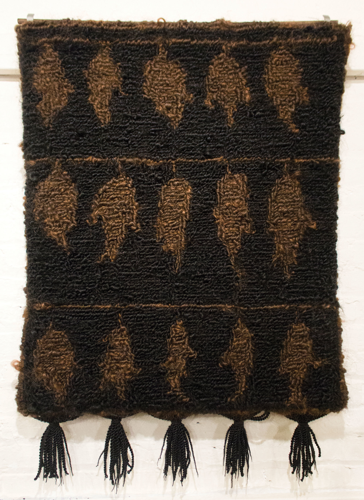
“32 Hours of Negotiations Between the World and Me,” Quinn Hunter
Other standouts of the exhibition are Quinn Hunter’s two works, in which the Athens, Ohio-based artist considers the historical objectification of black women’s bodies. Her work is concerned with the dehumanizing archetypes that have confined black American women — the stereotypes of the Mammy, the Jezebel and the Sapphire. In “32 Hours of Negotiations Between the World and Me,” Hunter uses artificial hair, linen and hair ties to call to mind the time and labor it takes women to get hair extensions. It’s a tightly woven piece in which light-brown pod-like shapes hang from horizontal lines, recalling the image of lynchings as described in Billie Holiday’s “Strange Fruit.” In “My Mother’s Hot Combs (Beauty if Pain),” Hunter has heated her mother’s hot combs and imprinted their burn marks on an off-white blanket, further exploring the painful societal expectations that black women face.
Locals Vadis Turner and Jana Harper show pieces that are in keeping with their recent work — Harper’s soft sculpture recalls sacred shapes, and Turner’s fabric vessels are made from antique quilts. Murfreesboro-based artist Becky Dickovitch’s thread-on-salvaged-canvas pieces show an obsessive attention to detail, a desire to fix what’s broken and transform it into something taut and muscular — but beautiful.

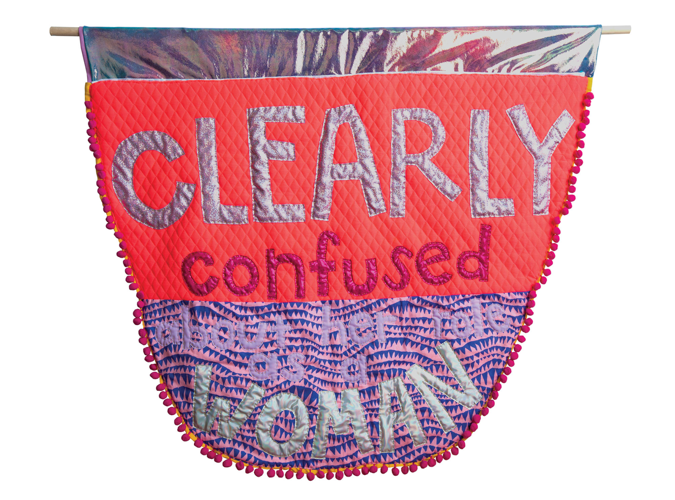
“Clearly Confused V,” Natalie Baxter
The visually loudest — and most fun — works in the exhibition examine sexism in the online sphere. Natalie Baxter’s three pieces are plush wall hangings in flamboyant colors. The artist pulled text from online reactions to an article about her that ran on Glenn Beck’s website The Blaze. Appliqued messages like “nothing more than psycho-babble bullsheet” and “clearly confused about her role as a woman” are emblazoned across her sumptuous sculptural pieces. One looks like a biology textbook’s illustration of an animal cell, with the words “That’s art? See folks what LSD and shrooms do to the head?” stitched in the nucleus.
Baxter claims these messages as her own and uses them as artistic leverage. It’s a bold proclamation of pride and confidence that aligns with the themes of this exceptional exhibition.



