


"Burst Manga"
In Harmony Korine’s 2012 film Spring Breakers, a corn-rowed Florida rapper and small-time gangster named Alien shows some college girls the stuff he’s accumulated in his nunchuck-and-throwing-star-riddled bedroom. “I got Scarface on repeat,” he says. “I got Calvin Klein Escape.” Over and over he implores the girls, almost maniacally, “Look at my shit.”
Although the character was inspired by real-life rapper Riff Raff and was played to perfection by James Franco, Korine might just be the perfect real-world analog to Alien. He’s caught somewhere between the role of a hustler — a sort of charismatic outsider — and a collector of banal items who is desperate to be seen. Shadows and Loops, an exhibition of Korine’s paintings that opened Nov. 4 at the Frist, offers a chance to see the artist again in a completely different light — as a top-notch, heavy-hitting painter in full command of his medium.
The typical approach to Korine as filmmaker is to try to pin him down as a master of opposites, as both an auteur and an enfant terrible. In a 2008 cover story in the Scene about Korine’s film Mister Lonely, the late Jim Ridley described Korine with a string of antonyms: “one of the most divisive, inspiring, infuriating, hated and revered figures in recent American movies.” Korine straddles a similar line with his fine art, a medium that is often perceived as being hierarchically above, or at least separate from, films. In this realm he is somehow a naive artist, even as he sells out shows at New York City’s Gagosian Gallery. But to Korine — whether he’s writing, directing or painting — it really doesn’t matter. It’s all the same thing.
“Everything is the same to me,” Korine tells the Scene. “It’s all just making. It’s just creating — it all comes from the same place. I just want it all to kind of vibrate and hum. ... There’s no hierarchy. I just try to keep myself entertained.”
The curator of the exhibition, Frist chief curator Mark Scala, echoes Korine’s self-assessment as a kind of art-anarchist. “He’s very much an intuitive artist,” Scala tells the Scene as we sit in the Frist Center Cafe. “For him, there’s really not that much of a difference between work that’s inspired by graffiti and has faint echoes of Basquiat, and other work that has faint echoes of Bridget Riley — and you can’t put two more different artists in the same sentence.”

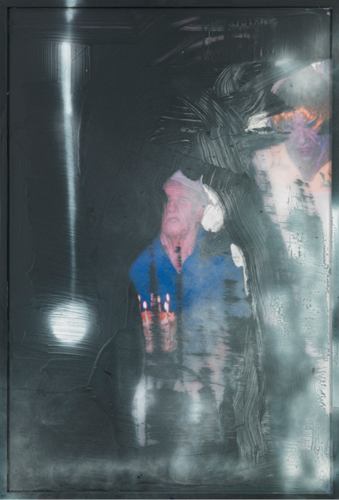
"The Kotzur Gift"
The paintings include a handful of Korine’s large-scale checkerboard paintings that, perhaps more than anything else in Shadows and Loops, illustrate the crossover portion of the Basquiat-Riley version of a Venn diagram. “Skinamax Chex” is a 93-by-124-inch canvas covered with an orange-yellow-and-pink checkerboard design rendered in house paint and ink. More than just op-art illusion, the pattern seems to waver on top of the abstracted underpainting, creating a disorienting effect that makes its colors seem more like vomit and bile than sunshine.
For someone who is notorious for his incendiary behavior during interviews — he was banned from The Late Show With David Letterman in the late ’90s after allegedly rifling through Meryl Streep’s purse backstage — Korine understandably avoids displays of public self-assessment. But he’s quick to heap praise on Scala, whose assessments of the work act as a kind of proxy for Korine’s own.
“I like his ideas, and he’s got a good eye,” Korine says of Scala. “I really just kind of wanted him to choose [which paintings would be in the show], so I pretty much stayed out of it. I mean, I never really think of Nashville as an art town. I still don’t really. But Mark’s show [Phantom Bodies] — that was exciting. You would never see a Hermann Nitsch painting in Nashville. So Mark put it in Nashville.”
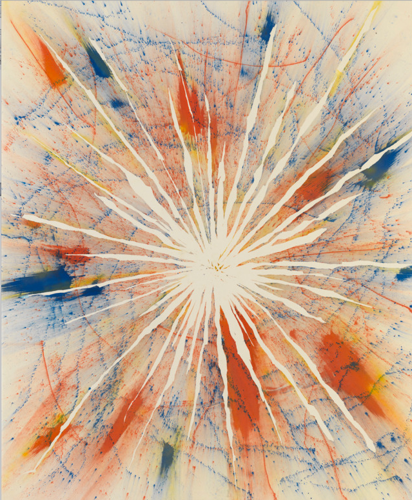
Korine’s reference to Nitsch, an Austrian artist who garnered infamy even in the hard-to-shock world of contemporary art with his splatter paintings created using actual blood, helps explain the scuzzy veneer of Korine’s seemingly playful works. Take, for instance, “Burst Manga,” which could be a child’s Spirograph drawing or an exploding asshole, depending on your perspective.
And what about the exhibition’s title, Shadows and Loops? That was Scala’s idea, and it reflects the curator’s understanding of Korine’s paintings as examinations of the dark and psychedelic sides of life.
“A lot of his work,” Scala explains, “is about what’s beneath the surface, or using the surface as an invitation to imagine what’s beneath it. There’s this idea of shadows — the surface and what’s beneath the surface — and how the atmosphere of the painting or the paint or the atmosphere of the film implies something else.
“Then the idea of loops is just this notion of repetition,” he continues. “Especially in his pattern pictures. He’s trying to evoke a sense of delirium in the paintings — you look at those and your eyes start to quiver a little bit because you can’t quite place them, you can’t quite sit yourself down on one of them. There’s this constant sense of challenging or changing or causing you to question your own perspective, which of course is something that’s a particular challenge if you’re working with a two-dimensional medium, with a solid unchanging medium. How do you make it seem to be in constant shift when it’s not? That’s a really seductive idea behind his paintings.”

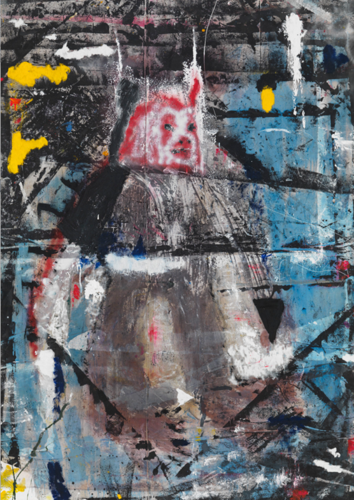
"Caker Plino"
It’s that insightfulness that first drew Korine to Scala, and made him receptive to showing his work in Nashville — aside from a 2009 exhibition of photos at the Vanderbilt Fine Arts Gallery, Korine has been reticent about exhibiting in his hometown.
“I’ll always love it, and I’ll always think of it as my home,” Korine says. “I’ve always felt connected to it in a real way. But I can’t take any more breweries, denim shops and reclaimed wood. I just can’t deal with that shit anymore. All the places I liked growing up are gone now. There are a lot more restaurants, but it doesn’t have the same character. So I just was like, ‘Time to split.’ ”
Korine left Nashville earlier this year and is now living full time in Miami, although he maintains a studio in Nashville.
“I still love it,” he says of Nashville. “It’s just like a lot of the character has been kind of polished.”
All the paintings included in Shadows and Loops, Korine says, were made in Nashville. His studio on Eighth Avenue in SoBro still has its original name painted on the side: Voorhees Building. A spray-painted letter V on a marquee overhanging the building’s main entrance is the only clue that something is happening inside, and even that seems coded, like an urbanized art-world version of a speakeasy.
“For me,” Korine explains, “it was just a good place to work, because nobody cared about it. So there was never anyone hassling me. I always felt left alone, and that was nice. The city did give me a lot — it gave me a peace of mind. I always feel like my blood pressure goes down when I come back.”
Email arts@nashvillescene.com



Post a comment as anonymous
Report
Watch this discussion.
(0) comments
Welcome to the discussion.
Log In
Welcome to the discussion.
Keep it clean. Please avoid obscene, vulgar, lewd, racist or otherwise abusive language. Comments featuring hate speech or threatening or violent content will not be tolerated.
PLEASE TURN OFF YOUR CAPS LOCK.
Be truthful. Don't knowingly lie or mislead.
Be proactive. Use the “report” link on any comment that violates our comment policy.
Share with us. We'd love to hear your feedback.