

The contemporary resurgence of content-forward art started with the politically charged 1993 Whitney Biennial. The art in the show tackled the AIDS crisis and served as a protest against attacks on the National Endowment for the Arts. Suddenly, an artwork wasn’t a thing unto itself anymore. After the ’93 Biennial, artworks needed to be about something. Content — and the figures and narratives it most often relies on — ruled. But it seems that’s all over now.
A growing appetite for formal abstraction is overtaking representational art, and ideological messaging is giving way to emotions, sensations and musings stirred by color, shapes and expressive marks. The change hasn’t come with a bang or a whimper, but with a growing conversation in arts reporting that has collectors speculating, museums programming and artists finding new opportunities for work that might have been overlooked only a few years ago. Art & Object magazine covered the shift as early as February 2025, and in April of last year ARTnews editor Alex Greenberger announced that after a decade of figurative art dominating the New York gallery scene, abstract art was making a dynamic comeback. By May, Art in America’s New Talent issue was focused on a trending crop of abstract artists.
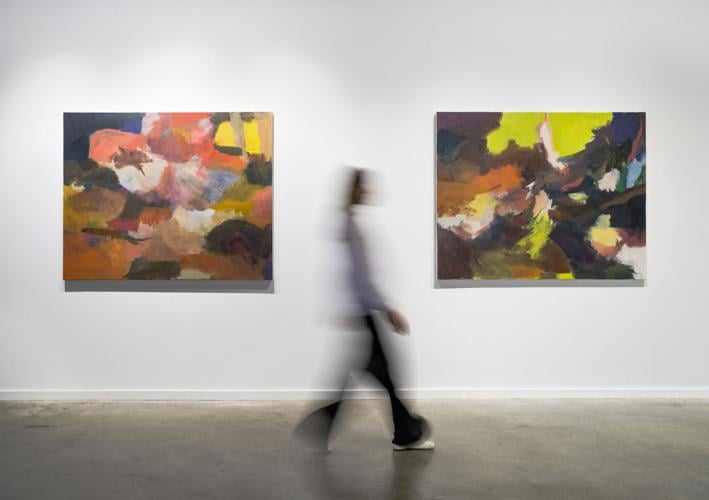
Demetrius Wilson is a New York-based artist with an internationally established résumé, but Aftershadow at Red Arrow is his first solo exhibition in Nashville. He is emblematic of a new insurgency of abstract artists — a movement I’m calling Next New Formalism — at the forefront of the swinging cultural/market pendulum. He’s also a Black artist whose work doesn’t overtly point to the signs and signifiers of contemporary Black art, insisting that Black art and artists cannot be contained by ill-fitting reductionist identity categories. Wilson makes paintings about paint, and viewers will also find a blush of emotional content reflected in the artist’s titles and palette. This is a display that upsets expectations, even as it reaffirms bedrock truths about artists and artmaking.
The COVID pandemic echoed the Spanish Flu of the early 20th century, and new global military tensions recall the World War years. I’ve been tracking the shift toward abstraction in these pages since 2023, noting that 21st-century American painting resonates with the work of the early Modernist painters of the first half of the 20th century. For a variety of reasons, we currently find ourselves retesting the trials of the past century, and you can see it in the painting.

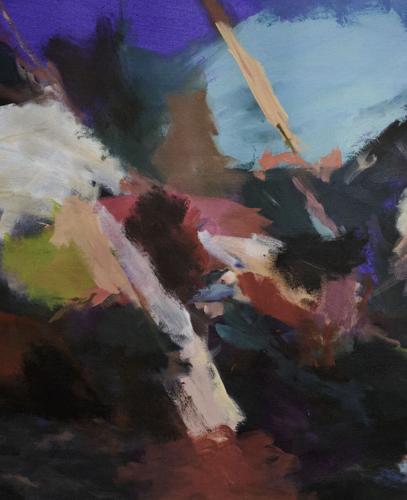
“Paranoia Taking Over Me,” Demetrius Wilson
Many of the early American Modernists were landscape painters who adopted new ideas coming from Europe, resulting in works that pictured mountains, trees and streams in suggestive gestures, loose brushwork and unreal palettes. In the first half of the 20th century, painters like Arthur Dove and Charles Burchfield painted the kinds of natural and agrarian subjects that had always been popular in American painting, but their renderings were stripped down and stylized by Dove and imbued with hallucinatory imaginings by Burchfield.
Wilson’s works read like landscapes. Amid overlapping swatches of orange, brown, white, blue and green, viewers see trees and mountains, frozen ice and farmers’ fields. All of Wilson’s compositions are strong, and the mostly dark palettes bring a pleasantly solemn mood to the show. The sweet spots in Wilson’s oil paintings on canvas are the rough, instinctive brushwork and the interplay among his colored layers.

Read our critic’s short reviews of shows at Red 225, Coop and Open Gallery
Close observation of these works pays dividends and leads viewers to Wilson’s titles, which often reveal that these paintings about paint are also about the painter and emotions. One of the standout works in the show looks like an abstract take on a sunset in a mountain valley, but Wilson calls that painting “Paranoia Taking Over Me.”
My favorite work in the show is called “Put Your Name on It.” It features a luscious profusion of pink, yellow and orange, and it’s like diving face-first into a springtime flower garden. Wilson is a dedicated formalist, and his work demonstrates how abstract painting can still be a vehicle for content, even when it’s not emphasized.
As abstract imagery reasserts itself in studios and galleries, we’re watching figures, narratives and content fade and hush into the background. Demetrius Wilson’s paintings aren’t about identity or sociopolitical commentary. They’re not diary entries, and they’re not about pop culture. They’re about paint. In the Next New Formalism — as in every old formalism — a painting isn’t about something. It is something. Wilson’s separation of identity and art is an important reminder that census categories and demographic data don’t make art — sacred, unique, individual people do.



Post a comment as anonymous
Report
Watch this discussion.
(0) comments
Welcome to the discussion.
Log In
Welcome to the discussion.
Keep it clean. Please avoid obscene, vulgar, lewd, racist or otherwise abusive language. Comments featuring hate speech or threatening or violent content will not be tolerated.
PLEASE TURN OFF YOUR CAPS LOCK.
Be truthful. Don't knowingly lie or mislead.
Be proactive. Use the “report” link on any comment that violates our comment policy.
Share with us. We'd love to hear your feedback.