
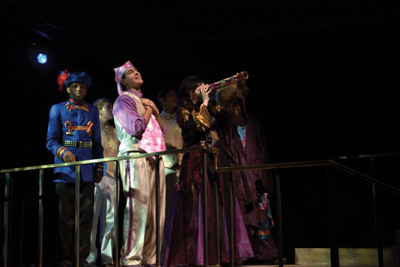
Vanderbilt University Theatre serves up enchantment seasoned with some sly verbal twists in its new production of Carlo Gozzi's The Green Bird, an 18th century adult fairy tale. The translation by Albert Bermel and Ted Emery is nothing if not clever, elevating the tropes of traditional fable to something more sophisticated while still maintaining the essential charm of the form.
Director Leah Lowe's production is highly theatrical in all areas, as befits a piece that was successfully mounted more than a decade ago in New York by the grande dame of contemporary Broadway, Julie Taymor. There is a bit of puppetry — all about that eponymous feathery creature — plus delightfully eccentric touches that include living statues, squirting mammaries (it happens only once, so don't blink!) and otherworldly sound effects.
Lowe's youthful cast features 24 actors, and some of the performances reveal a bit of inexperience. But overall, it's an energetic and cohesive ensemble that tenaciously relates the story of a mysteriously orphaned brother and sister who seek love and identity.
There is broad comedy here, to be sure, along with welcome wordplay, and the two merge agreeably to maintain an overall sense of wonder. Yet the script's more sober subtext confronts notions concerning incest, greed, vanity and one dominating theme — self-love as the main motivator for all human action. Meanwhile, the siblings' Act 2 quest for "an apple that sings and waters that dance" helps reconnect the audience to the scenario's more magical aspects and leads to the requisite happy ending.
First among the very likable players are Brian Jones and Madeline Mooney as the sausage maker Truffaldino and his wife Smeraldina. Also offering enjoyable characterizations are Jessica Owens as Barbarina the orphan girl; Sam Mallick as Tartaglia, the overwrought king; Nathan Markiewitz as the obsequious poet-astrologer Brighella; Arian Flores as the all-knowing Calmon; and Max Rackoff as the distressed title character.
Laura Winston is the villainous Tartagliona, and — as any lady villain in a fairy tale ought to be — she's sexy in an evil sort of way, and makes us laugh right up until she's banished forever.
The technical work, under the direction of Matthew Stratton, is stellar. Neely Auditorium's hip black-box space is appealingly transformed by Amanda Sweger's childlike setting of multicolored brickwork, oversized books and dresser drawers. Alexandra Sargent Capps' costumes are colorful and witty — quaint as befits a fairy tale, but also enlivened with comical extremes. Plus the original music by veteran Nashville composer/arranger Paul Carrol Binkley adds both mirthful and ironic counterpoint to the proceedings, including a song interlude that conjures the spirit of girl groups.
If there's a fault, it's that the production is a tad long-winded. But it's an assured and sincere staging that makes for an entertaining evening of theater.
Who goes there
A self-described "word nerd," Trish Crist has always found satisfying verbal expression in her various avocations as a translator and actress. And as artistic director of Rhubarb Theater, Crist has found further creative outlet as a playwright. Her latest work, Who, opens Friday at the Darkhorse Theater for a run through Nov. 12.
Who is a sequel of sorts to Crist's What, which was presented in 2009. "They're similar in structure," Crist says. "That is, a series of vignettes — some comedic, some dramatic, some provoking the audience more than others."
The play is set in a Nashville coffee shop — "kind of like Fido," says the author. The cast of four represents a solid blend of talent and experience, including Melissa Bedinger Hade (as the cafe owner), Robyn Berg (as a waiter), Bob Roberts (as a novelist) and Chaz Howard (as a songwriter).
Playing out in two acts, Who takes some liberties with its through-line. "There's a plot, but with interstitial vignettes that are not set in the coffee shop, with different characters," Crist says. "I like channel surfing — and then checking back in with 'your regularly scheduled programming.' The scenes throughout are about our community and our people, with our jokes and our references and special commentary about Nashville."
Meanwhile, Crist is already well along into the script for Potty Talk — Number Two, a sequel to her original Potty Talk produced in April 2010. That show is scheduled for presentation in March 2012 featuring the cast from the original. Then in June 2012, Crist will stage Joe Pintauro's Birds in Church, an anthology piece originally produced by Rhubarb in 2004 under the direction of Julie Alexander. This remounting will feature a set designed by Jim Manning and original dance elements choreographed by Kate Adams-Johnson.
As always, Crist aims to adhere to Rhubarb's founding commitment to presenting material dedicated to tolerance and diversity in slice-of-life situations. "Rhubarb has only changed as the company has transitioned to producing more original writing with focus on Nashville and Nashvillians," she says.
Email arts@nashvillescene.com.



