

At the latest art opening at Zeitgeist, a banner stretched down the front window announcing a big-name double lineup as if it were a heavyweight championship — and it was, sort of. Wayne White and Kurt Wagner have mounted a twin exhibition of recent work that also serves as a reunion of two renowned creative forces with a shared history.
"Kurt is an old friend of mine," White says. "I've known him for 30 years, and we sort of started out together in Nashville." They've remained friends, and Wagner — frontman for revered indie-rock institution Lambchop — has even used four of White's word paintings for album covers — Thriller, Nixon and the double-album Aw Cmon/No You Cmon. "We've both done our thing and had some success," White explains, "and so it's nice that we can still be friends and still be creative together."
White's success began with his stint as set designer for Pee-Wee's Playhouse. From there, he went on to create some of the most iconic designs in recent pop culture, including the aformentioned Lambchop album covers. Filmmaker Neil Berkeley is currently at work on a documentary about White's life, Beauty Is Embarrassing, slated for a premiere next spring.
White, who now lives in LA, makes work that's as highbrow as lowbrow can get, with sharp-tongued witticisms in bold text sprawled across vintage landscapes he's acquired — like a fine art version of flipping the bird. This is his first exhibit of new word paintings in over a year, but White has been making work like this for more than a decade. The signature piece from the exhibit, "Slow Burn," alludes to what White calls "the ongoing slow burn of doing these paintings for 12 years."
White's word paintings are hilarious, and stretch out in your mind for the amount of time it takes to get from the beginning of the monolithic phrase to its end. In one of the works, you start out with "Aw," the syllable as heavy in your head as the bold blocks of letters, and by the time you clear "they're just mad," you've visually crossed an ocean. But all the weight's at the end of the sentence: "because I'm a mystical truthteller." You can't help but grin at this massively egocentric sentiment that's popped out of such genteel beginnings, like a Southern gentleman prefacing his complaint with, "Bless their hearts."
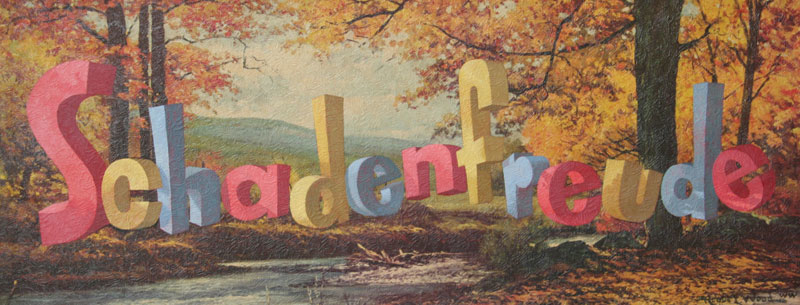
White's Jack-in-the-box lettering in "Schadenfreude," another exhibition highlight, bounces along a brownish wash of autumnal trees that are so dated they seem tired, like something from your grandmother's basement. Its mawkish texture is brought to the forefront with White's primary-colored words, like a joke about the past that we're all in on together, with White's "W.W." signature right alongside the signature of the original painting's artist.
The exhibit is a homecoming of sorts for White, who spent a few years as an art student in Middle Tennessee. Wagner, too, is making a return — not to a locale but to an art form.
"I had always wanted to be a painter," Wagner says, and although he's globally recognized for his prolific musical output with Lambchop and KORT, he first thought of himself as a visual artist. He met Wayne White when both of them were fresh out of art school — White from MTSU, and Wagner from graduate school at Montana State University. "It took me a long time to find a way back to making painting a significant part of my creative output."
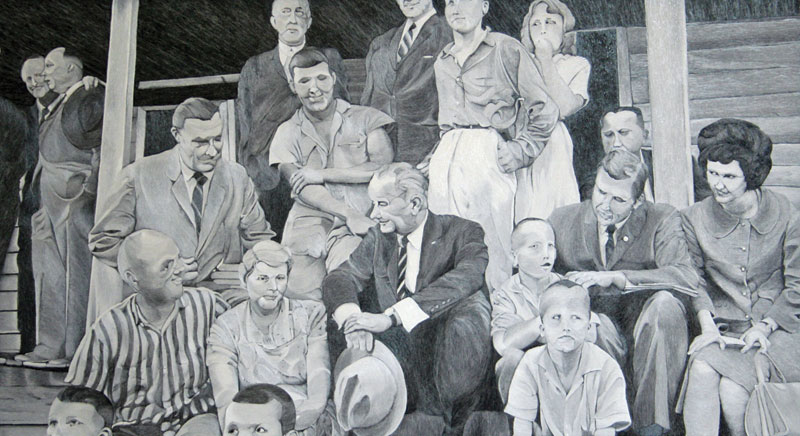
As it turns out, Wagner's output is arguably the strongest in the exhibit. The standout is "LBJ," a painting of the 36th president sitting on the stairs of a front porch, surrounded by a crowd of people. The painting was based on a press photograph taken during Johnson's War on Poverty tour through the South, but that wasn't what drew Wagner to it — it was his hat.
"My wife Mary gave me a hat like the one LBJ is holding in the picture for my birthday," Wagner says, "and as a birthday card she found this image and made a quick print of it. The image had as much to do with the fact that I identified it with the gift, the occasion and my wife." That kind of relational identity is repeated in Wagner's process, which he says is very similar to songwriting — a means of communicating with friends.
Wagner doesn't try to capture reality with precision. The monochromes are reminiscent of a Xerox, newsprint or black-and-white photography, with layers of political, economic and artistic meaning piled atop each delicate line. The finished piece works like the artist is retelling an old story about a president taking a trip to visit an impoverished family, a husband struggling to support too many kids, and a wife giving her husband a hat for his birthday.
Wagner's painting process involves using the small steel nib of a fountain pen instead of a brush to apply paint to canvas. It's a time-consuming process — it took Wagner 11 months to complete the LBJ piece. "I was averaging about 2 square inches a sitting," he says. Reminiscent of impressionism's swirling brushstrokes but more delicate, Wagner's surfaces are filled with kinetic movement, like stills from a Claymation video.
Another great Wagner piece is "Beautillion Millitaire 2000," a series of 19 miniature portraits of young African-American men, proudly handsome in top hats and tuxedos. "The images those are based on were given to me about five years ago," Wagner says, "by my friend and sometimes songwriting collaborator from Memphis." The photos are from a newspaper spread on the Beautillion, a traditional Memphis gala for young African-Americans, and each of the men were participants in that year's celebration.
The portraits are arranged in four rows, making a rectangle — three rows contain five portraits, but one row has only four, with an empty space where a 20th portrait once was. Wagner, it seems, gave it to a friend who got married, and the hole it's left in the series remains as a reminder of that friendship, and is now as much a part of the piece as the painting it once contained.
"Those images have as much to do with the relationship between us as artists and our connections with Memphis as anything," Wagner explains. That's the strand that holds all of Wagner's work together: a reverence for the ties that bind him to others — each line drawn in the paint commits the artist to his subject, while also transforming it from a newsprint replica into a symbol of the relationship on display.
White and Wagner work in distinctly different tones and methods. But what's striking about the exhibit is how well the artists complement each other — the harder edge of White's sarcasm is softened by its placement next to the more emotionally resonant work of his old friend. This is the first art exhibition they've ever mounted together, and after 30 years of friendship, it's about time.
Email arts@nashvillescene.com.



Post a comment as anonymous
Report
Watch this discussion.
(0) comments
Welcome to the discussion.
Log In
Welcome to the discussion.
Keep it clean. Please avoid obscene, vulgar, lewd, racist or otherwise abusive language. Comments featuring hate speech or threatening or violent content will not be tolerated.
PLEASE TURN OFF YOUR CAPS LOCK.
Be truthful. Don't knowingly lie or mislead.
Be proactive. Use the “report” link on any comment that violates our comment policy.
Share with us. We'd love to hear your feedback.