
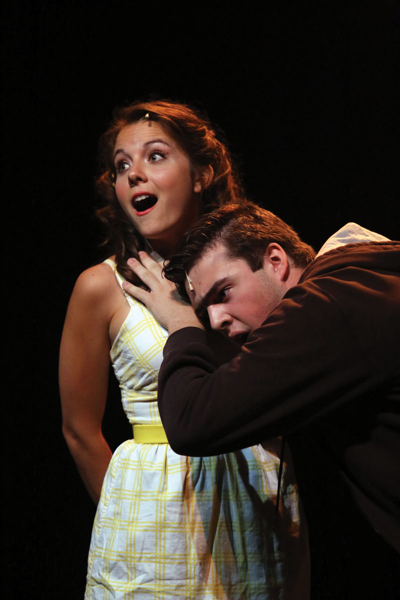
Photo: Kenn Stilger, Heavenly Perspective Photography
Greg Kotis and Mark Hollmann’s 2002 Tony-winning opus Urinetown is a creative mash-up of musical styles — Yiddish folk song, jazz, gospel, Broadway ballad, a cappella chorus. But in essence, it pays homage to the minor-key melodrama of composer Kurt Weill, whose famous collaboration with Bertolt Brecht spawned The Threepenny Opera, a critique of capitalism with a socialist POV. Kotis/Hollmann’s political inspiration seems clear, then, but Urinetown offers added texture in the form of self-conscious comical references to its own dour message, plus little barbs at the very theatrical conventions that deliver it.
The show’s alternative history is of note: It started first as a project of Chicago’s experimental Neo-Futurists theater company, later as an entry at the New York Fringe Festival and finally on the road to Broadway with the encouragement of playwright David Auburn (Proof). Intellectually keen, smartly crafted and stylistically brave, Urinetown opened in New York nine days after 9/11 and now seems as topical as ever.
Fortunately for Nashville, Street Theatre Company has mounted one of its finest-ever productions in bringing Urinetown to life. Under Jason Tucker’s controlled yet still very freewheeling direction, a cast of 18 — a mix of familiar and lesser-known talents — passionately embraces the provocative story of a water shortage and its rueful socioeconomic impact.
Entering the theater, the audience is greeted interactively by the performers, already dealing with their challenge: They live in a place where an authoritarian profiteer, charged with managing the water crisis, enforces a fee to pee. Publically controlled amenities must be used for bodily functions, and there is no getting around the toll, as pathetic folk stand endlessly in line. Failure to pay brings down the cops and exile to the supposed outpost of Urinetown, which we learn is actually only a metaphor — for the ultimate act of elimination.
While the people suffer, the nefarious UGC (Urine Good Company) commandeers the corrupt politicians and reaps its profits, until finally a revolution is at hand, pitting young firebrand Bobby Strong and the oppressed versus bad-guy CEO Caldwell B. Cladwell, who just happens to have a young daughter, Hope, whose naive idealism leads her to Bobby’s cause — and love.
The tropes of conventional musical comedy are cleverly lampooned here, yet within that structure the authors manage a deft meditation on the contradictions inherent in social and economic philosophy. The evil Cladwell is eventually dispatched, but we learn that power to the people can have its own unintended negative consequences.
Key players Sondra Morton and Mike Baum both appeared in Boiler Room Theatre’s local 2007 production of this show, though in different roles. They are strong here indeed, Morton as Penelope Pennywise, the hard-ass gatekeeper to the public amenity, and Baum as Officer Lockstock, who introduces the show, cynically narrates its action on occasion, and does some fine singing. Popular ingenue Corinne Bupp is appealing as ever as Hope — combining her automatically likable presence with her typically pleasing vocals. Brian Best’s Cladwell is an agreeable visual representation of the unctuously engaging bad guy. His acting is top-notch; alas, we lose a lot of lyrics when his singing voice descends too far below the musical accompaniment.
Other important contributors are Katie Bruno, LaDarra Jackel, Angela Madaline-Johnson and Darci Wantiez, plus a remaining cast of versatile performers who sing, dance and stay on the move with quick costume changes.
For all that welcome experienced talent, it’s the youngsters who threaten to steal this show. Nashville School of the Arts senior Marcella Jones’ portrayal of Little Sally, Urinetown’s urchin girl with the symbolic simple wisdom, is original and perfectly pitched. Meanwhile, high school junior Easton Curtis is a revelation as the revolutionary Bobby. He’s a totally poised leading man and singer well beyond his years. Bravo!
Musical director Randy Craft and his five-man combo ace the score, which features 20 numbers in all, ranging from the memorably menacing title song to a raft of diverse ensemble numbers, plus a few gentler pieces.
Katie Gant’s lighting schemes are an important element in the show’s success, her highly theatrical stage pictures proving that one can actually conjure substantial technical art in Looby Theater’s functional if limited proscenium space.
As Officer Lockstock tells us, Urinetown “is not a happy musical.” But it sure is damn fine entertainment.



