

In his director’s note for The View UpStairs, Deonté L. Warren writes that “Pride is a celebration, but it is also an act of remembrance.” With this engaging production, Street Theatre manages to succeed on both fronts — this show is by turns tender, raucous, devastating and life-affirming.
Premiering off-Broadway in 2017, The View UpStairs explores a largely forgotten incident from 1973 in which 32 people died in an arson attack on a New Orleans gay bar called the UpStairs Lounge. It was the deadliest attack on a gay club in U.S. history, until the 2016 Pulse nightclub shooting in Orlando. Despite this horrific backdrop, writer and composer Max Vernon offers a surprisingly joyful meditation on community, connection, resilience, and what — if anything — we owe to those who came before us.
The story centers on Wes, a modern-day fashion designer (and rather self-absorbed influencer) who has just flown into New Orleans from New York and is looking to purchase the long-abandoned Lounge. Unaware of the building’s dark history, he plans to raze the dilapidated structure and kick-start his career — or at least “build his brand.” As he nervously considers his questionable investment, Wes is mysteriously transported back to 1973, where he is soon immersed in the bar’s quirky, vibrant spirit.
It’s an interesting approach, though the device used to send Wes back in time is a bit clunky. Vernon also leans pretty heavily into the anachronistic humor of it all, with Wes dropping a steady stream of social media references and other modern lingo to his befuddled new friends. (The scene in which he tries to explain Grindr is especially good.) In trying to squeeze in so many different backstories and perspectives, Vernon runs the risk of reducing these genuinely likable characters to well-worn archetypes. Still, I like the idea of putting two very different generations in direct conversation with one another — it highlights the fragility of hard-won progress and the dangers of complacency.
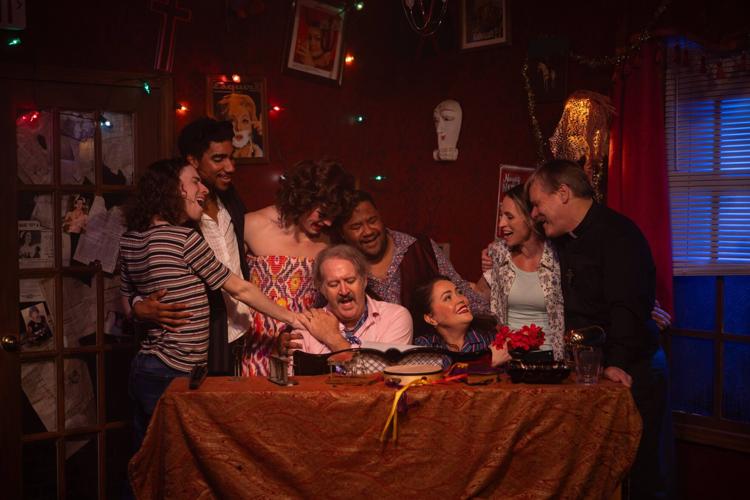
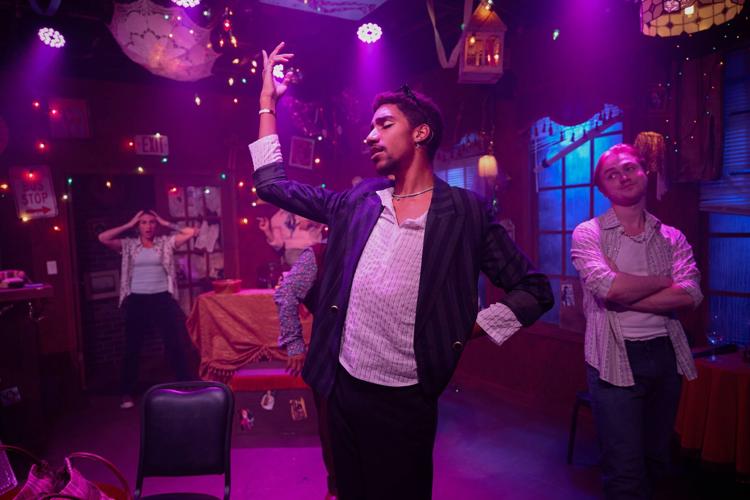
A frequent Street Theatre collaborator, Warren draws the audience into that conversation with a smart, immersive staging that keeps the action moving along. Scenic designer Garner Harsh has transformed the cozy Barbershop Theater into a kitschy piano club — complete with a full bar, plenty of neon, Mardi Gras beads, paper lanterns and a prominently displayed nude centerfold of Burt Reynolds. As the audience files in, most of the actors (decked out in Melissa Durmon’s groovy period costumes) are already onstage, trading quips and enjoying a few drinks.
By the time the music kicks in, you’re fully invested in this ragtag chosen family — as well as the show itself. Vernon’s eclectic score provides passion and panache, blending glam rock and funk with a touch of blues and even gospel. Music director Makai Keur leads an outstanding band, and let me tell you — everyone in this cast can sing.

The View UpStairs
Jerry Sims makes a marvelous Street Theatre debut as the Lounge’s resident piano player Buddy, a closeted gay man with a wife and kids at home. Sims delivers a soulful rendition of “Some Kind of Paradise” — arguably one of the show’s best numbers — along with the rousing “Lost and Found.” Tristan Valdez is fairly irresistible as a young drag artist named Freddy (who performs as the outrageous Aurora Whorealis, serving up a blistering “Sex on Legs”), and Casey Hardin is quite moving as Freddy’s devoted mother, Inez (“The Most Important Thing”).
Newcomer Evin Baylis Jr. is well cast as the ambitious yet insecure Wes (“#Householdname”). While he seemed somewhat tentative at times on opening night, Baylis shares some lovely moments with Lucas Beckett, who plays a sweet-faced hustler named Patrick. Beckett’s voice is particularly strong, soaring in both the fanciful “What I Did Today” and the haunting “Waltz.”
Hannah Arn packs a punch as the no-nonsense bartender Henri, and Payton Justice gives a nicely layered performance as Dale — a desperate outcast whose rage and trauma finally surface in the powerful “Better Than Silence.” It’s wonderful to see Leon Blandon back onstage as the sassy, wise-cracking Willie, though he’s definitely a little young for the role. The always reliable Jack E. Chambers is also excellent as a kindhearted minister named Richard, and Aaron Catron makes the most of his time onstage, as both a corrupt cop and a dodgy real estate agent.
Each actor gets their time to shine individually, but The View UpStairs is truly at its best when the entire ensemble comes together, their voices lifted in strength, solidarity and celebration. What better message could there possibly be for Pride Month?



Post a comment as anonymous
Report
Watch this discussion.
(0) comments
Welcome to the discussion.
Log In
Welcome to the discussion.
Keep it clean. Please avoid obscene, vulgar, lewd, racist or otherwise abusive language. Comments featuring hate speech or threatening or violent content will not be tolerated.
PLEASE TURN OFF YOUR CAPS LOCK.
Be truthful. Don't knowingly lie or mislead.
Be proactive. Use the “report” link on any comment that violates our comment policy.
Share with us. We'd love to hear your feedback.