
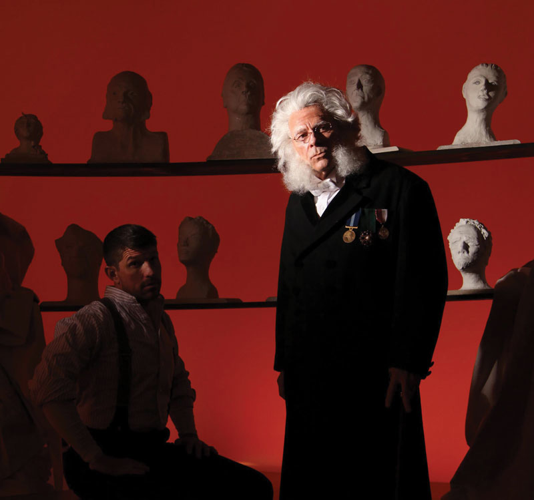
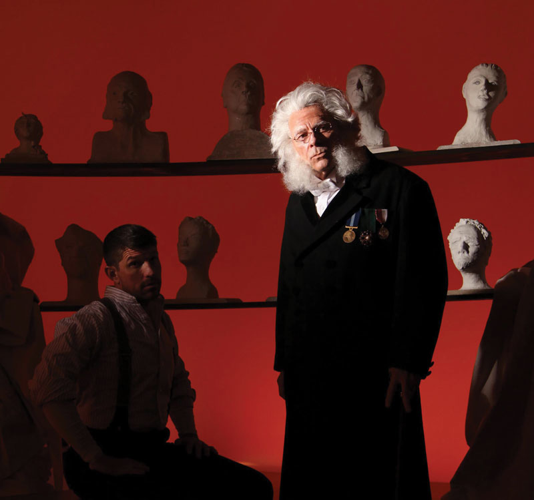

Photo: Michael Scott Evans
Playwright Doug Wright’s Posterity, now on the boards at TPAC, is a work that pits two great artists against each other in a revelatory, psychological pas de deux.
Wright’s opus traverses a largely successful path, which will be good news to locals on the theater scene, since Posterity was nurtured during the author’s stint as the Rep’s Ingram New Works Fellow three seasons ago. The payoff here is the Rep receiving the honor of presenting the first regional mounting of the play, following its relatively brief 2015 off-Broadway run.
The setting is Kristiania (now known as Oslo, Norway) in the year 1901, where we’re introduced to the first of Wright’s key personages — Gustav Vigeland, a 32-year-old sculptor with a big career ahead of him. At curtain’s rise, Vigeland is in his studio, fashioning the likenesses of two models, a buff young man and a much older woman, both all-but-completely naked. Enter Sophus Larpent, Vigeland’s agent, a proper gent who has big news but is appalled at the sight of his own cleaning woman posing for his client. He fires her for this social infraction, whereupon Vigeland hires her for himself. Thus is the sculptor foreshadowed: The committed artist exhibiting his easy disdain for convention.
Larpent informs Vigeland that he is being granted the opportunity to sculpt a bust of none other than Henrik Ibsen, the great playwright, now in his 70s and in uncertain health. Vigeland seeks commissions, of course — he’s an artist in need of money, and he’s already suffered the ignominy of his wife and children having left him. But leery of “fatuous public art,” he balks. Larpent horse-trades: Do the Ibsen bust, ingratiate yourself to the local patronage, and the big artistic projects you really want will be within reach. Thus enters the play’s central figure — Ibsen, the father of dramatic realism, and a revered literary icon not only in Norway but the whole of Europe.
For the remainder of the evening, we are in thrall to an Ibsen-Vigeland psychic duel, with the younger man seeking to uncover the older’s character in search of the inspiration to sculpt an image for the ages. Those discussions circle around creativity, the impact of critics (reviled, except when the notices are good), public acclaim — “Fame is an aphrodisiac,” says the playwright — ultimately zeroing in on an artist’s legacy and how he is to be remembered.
In the moments of most tension, Vigeland probes behind Ibsen’s theatrical notoriety, which provokes outpourings of self-recrimination and revelations of a flawed personal life.
If not always charged with emotion — there’s the turgid rhythm of 19th-century formality here — these encounters are nonetheless confidently played by two of Music City’s most respected actors, guided with care by director René D. Copeland. As Ibsen, Chip Arnold adds another epic portrayal to his résumé. Stiffly aged, his craggy visage framed by gray muttonchops, he ably runs the gamut from prideful to humbled to moribund. Patrick Waller’s Vigeland is an energetic turn marked by clear purpose, though pushing his characterization further into darkness might supply audiences with an even more combative — and colorful — edginess.
The supporting cast offers complementary work, led by Bobby Wyckoff as the appropriately mercenary and priggish Larpent. Daniel Mark Collins is the artist’s assistant, Anfinn. He’s certainly the perfect physical specimen, and the same might be said for elegant veteran Ruth Cordell, who as Greta the servant proves to be a courageous model while also sharing a lot of hard-won wisdom via some of the sharpest lines in the play.
Excellent designer Gary C. Hoff captures period authenticity in his sets, first with Vigeland’s arty studio — studded with dozens of busts created for the production by the Rep’s technical staff — and later with Ibsen’s drawing room, where the sculpting process begins, then is overshadowed by the meeting of minds. Trish Clark’s costumes effectively replicate turn-of-the-20th-century Scandinavian style.
As a new work, it’s possible that Posterity might struggle with legacy issues of its own, but it remains a carefully crafted — and wholly actor-worthy — piece. Plus, its portrait of the great Ibsen may also serve to tantalize producers in regional theater circles.
Email arts@nashvillescene.com



Post a comment as anonymous
Report
Watch this discussion.
(0) comments
Welcome to the discussion.
Log In
Welcome to the discussion.
Keep it clean. Please avoid obscene, vulgar, lewd, racist or otherwise abusive language. Comments featuring hate speech or threatening or violent content will not be tolerated.
PLEASE TURN OFF YOUR CAPS LOCK.
Be truthful. Don't knowingly lie or mislead.
Be proactive. Use the “report” link on any comment that violates our comment policy.
Share with us. We'd love to hear your feedback.