


How to Catch a Flying Woman
As a child, Cynthia Harris would sit in her mother’s beauty shop and listen to her mom talk with her aunts. Their voices were all so similar, rising and falling as one and creating a distinct, pleasing melody. More than just pleasant sounds, these everyday interactions signified the community of the beauty parlor — of black women relying on each other for companionship and support, self-actualization and celebration. Those afternoons in the beauty parlor soon drew Harris to the stage.
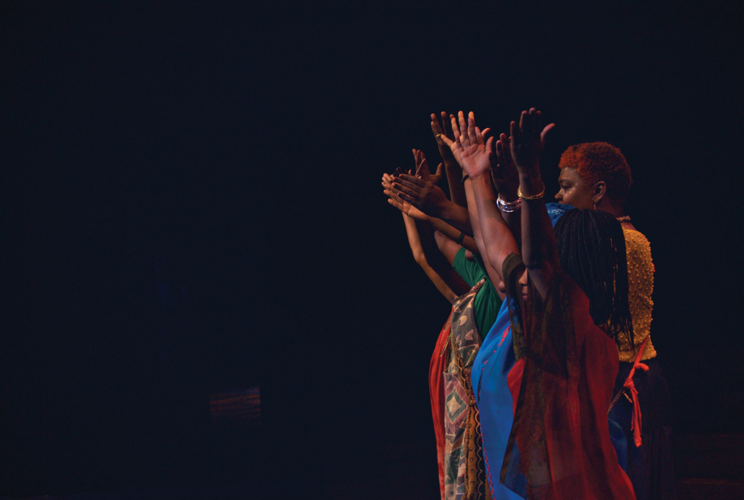
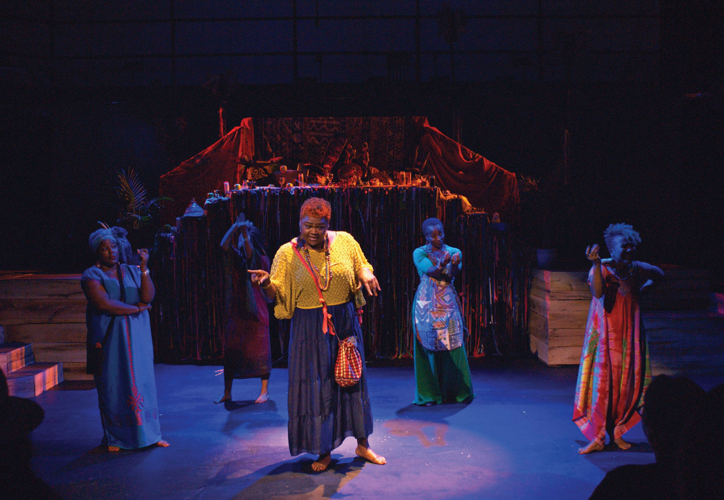
Last year, Actors Bridge premiered How to Catch a Flying Woman, a play written by Harris and fellow cast members OlaOmi Amoloku and Tasneem Grace Tewogbola. The play will return May 25, this time at the Nashville Public Library downtown branch, and entry will be free of charge. Accompanied by performers Amoloku, Tewogbola, Nailah Ajamu and Deyonna Fairbanks-Duskin (N’biyah), Harris plays a woman who is on a journey to self-actualization, braving her own self-doubt and the criticism she sometimes receives from her own community. She’s taking the path of an artist who sets out to “reclaim an essential truth,” Harris says. This is more than an impulse to create for self-expression. Some stories demand to be told, and the artist has little say in the matter.
“When that is your task and part of your walk,” says Harris, “you are a trailblazer, which means if you just think about going through some wooded patch, you’re the one in front with the machete getting the leaves smacked in your face. … But you’re determined ’cause you’re the only one that knows that if we just keep going further on to the other side of this, there’s a big clearing we need to get to.”

How to Catch a Flying Woman
How to Catch a Flying Woman is inspired by Ntozake Shange’s seminal 1976 theater performance For colored girls who have considered suicide / When the rainbow is enuf. With colored girls, Shange coined the term “choreopoem,” meaning a series of poetic monologues that are spoken by various performers and accompanied by music and dance. Harris received the text from her aunt in the fifth grade, and she later performed it when she was a student at Hume-Fogg Academic High School here in Nashville. Like colored girls, Flying Woman embraces the cadence of everyday speech and African American English, with dance and music that’s steeped in African traditions. Last year’s rapturous production was striking in its universality. While the women convey the struggles they face on their journeys, the overwhelming feeling is one of celebration, and it broadcasts important messages about women’s health and wellness.
In her day job, Harris is the director of programs and outreach at the Tennessee Kidney Foundation. Theater and public health have long been the twin passions in Harris’ life. For some, these interests might be at odds — the arts and sciences don’t always play nicely together. But for Harris, letting quantitative data guide public-health intervention strategies is not enough. She sees the need for community-engaged research about the health and wellness of black women that is not divorced from their complex life experiences.
“Each number that we talk about is a person, and each person has a story,” says Harris.
In Atlanta, she worked to research sexual health interventions for young black women, and she found that the challenges women face in juggling jobs, family, partners and systemic racism affects the wellness choices they make. That may seem like an obvious assessment, but it’s one that is difficult to measure quantitatively and often overlooked in public health research. But Harris found that these very obstacles can also be a source of strength.
“Because we find ourselves in certain socioeconomic spaces, [that] doesn’t make us less human.” says Harris. “It makes us sometimes craftier and more brilliant, because we have more stuff to negotiate and navigate on a daily basis just to get the same basic needs met. … For centuries, we have been taking whatever fuck was in front of us and making it beautiful and special and as magical as possible so that we can still retain a sense of celebration for life.”
Flying Woman addresses the issue of self-care and rest for black women, targeting the notion that resting is selfish, lazy and unproductive. By societal standards, says Harris, “[a black woman] should be producing and executing and serving and pacifying and entertaining us at all times. But that is true for every woman — that expectation that comes with that gender assignment that we be nurturing and supportive and caring, and somehow we have all this extra energy to give.”
These expectations are internalized, says Harris, and women judge themselves when they need rest. Women need what Harris calls “beloved community” to catch them when they fall. In Harris’ family, her mother and aunts provided critical support to one another. In Harris’ own adult life pursuing public health and theater, she’s had to forge a path much like that of her character. It can feel solitary at times, and support from other women has been vital.
“It didn’t take a lot,” says Harris, “but just a small little crew of girls in my life who are like, ‘We see you. And if you sit in that tent alone, we’re gonna have a tent next to yours. Keep walking. We got you .... trust the vision that you see that’s beyond what we can grasp.’ ”
The result is a bold, restorative vision of health and wellness with a simple, radical agenda: Help women soar.
All tickets to the free performance have been reserved, but go to actorsbridge.org to reserve a spot in the overflow room and on the wait list.



