

A recent article by Reuters blogging editor Felix Salmon pondered whether Andy Warhol's work was being overpriced at auctions through the use of a tactic known as irrevocable bidding. What followed was a tour of the money-grubbing underbelly of the art world as Byzantine and fraught with shady implications as an examination of the finer points of hedge fund speculating. The queasy relationship between cash and creativity may have been summed up best by W. Somerset Maugham: "Money is like a sixth sense without which you cannot make a complete use of the other five."
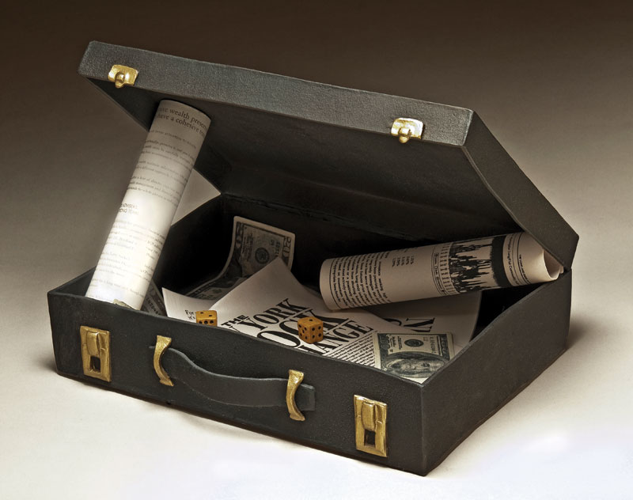
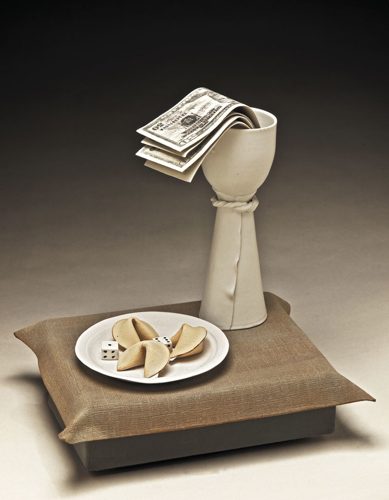
The topic of money in art is addressed both literally and conceptually in Sylvia Hyman's current show at Gallery One. The exhibit, which also features Jeff Faust's surrealist paintings, includes almost 20 new trompe l'oeil ceramic works by the 94-year-old artist, and about half of them deal with monetary concerns: economic crises, greed and the problem of assessing value when it comes to art. These pieces are identified through Hyman's typically playful titles: "Stash of Cash" offers up a lady's bedroom drawer full of money while "Drawer of Dreams" presents a dark wooden desk drawer filled with stacks of greenbacks. The best pieces in the show resonate with film noir tropes. We'd like to slip "Economic Collapse" — a battered briefcase bursting with bills — into Tracey Snelling's Frist Center installation Woman on the Run (sort of a faux whodunit movie set), just to see if anyone would notice.
The other pieces cover familiar Hyman territory, mimicking letters in baskets, perfect pens and pencils displayed with studied nonchalance, and the exquisite MAD magazine replicas we've coveted since we first discovered her work — Alfred E. Neuman smiles from their covers as if to say "Gotcha!" to the next viewer who is shocked to discover the sculpture isn't a magazine at all. (So much for that fold-in on the back cover.)
Without making too much of a woman's age, it's worth noting that Hyman has been creating art for nearly half a century. While she started out doing more traditional work, her well-known trompe-l'oeil style took hold when she noticed that porcelain fired at very high temperatures could be made to resemble paper. Hyman paired the discovery with stoneware clay techniques that allowed her to mimic wood and marble. (Her faux corrugated cardboard is our favorite texture.) By screen-printing on the wet clay surfaces, her "paper" becomes crossword puzzles, rolls of sheet music, stamped envelopes and, yes, MAD magazines.
Of course, upon closer scrutiny, Hyman's illusions don't hold up. The wood surfaces aren't really wood at all, and the undersides of some of the dollar bills are as blank as a derivatives trader's conscience. The fire-cured ceramic whites on the MAD covers sparkle like beach sand, and the postcards are just a little too thick. This is as it should be. Any magician depends on the element of surprise to pull off a real abracadabra, and every illusion requires a willing accomplice — the audience wants to be amazed. We didn't realize just how spellbound we were until we stopped ourselves from picking up an actual fashion magazine upon leaving the gallery for fear of snapping off a corner.
Hyman's work is so enchanting, in fact, that it seems she is something of a sorceress. Perhaps many artists eventually acquire similar powers. Perhaps it's a reward for such a long and active life. Call us in another 50 years. We'll let you know what we've come up with.
Email arts@nashvillescene.com.



