
Art galleries are in the business of selling art. But a couple of times a year Cumberland Gallery owner Carol Stein stages a show for which she says, “I don’t expect many sales.” Her purpose: “to get people to think.” With Intelligent Design, Stein intends to get people to think about the intersection of art and architecture.
Stein got the idea for the exhibit during a brown-bag brainstorming session with her staff. “We talked about artists who take points of reference from architecture,” she says. The next step was to join these artists—Michael Greenspan, Cheryl Goldsleger, Terry Thacker and Dan Gamble—with some architect companions. Stein says she picked Nashville designers Seab Tuck, Kem Hinton, Manuel Zeitlin, Stephen Wells and Robert Anderson because they still use hand work in their renderings, a definite minority in this computer age. The result is a show that’s less a coherent statement about the relationship between art and architecture and more a wide-ranging visual discussion of the process of using geometry in form-making.
The grouping of pieces by Terry Thacker illustrates the complete process cycle, featuring everything from conceptual doodles to finished paintings. In the latter, biomorphic forms rub shoulders with geometric shards, and bright pigments bump up against more muted tones. The effect, particularly in “Untitled #7,” is a heightened and abstracted version of a Western landscape seen from 30,000 feet.
Paintings by Dan Gamble present the armature of structures spiraling in a void. In “Stem,” the world appears to be emerging from chaos—or descending into it. “Twilight” recalls those “city of the future” visions popular in the 1920s and ’30s, but with a post-apocalypse hangover.
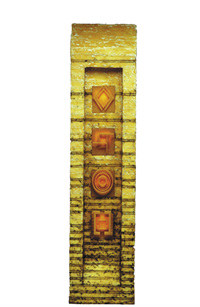
In his artist statement, Michael Greenspan describes his work as “a two-dimensional interpretation of a three-dimensional interior or exterior space.” Because Greenspan employs fresco technique, layering a variety of media—beeswax, pigments, enamel, pastel—over plaster-veneered wood panels, his paintings are like mini walls, rich with the history of the artist’s exploration of line as generator of space. Through the layers, you can glimpse ghosts of a ground plan or landscape. Tensions are carefully balanced within each painting: between precise geometry and the obviously handmade (drips of pigment that look like blood), between arc and square, between glossy and matt finishes, between surfaces both smooth and pockmarked. It is unfashionable to talk about beauty in art these days, but Greenspan’s works are the most serenely beautiful in the show.
Among the artists’ work, Cheryl Goldsleger’s pieces are the most clearly “architectural.” Taking as her point of inspiration the works of historic and current women architects, she creates encaustic and resin reliefs—scored and colored geometrically—that rise from the gallery walls. In the series “30-36 Wagonaar Strasse,” she presents a simple four-room structure evolving from an enclosed to open space. And in the masterly “Slide,” archaic building forms rest in an encaustic-covered wood trough.
The works by architects range from literal renderings of projects (Stephen Wells) to abstract explorations of form (Manuel Zeitlin). Those by partners Kem Hinton and Seab Tuck fall somewhere in the middle.
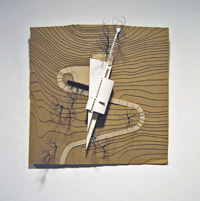
Hinton’s and Tuck’s works are either conceptual studies for unbuilt architecture or drawings of actual structures. Tuck’s “Study Model for Runyon/Atkinson Residence” is the only model in the show. Instead of being placed on a tabletop, as would be typical for an architectural model, the piece is mounted on the wall, turning architecture into sculpture and revealing strong intersecting geometries that, at one end of the home, create what looks like a ship’s prow.
In the unbuilt category, Hinton’s “Defiance (Proposal for the Flight 93 Memorial in Rural PA)” illustrates a dramatic series of glass shards that suggest not only the tragic path of the plane into the ground but the passengers’ resistance to their captors.
The drawings of actual projects are a tradition for the partners, made as gifts for clients after design is completed. Each serves as a visual summary of the project, explicating its symbolism, and often includes a collage of the various elements presented in a perspective unavailable in life. Tuck’s “Brooks Fiber Properties, St. Louis,” for example, presents different facades to illustrate how a fenestration pattern spells out the name of the company in Morse code. Some drawings are “star is born” architectural dramatizations, with rays of light beaming into skies of heightened, often otherworldly color.
Despite the integrated nature of the partners’ approach to building design, their respective drawings reflect distinct differences in character. Hinton’s works are clearly drawings, crisp and precise, with clear color contrasts and each black dot carefully controlled. Though they’re also drawn, Tuck’s images are more painterly, with impressionistic touches.
If Goldsleger’s art is the most architectural work among the artists, Manuel Zeitlin’s is the least architectural among the architects. Last summer Zeitlin began studying printmaking at Watkins College of Art and Design. “When I studied architecture at Washington University, other art forms—we did prints, woodcuts—were considered an important part of our design education,” he says. “I love taking the class because it gets me back into all that.” His six polyester lithographs in the show record his progress as a student. Mounted in shadow-box frames that reveal the deckled edge of the paper, the black-and-white studies illustrate the process of “starting with the line, developing some intersections, and then allowing accidents to happen,” the architect explains. The “accidents” take the form of smears and splatters that come off the lines; ink infills suggest darker and lighter moods. “The way I make prints is the way I like to design architecture,” Zeitlin says. “I never start with a preconceived notion, but work intuitively, which sets up the chance” for the unexpected to happen.
What happens in Intelligent Design is not a clear and logical connection between what are, after all, two quite different occupations. What the show exposes, rather, is the design process itself—how the hand starts with a simple line and from it makes a visual world.



