


"Still Life With Sheet Music"
[Editor's Note: On the occasion of his solo show More Works About Tables and Food, opening tonight at Lipscomb's Hutcheson Gallery, we sent artist Rob Matthews a list of questions about his work, where he finds inspiration, what he thinks makes a good art scene and more. The opening begins tonight, Jan. 25, at 6 p.m., and will be on display through March 11.]
Your exhibit at Lipscomb is titled More Works About Tables and Food — why are those subjects so interesting to you?
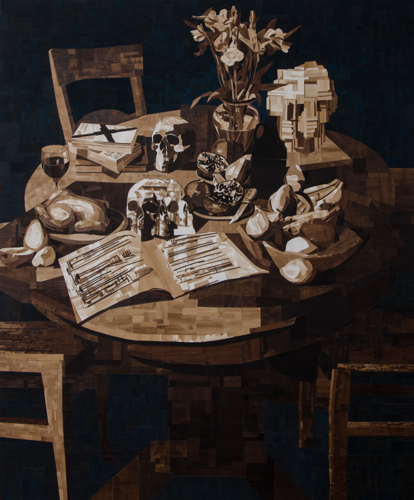
Still life is like painting — it is constantly declared dead and is overlooked, but it keeps going and people find a way to address it in a new way. It’s had a nice revival lately with people like Holly Coulis, Jonas Wood, David Korty and a few Morandi shows here and there.
I am drawn to these subjects for similar reasons that most still life has been made: mortality and experimentation with form. A lot of Western still life is rooted in death, which I focus a lot on in my work. I also use a lot of objects in my work, and sometimes you just need to look at something somewhat isolated, and find a new way to visually express it before you insert it into a larger idea.

"TBD"
What do you think makes a good art scene?
A good scene should ask this question: "Are you in New York or L.A.?" If the answer is “No,” then don’t try to be a smaller version of New York or L.A. Figure out what your identity is and build on that rather than ignoring what is there. Trying to manufacture something out of nothing is how you end up with Las Vegas. The cities that don’t always look like they are trying to play catch-up interest me more than cities with a second-city complex.
By the same token, don’t try to build an art scene and then wonder why the money in the area didn’t show up to buy the work. You have to build an art community and also build an art-collecting community. Get ’em hooked while they’re young. Set your prices relatively low and encourage young people to start collecting early. In theory, as they become more successful in their careers and have more money, they will want to spend more on art. I sound like a Philip Morris executive.
That aside:
- Gangs of like-minded artists who can honestly critique one another and help out one another. If you want to just hang out, drink beer and have other artists tell you that you’re good, join a band. If you want to get better as an artist, let your friend tell you when you are making bad work.
- Large studio buildings for artists to work in and be in dialogue with one another. It helps to have hubs and gathering places … preferably near good coffee, beer and tacos.
- Institutional support for local artists, such as a dedicated exhibition space for rotating local shows. Regional museums should help put a spotlight on the region.
- Galleries that show both local and national/international artists and also go to art fairs to take the show on the road. Art fairs are big checks to write though, so I understand why some galleries cannot do it. Everyone complains about art fairs, but it’s like complaining about going to the dentist — it helps to go so someone can check you out. You can have a show in Nashville for a month and have it seen by 300 people, or you can have work in Miami for a weekend and have it seen by 5,000. Do both, if possible.
- For an emerging or “small” scene, a mix of thoughtful criticism and cheerleading. I think it’s OK to be a champion for a scene until it has some stability. Don’t be the parent telling their 4-year-old that they aren’t good at soccer. Respond thoughtfully to good work. It might be best to not write about bad work rather than just cutting off an emerging artist at the knees. We’re all trying to get better.
That’s probably a longer answer than you wanted.

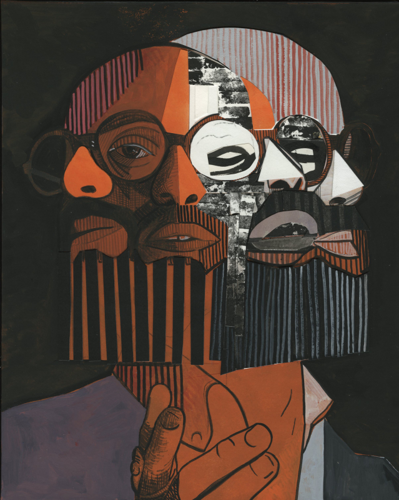
"Study for Prophets"
What's the last art show that you saw?
I have not had time to get out since the two January art crawl weekends. So, according to how my night went, the last show I saw was Daniel Holland’s at Red Arrow.
What's the last art exhibit that surprised you? Why?
Merrilee Challiss’ show at Julia Martin. I did not know much about her before the show and had no expectations. It floored me. It’s great to still be taken off-guard after looking at art for two decades.
What's your favorite place to see art in Nashville?
Alicia Henry’s piece at the Music City Center. I don’t know why. Normally it is quiet and it feels like you stumbled upon a masterpiece that everyone else just walked by. There are tables and chairs, so you can sit and think on it for a while. Plus it fulfills the formula for proximity to coffee, beer and tacos.
Where are you finding ideas for your work these days?
The news, which may sound like a “duh,” but that’s kind of new for me. I’m thinking of the refugee/migration crises around the world, but mainly Syria and south of our border. The work doesn’t look much like that because I am wary of “illustrating” a situation and the work usually ends up allegorical, for lack of a better word. My art immediately became less introspective when ISIS beheaded 20 Coptics and a Ghanan on the coast of Libya last February. I have a show at David Lusk in April/May that will be rooted in this subject matter.
What work of art do you wish you owned?
The Morgan Library has a preparatory drawing that Albrecht Dürer made for his “Adam and Eve” print. That one drawing fundamentally changed the way I looked at my art-making, and I still look at it on my computer all of the time. Fortunately, I’ve been able to see the actual piece on multiple occasions, ignoring people clearing their throats in an effort to get me to move away from it.



Post a comment as anonymous
Report
Watch this discussion.
(0) comments
Welcome to the discussion.
Log In
Welcome to the discussion.
Keep it clean. Please avoid obscene, vulgar, lewd, racist or otherwise abusive language. Comments featuring hate speech or threatening or violent content will not be tolerated.
PLEASE TURN OFF YOUR CAPS LOCK.
Be truthful. Don't knowingly lie or mislead.
Be proactive. Use the “report” link on any comment that violates our comment policy.
Share with us. We'd love to hear your feedback.