
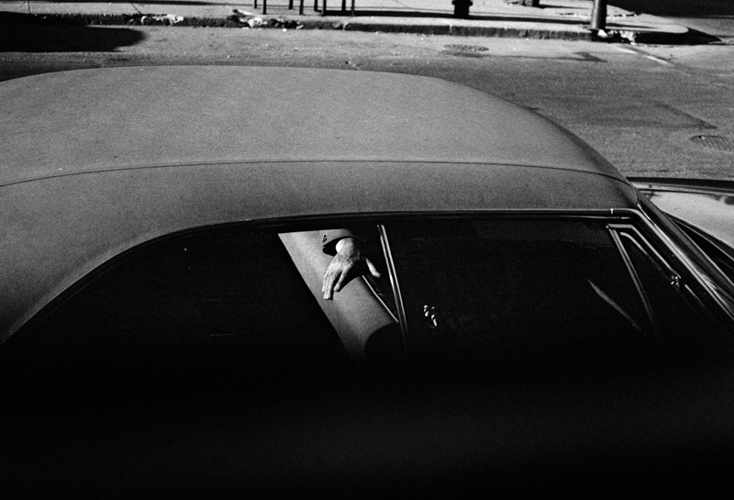
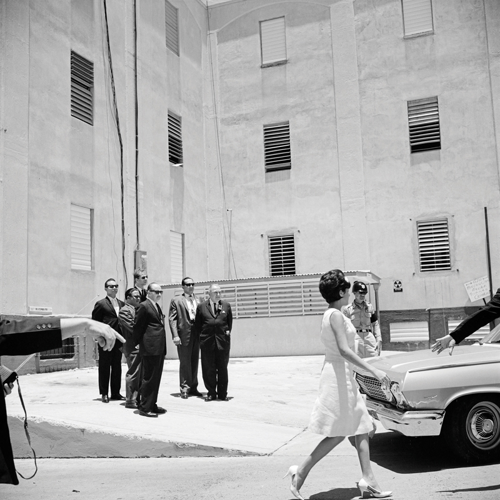

Very few art-world superstars have risen to critical acclaim and public attention as quickly as the late photographer Vivian Maier, and the exhibit of her work currently on view at Sherrick and Paul Gallery should act as a primer for those unfamiliar with her, and might very well serve as a pilgrimage site for those who are.
It's hard to talk about Maier without also talking about John Maloof, the man who, for all intents and purposes, discovered Maier's work and controls a large chunk of her estate, including the photos on display in this exhibit. In 2007, Maloof won a lot of the unknown photographers' negatives when he bid $380 on them in an auction house near his Chicago home. Later, when Maloof developed the negatives, he saw that they were unusually good — so good, in fact, that some critics have said Maier's images redefine the history of street photography. The discovery of her work, especially told from Maloof's perspective, adds a sheen of accessibility to the photos themselves — it's as if Maloof is an art-world American Pickers or Storage Wars star, and if you're smart and really lucky, you too can scoop something up that will bring you fame and fortune.
It's tempting to imagine how differently the story would go if it were told from Maier's perspective. Would Maier have been OK with the fact that, when she fell behind on rent in her storage facility two years before her death, a stranger bought 30,000 negatives and now her name is often spoken in the same utterance as Diane Arbus and Walker Evans? It seems unlikely — most of Maier's acquaintances who were interviewed in the 2014 documentary Finding Vivian Maier said she would have been horrified by the fame and attention. Would critics have praised her work as resolutely as they have if she'd been in control of exhibitions like these? Perhaps. But we'll never know.
What we do know is that the photographs Maier left behind are often brilliant, and the exhibition of 32 shots at Sherrick and Paul, several of which are on view here for the first time, are proof. A 1954 photograph of a woman lying on the ground in Central Park is a great example of how the mystery around Maier adds another level of intrigue to her work. The woman in the shot might have only been napping, the straps of her handbag still around her arm, her sandal off and a paperback book by her side. But it seems just as likely that this is a crime scene — the book is ominously titled When the Gods Are Silent, and there's just as much dirt and gravel in the spot where she's lying as there is grass, making it an unusual location for a daytime nap. Then you imagine Maier behind the lens, closing in on the woman like a creeping voyeur, unable or unwilling to tell the story behind the photograph.
There are also plenty of self-portraits in the Sherrick and Paul exhibit, and these insert the mysterious photographer directly, and often playfully, into the shots. Seven of the 32 photographs show Maier in reflection or shadow. In a shot from 1957, it seems like Maier has stood in front of a storefront mirror with her camera ready, waiting for a woman with a cinched-waist dress and spectator pumps — holding a cigarette and looking at Maier and her camera with a furrowed brow — to come into view. A shot from 1954 shows Maier's reflection in a toaster, and one from 1956 shows an almost imperceptible Maier in the reflection of a chrome ashtray.
Examining Maier's work is almost like imagining the intentions behind prehistoric cave paintings — no matter how convinced we are that those rhinoceroses in Chauvet, France, are spiritual symbols, the fact is we have nothing to contextualize them and will never know with complete certainty why they were made. If we were to ask Maier the story behind her photographs — why the man is on his knees on an outdoor staircase in one of the gallery's photos, or what the nature of the relationship was between the man and woman fighting outside a storefront in another shot — we might be better informed, but we'd also risk ruining the mystery around Maier's work, and that's a significant part of its appeal.
Vivian Maier is a perfect storm of populism. Her work is consistently good — a fact underscored by the contact sheets Maloof has published — and the story of her mysterious life is better than the plots of a lot of movies. In a 2014 review of Finding Vivian Maier, I wrote, "She is not a marginal artist — her work could, in 50 years, be part of photography's canon." Seeing her work in person, the quality of the prints and the range of work available, solidifies that claim. If anything, I'd say Maier is firmly nestled in the greater canon of modern photography already. It only took a lifetime of hiding her work and a chance discovery to get there.
Email arts@nashvillescene.com



