
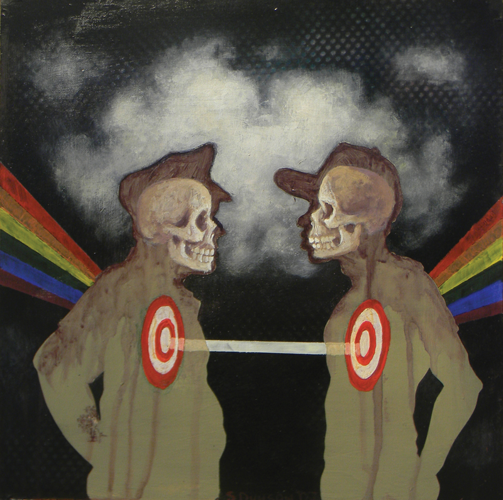

If you told me that an art show at Rymer Gallery featured a piece called "24-Hour Noose Network" — three swaths of khaki-colored fabric hanging ceiling to floor like nooses that are also neckties — I might tell you that's a pretty on-the-nose metaphor that doesn't give the audience much room to come to its own conclusions. And I might not be wrong, but I'd be missing the point. Sam Dunson's Lack History isn't trying to engage its audience with a nuanced understanding of some esoteric story — it's pissed off and shouting. That's the mark of Dunson, an artist who holds back on subtlety in favor of making sure his point is clear.
Dunson, who is also a professor of studio art at Tennessee State University, speaks about the subject of his work — the misrepresentation and mistreatment of African-Americans — with a warmth that might seem to mask his intensity, but which often underscores how ordinary incidents of violence against African-Americans have become. For him, it culminated with reports of the shooting of Walter Scott, a 50-year-old South Carolina man who was shot in the back eight times as he fled from a police officer after a traffic stop.
"This work came out of the anger that I was feeling," Dunson tells the Scene, "that I literally wanted to burn away everything that could be found from that point, and start something new."
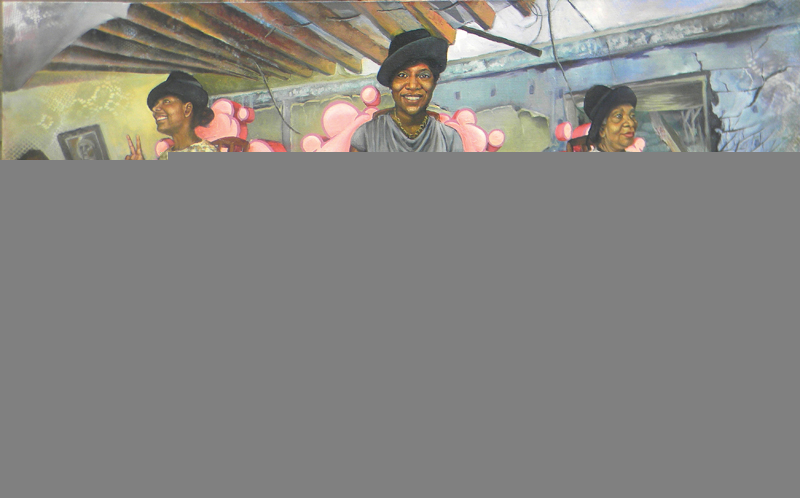
Lack History includes a few canvases that were also part of Dunson's Meet the Fergusons exhibit at Vanderbilt's Divinity School in the fall, and in many ways those works are the exhibition's highlights. Two 27-by-44-inch canvases are situated at the end of the gallery like the head of a household sitting at the end of the table. In "Domestic Relations — Momma," three women sit in straight-backed dining chairs in the foreground of a surrealistic tableau; bubblegum-pink graffiti clouds surround each woman like the halos of a saint, and the room they're seated in crumbles and deteriorates behind them. "Domestic Relations — Daddy" is similar, but with male figures in place of the females and the destruction behind them much more serious. The paintings' signage expounds on their meaning: "In order to see and perceive the destruction in the background, you must look past the family in the foreground." Dunson isn't using graffiti imagery to put urban quotes around his subject matter — he's building a new iconography of African-Americans, and he's asking his audience to look deeper as well.
"It's all about the idea of lacking a history," he says, "and what does life look like if we were to burn everything away and start over?"
The news-nooses might not seem groundbreaking or original, but don't think Dunson is pandering with his symbolism. The nooses aren't nudging you to get a joke — they are emphatic cries for attention.
Email arts@nashvillescene.com



