


"The End of Time"
When an exhibition shows work of a high technical caliber, you could call it successful. When it shows work that's conceptually sound, that's another mark of success. And when it gives you ideas to chew on about current world events, you know it's solid work. Rob Matthews' Dawn-Watchers Watch for the Dawn at David Lusk Gallery could check off boxes in all three of these categories — a rare feat. But great art isn't just about checking off boxes, and Matthews' exhibit appeals to the part of your brain that's drawn to pretty candy-colored arrangements just as much as it does to the chin-stroking intellectual portion of your mind, and that's what makes it the most exciting exhibit by a Nashville-based artist I've seen so far this year.
Matthews is known for his precisely detailed graphite drawings, but like a vocalist who eschews melisma to make room for musical innovation, he here trades pencil and paper for enormous canvases — his largest in more than a decade — and a color palette that grabs you, soothes you and compels your eyes to linger. The deeply symbolic work is less of a departure, since Matthews has long incorporated religious and art-historical imagery into his works, but with Dawn-Watchers the symbolism gets specific: It deals with martyrdom, war and the growing number of refugees from Syria and elsewhere.

"Auto Auto Harp Harp"
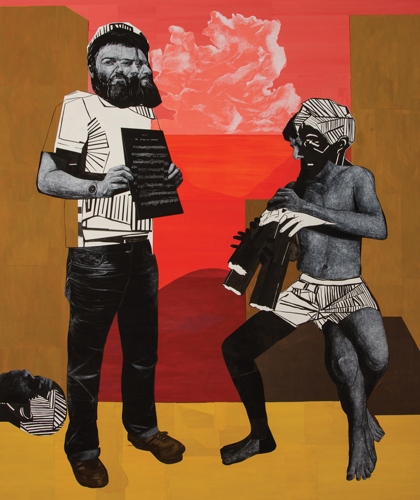
The first thing you'll see when you walk into the gallery is "The End of Time," an 81-by-69-inch canvas hanging on the wall that divides the gallery's front and back, which has become Lusk's de facto showcase for the strongest work in any given exhibition. This time is no exception — the piece's striking red background and two impeccably rendered black-and-white figures make it the most immediately captivating work of the show.
The painting, which is actually an ink-and-gouache work on paper that's been attached to canvas and stretched over wood supports, borrows its composition from Picasso's "The Pipes of Pan" — a bold reference, perhaps, but it fits right into Matthews' art-history-heavy palette. A figure in a captain's hat (art-loving Nashvillians may recognize the model as printmaker Bryce McCloud, who is a longtime friend of Matthews') holds a piece of sheet music as a seated man beside him plays. Both figures are so well-defined that the works almost seem like mixed-media pieces with hyper-realistic drawings that have been pasted onto the painting — but the cross-hatched formations are the result of Matthews' ultra-fine white brushstrokes on a black background.
Still, the symbolic details weigh even more heavily on the work's overall effect. For example, the sheet of music references French composer Olivier Messiaen's "Quartet for the End of Time," a composition Messiaen wrote during his time as a prisoner of war during World War II. The piece itself, which was played for the first time in the prison camp by an orchestra composed of Messiaen's fellow prisoners, references the biblical book of Revelation. In the bottom-left corner of Matthews' work a person's head is seen in profile — a seemingly out-of-place element that recurs in several other works in the exhibition. The head is based on that of Matthew Ayariga, a Ghanan — some reports say that he was from Chad — who in 2015 was decapitated in Libya by ISIS alongside 20 Egyptian Coptic Christians. The color-blocked red of the painting's background is meant to suggest the Mediterranean's blood-red sea.
Once these details are uncovered, "The End of Time" becomes something of a Rosetta Stone for the entire show — an enormous black-and-white work called "Same Stars, Different Beds" repeats Ayariga's head, and the subjects of each of the smaller works suddenly become clear: The artist has cut all the heads from their bodies. If there's a downside to Dawn-Watchers, it's that the works make the gallery's secondary exhibit, Ted Faiers' Scene Paintings From the 1940s, so uninteresting by comparison that I'd completely forgotten about it before I left the gallery.
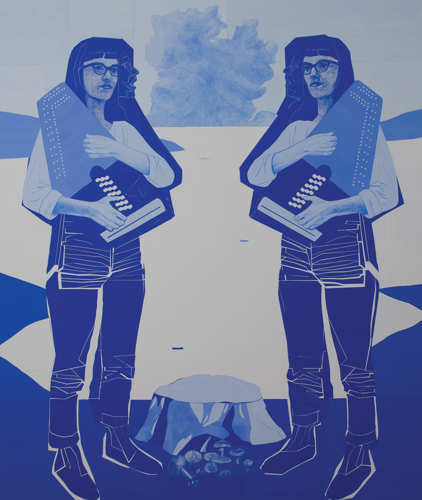
The image you'll likely see as you leave the gallery is a kind of accompaniment to "The End of Time," and in many ways helps bookend the show. "Auto Auto Harp Harp" is a mirror image of a woman representing singing sirens (who, again, art-loving Nashvillians may recognize as artist Elizabeth Williams), each strumming an autoharp, each serenely prepared to greet visitors from the shore. It's a hopeful turn from "The End of Time," with a monochromatic canvas of blue and white that reverses the first piece's blood-red, and takes a likewise hopeful turn on the events depicted in the exhibit.
Hopefulness, after all, is embedded in the show's very theme: The exhibit's title is borrowed from a translation of Psalm 130 that refers to hoping for God more than the dawn-watchers watch for the dawn.
Email arts@nashvillescene.com



Post a comment as anonymous
Report
Watch this discussion.
(0) comments
Welcome to the discussion.
Log In
Welcome to the discussion.
Keep it clean. Please avoid obscene, vulgar, lewd, racist or otherwise abusive language. Comments featuring hate speech or threatening or violent content will not be tolerated.
PLEASE TURN OFF YOUR CAPS LOCK.
Be truthful. Don't knowingly lie or mislead.
Be proactive. Use the “report” link on any comment that violates our comment policy.
Share with us. We'd love to hear your feedback.