
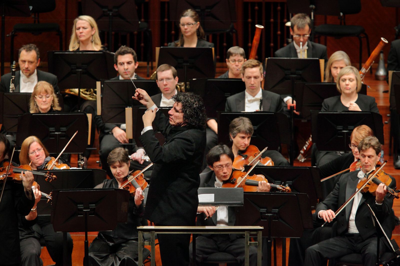


Giancarlo Guerrero
Giancarlo Guerrero has a well-known appetite for contemporary American music. And yet for his program this weekend with the Nashville Symphony Orchestra, he’s limited his menu to a handful of 19th century European favorites. The audience that filled the Schermerhorn on Friday night must have been craving this repertoire du jour, since they heartily cheered the maestro when he first stepped onstage.
The concert opened with a pleasant enough hors d’oeuvre, Rossini’s Overture to the Barber of Seville. Guerrero’s account of this short eight-minute curtain-raiser, which cartoon fans surely recognized as Bugs Bunny’s theme from the Rabbit of Seville, had just about everything: color, suspense, urgency, vitality. All that was missing was a little humor, a touch of light-heartedness — important ingredients, to be sure, for a comic opera (not to mention a Looney Tunes soundtrack).
[page]
It seemed significant that Guerrero conducted the next piece, Brahms’ Symphony No. 3 in F major, without his usual baton. Instead, he used his flexible hands to coax succulent phrases from his expressive musicians, allowing the score to unfold organically, as if it were chamber music. The approach rightly emphasized the lyrical qualities of Brahms’ most intimate orchestral work. It is, after all, the only one of his four symphonies that ends quietly, without heroic fanfare.
After intermission, Guerrero concluded with a theatrical rendition of Richard Strauss’ Don Quixote. This sprawling tone poem, lasting nearly 50 minutes, seemingly uses every conceivable orchestral color and sound effect (including a wind machine) to convey Cervantes’ classic story.
Guest cellist Johannes Moser played the score’s extensive solo cello part (Don Quixote is practically a cello concerto), intended to evoke the title character. Moser was thoroughly entertaining in this role, wielding his bow like a broadsword during fast passages, playing with luminosity during quieter moments. Principal violist Daniel Reinker was just as effective in his part, his polished playing easily conjuring the humorous spirit of the don’s sidekick Sancho Panza.
Guerrero and his musicians, for their parts, provided the soloists with a luxurious bed of sound. Their playing was beautifully balanced, colorfully detailed and utterly transparent. It was also blazingly virtuosic, which is exactly what you’d expect from a first-class Strauss orchestra. The program repeats at 8 tonight at the Schermerhorn Symphony Center.



