
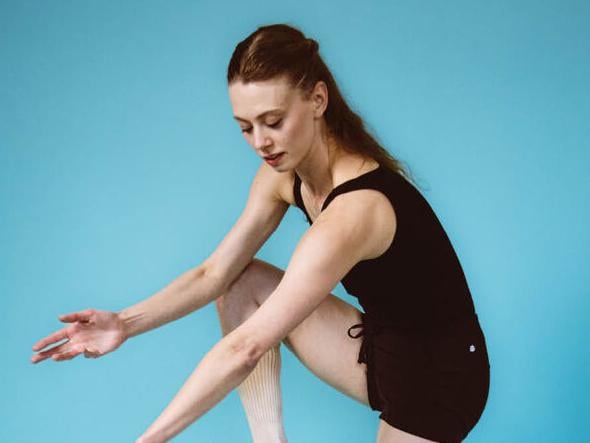
Becca Hoback — the independent contemporary dance theater performer, choreographer and producer — will be debuting Rapt, a new full-length work, on Thursday, July 23, at OZ Arts as part of a trio of new dance performances presented by the Kindling Arts Festival. In advance of that performance, she spoke with us about new movements, inspirations, art grants and more.
You have a very distinct way of moving and performing that mixes fluidity and intensity. How are you using your movements to convey this work?
In the first scene of this piece, the contrast of fluidity with rigidity and sharpness is going to be amplified in a way that I have not really explored before. There's a lot of sudden, sharp, sort of aggressive motions, and a lot of tension that I'm carrying in the body. Throughout the piece, there's this unraveling that happens, and slowly but surely we move into something that is much more of a soft body state. Much more flowing and fluid, but in a way that still carries a sort of integrity in the body.

The ninth annual festival will take place July 23 through 26 across Nashville
Is this piece more of an improv score or set choreography?
Yeah, I think there will be sections that I improvise a bit, but under a very specific kind of improvisational mode or state of tension or zone. I think depending on how you define choreography, some might consider it fully choreographed. But there are still going to be moments where the movement that I do each night will be different, even if the zones that I'm working through look very similar. I do like to have a clear and sort of crafted map.
On the Kindling website, the blurb about your piece says: “Becca Hoback fills the stage with her riveting presence, transforming herself from a defensive, almost predatory creature to one that is soft and free.” Did you have any specific imagery in mind when creating the movements?
There is a lot of inspiration that I'm drawing from birds. I have a little sweet green-cheeked conure that we adopted about a year ago, and just observing her silly little body language that is sometimes so sweet and soft and beautiful and natural, and then sometimes it is so extreme and performative and defensive. It's kind of bizarre and funny and cute, but also a little scary from the outside. That's a place where I'm drawing some movement inspiration from.
In an Instagram post, you posted a photo of yourself in front of the statue "The Fountain of the Fallen Angel," in Spain, and wrote: “This statue made me think of the parts of me that I haven’t found the space to forgive. Where do you go from there? How do you recover? How do you continue?” What was the process of exploring those questions like?
To be honest, I'm still in the midst of it at this point. I will say that, in the past, I've dug into some pretty personal subject matter. I think to really engage with the personal creative process is also a mental practice — a physical practice, certainly, but a mental and emotional practice of learning how to let yourself into those feelings, experience them, and then also create a sort of ritual or gateway out of those feelings as best as you can. And each time it has to be a different process, because there isn't one formula that works every single day to get you into that zone of processing.

Talking to Banning Bouldin and Becca Hoback about moving contemporary dance forward in Nashville
Rapt was supported, in part, by a Foundation for Contemporary Arts Emergency Grant. Can you tell me why it was important for you to receive it?
It goes such a long way to being able to bring the work to life in a way that is more fully realized, especially as a solo artist. But just having these funding opportunities and receiving the Foundation for Contemporary Arts Emergency Grant, is bringing this piece to life in a way that I think will allow it to be more broadly accessible and applicable.
Rapt is making its debut at the Kindling Arts Festival, but what's next for the piece? Where do you think it will live?
I would love to be able to bring it somewhere in Europe, preferably Spain, so that my collaborators can experience it live. I also am curious about engaging with film. And I think this could be a really striking work onscreen. I feel like I'm in real time processing some of the themes and ideas that I am engaging with. I hope it has a life beyond Kindling, but right now that's the whole focus. I'm super grateful for the platform that Kindling gives me and other local artists to be able to share.



Post a comment as anonymous
Report
Watch this discussion.
(0) comments
Welcome to the discussion.
Log In
Welcome to the discussion.
Keep it clean. Please avoid obscene, vulgar, lewd, racist or otherwise abusive language. Comments featuring hate speech or threatening or violent content will not be tolerated.
PLEASE TURN OFF YOUR CAPS LOCK.
Be truthful. Don't knowingly lie or mislead.
Be proactive. Use the “report” link on any comment that violates our comment policy.
Share with us. We'd love to hear your feedback.