
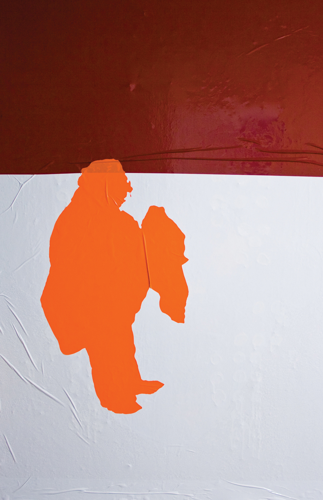
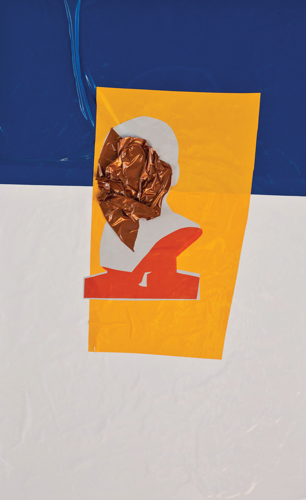

Walking into the vast two-room exhibition of new work by Nashville artist Lain York, you'd be forgiven for thinking the longtime abstract painter had taken a turn toward the narrative. The primary-colored cut-vinyl panels depict figures engaged in various activities. But look deeper into the layers of built-up paint that have made humps and crevices beneath the slick plastic wrappings and you'll see that the entire piece is more like a collection of palimpsests than a straight-ahead silhouette. Selections From the National Gallery is a collection of new works that York made as a kind of conversation with art and art history. But these works aren't about historical events — they're about the way we tell history.
"A number of my colleagues work in paper, and I became interested in using the vocabulary of painting with materials other than paint," York says. "I think that's where the vinyl came from. It was the next logical step — I'm looking at the painting, and I'm throwing all of these things out, but what happens when it gets this final treatment that would be a wrapping? What if, by wrapping the piece in vinyl, it was holding some of those things in?"
Each painting's title seems needlessly wordy. For example "A Man of Sterling Ability (Something Should Be Done About This)" is a single orange caricature silhouetted against blocks of white and red reminiscent of a can of Campbell's Soup or a pack of Marlboros. The figure is overweight in the kind of unself-conscious way men were in the days when wearing a well-fitted suit was au courant — think of Winston Churchill, Alfred Hitchcock, even the bartender in Casablanca. ("He's as honest as the day is long!") He has a long string of snot falling from his nose, and it too is rendered in a tasteful silhouette form.
According to York, the title and even the figure itself aren't quite afterthoughts, but they're not far from it, and they were definitely not York's top priorities when he was making the piece. What this collection is really about is compressing all the information York sets down with his paint — the rhythmic action of pounding dots into the surfaces at intervals of three, four and five at a time — underneath the tight surface of vinyl. The wrinkles give the panels the same kind of purposeful imperfection as the drips that litter an abstract expressionist's canvas. Those elements of piling thoughts on top of thoughts, references and influences like a chart layered on itself instead of graphed out for others to read — that's the kind of vocabulary York prefers to work with. And no wonder: As the longtime director of Zeitgeist, one of Nashville's most respected commercial galleries and a cornerstone of the studio community for longer than just about anyone else in town, York knows a thing or two about being surrounded by art.
He enunciates words carefully but speaks quickly, and has a dry humor that sometimes makes you question whether you understand the verbal winks he gives — short pauses after certain sentences to let you catch up with his train of thought. Part of the reason he's so interesting as an artist is that you might not immediately peg him as one — he seems too jockish, like a high school gym teacher. But start talking about Cy Twombly or Jean-Michel Basquiat and you'll soon realize he thinks about art at the advanced level of someone who's been at it for decades.
"I was collecting scraps from various sign companies I'd been working with through the gallery," York says of his materials' previous lives as utilitarian colored vinyl. The original purpose for the vinyl can be seen just around the corner from the National Gallery series — the title wall of the Frist's main exhibition Looking East showcases an ornamental pattern, like a big Japanese medallion that covers the space. Like office supplies for exhibition designers, the large sheets of vinyl are used for museum signage, letters across windows and car decals, and it turns out they make beautifully tight wrappings for layers of built-up paint on York's canvases.
York was approached by Frist curator Mark Scala after he'd seen work some of York's work Zeitgeist. The surfaces of those pieces were based around the life of John Adams, whom York was reading about at the time. But the panels beneath the vinyl were filled with imagery York found in museum catalogs of African masks or Oceanic art. And to hear York tell it, the process of melding the two concepts together had more to do with auto mechanics than art history — specifically, York says, rat rods.
"I know nothing about cars," York says with a sideways glance, like he's setting up a rabbit hole of personal thought process. "But rat rods are are when someone takes an '86 Cadillac body — one of those really ugly Cadillacs with those funky trunks — and chops it way down low, like to the level that you'd have to get on your hands and knees to even get in the thing. And it's all about speed and aesthetics. It's this ugly, efficient machine.
"But I started thinking about how that sort of related to what I do as a painter — it's this kind of excavation. I started going back through layers: Here's a layer from 1996, here's a layer from 1974, here's one from 1931 — and that's what those old cars kind of looked like."
His artistic references, York says, are like his own personal excavation of what happens when a cultural record is unearthed. "I mean, how much do archaeologists really know about what happened?" York asks. "What would it look like if a thousand years from now, somebody unearthed the National Gallery of Art? And they're pulling things out, pulling out a Monet. Would they think he was an indigenous painter? What about a Chippendale vanity? What are people going to say about that? What does the historic record really say about John Adams? Those guys were really pretty funny. That's the main thing missing from the museum record — where's the humor?"
Take a closer look at the "Man of Sterling Ability" with a nose full of snot and a fancy kerchief in his hand. That appears to be Lain York's comment on history: Dig through the margins of the history books for long enough and you're bound to uncover a few dirty jokes, or at least a line of snot that's sticking the pages together.
Email arts@nashvllescene.com.



