
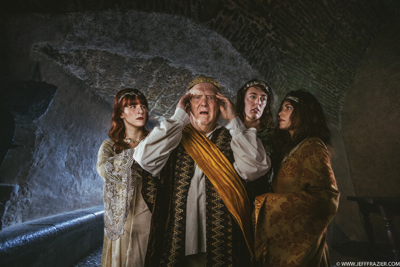
The plot summary of King Lear easily competes with the complex machinations of any prime-time soap opera. Move the story from ancient Britain to, say, 1980s America, and you'd have a saga worthy of the Ewings of Dallas or the Carringtons of Dynasty. The main action involves the contentious disposition of the legacy of a ruling family, plus there is a welter of subplots featuring conniving spouses and black-hearted siblings and also several honorable persons who are not necessarily rewarded for their integrity.
In the end, Lear grants us a pileup of corpses and two or three laudable survivors, and all things considered, a decent amount of satisfaction — the kind of satisfaction that explains why some of us love the Bard's tragedies above all his works. Because that's where the action is.
Nashville Shakespeare Festival ushers in the new theatrical year with a salutary version of Lear — serviceably clear on the details, generally intelligibly communicated, and featuring enough professional-level performances and directorial ideas to send us out of the theater with renewed positive feelings about the play, which is not routinely mounted anywhere these days.
To some degree, director Denice Hicks appears to want to brighten up the script's inherent darkness, with touches that include an opening and closing parade of cast members, who practically frolic to Pam Atha's step-in-time choreography. This device serves to first introduce the players, then later provide the structure for a nifty curtain call. In addition, after all the script's internecine challenges and family destruction, Hicks resurrects the deceased Lear and daughter Cordelia for a warm posthumous embrace, a moment that could've been stolen from a Hollywood fantasy.
Yet these anomalies don't ruin the big moments: Lear's inexplicably capricious wrongheadedness, which sets things in motion; the betrayal of greedy, lustful daughters Goneril and Regan; fair Cordelia's return from France; her father's wandering madness on the storm-swept heath; and the culminating bloodbath via grotesque torture, poison and cutlery. It's all here in a well-paced two-and-a-half hours.
There is no Lear without a commanding Lear, and veteran thespian David Landon, while not breaking any ground in the role, is a representative aging monarch who has trusted foolishly and failed to read the hearts of his own children — then goes over the edge in classic tragic fashion. Landon's Lear perhaps seems more avuncular worrywart than combative victim, but it's a firm reading and a sound interpretation.
Some very strong performances support Landon's steady effort, including Brian Webb Russell as the loyal but gullible Gloucester — deceived by nefarious son Edmund and later horrifically defiled — and David Compton as another loyal subject, Kent, whose honesty is rewarded with banishment but who returns to faithfully serve his king.
Santiago Sosa's Edmund is sufficiently detestable, his evil matched by the goodness of Matt Garner as his brother Edgar, and Craige Hoover, as Albany, emerges as a kind of surprise hero late in the proceedings. As the Fool, Becky Wahlstrom garners our attention with her cartwheels but not so much otherwise, her sarcastic humor and ill-fated fealty to Lear registering with muted power.
The critical roles of Lear's daughters are portrayed competently by three veteran actresses. Even so, Shannon Hoppe as Regan and Nettie Kraft as Goneril might actually ratchet up the malevolence in their characterizations, especially since it's doubtful they'd risk overstatement. As for Amanda Card as Cordelia, her one-dimensional take short-changes her character's virtue, not only as it contrasts with her sisters' selfishness, but also as it relates to the blessed nature of her reunion with her father. There is directness in Card's approach, but little in the way of inspiration or nuance.
The show's technical contributions are expectedly excellent. They include Paul Gattrell's functional set pieces, June Kingsbury's regal period costumes, the evocative projection designs of Sam Lowry, and David Wilkerson's fight choreography, which enlivens the Edgar vs. Edmund duel. Rolin Mains' percussion-driven underscoring throughout becomes a welcome dramatic element — performed with the assistance of percussionist Ryan Blihovde and veteran cellist/violist David Vanderkooi.
As for Hicks' overall direction, it is movement-conscious and visually gratifying. Yet given the occasionally confounding upstage echoes of Troutt Theater, it is always better, always clearer, always more immediate in the scenes played furthest downstage, where the audience can more readily grasp the language, which is some of Shakespeare's best.
George Bernard Shaw once wrote, "No man will ever write a better tragedy than Lear." NSF provides that craftsmanship a fair airing in a respectable production whose strengths outweigh its weaknesses, and where "vile things" are certainly made precious.
Email Arts@nashvillescene.com



