
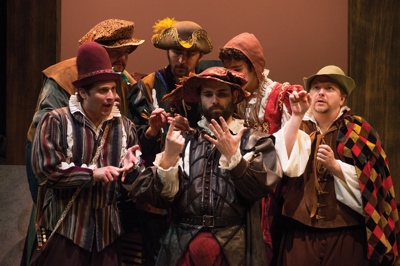
Cole Porter's "Brush Up Your Shakespeare" is a catchy show tune from Kiss Me Kate. Its message is a fitting one for any theatergoer first experiencing Tom Stoppard’s Rosencrantz and Guildenstern Are Dead, now onstage in a full-bodied production at Nashville Rep.
While the brilliance of Stoppard's writing is never in doubt, the piece — even for all its japery and penchant for evoking laughter — still strikes me as elusive as it is inviting. Which is why it probably helps a lot to have a working familiarity with Hamlet, the source of Stoppard's inspiration and, of course, his title characters, plucked from the famous tragedy (and literary obscurity) and elevated to a profile almost equal that of Vladimir and Estragon, Samuel Beckett’s iconic tragicomic clowns from Waiting for Godot.
It is noteworthy that the great W.S. Gilbert had already written the satire Rosencrantz and Guildenstern in 1874, wherein the duo plots to be rid of their "friend" Hamlet, so one of them can marry Ophelia. In this small regard, Stoppard's alienated heroes are somewhat standing on the shoulders of one giant, though where Stoppard takes them is a place all his own.
I'm sure that "boning up" on Hamlet — like operagoers familiarizing themselves with librettos that will be sung in Italian — can't hurt those prepping for the R&G experience. However, those with hard-earned knowledge of the play over time will have the strongest advantage, since so much of the story's humor and perspective rely on irony-steeped observation of the tragedy's action and characters.
Rosencrantz and Guildenstern are bit players turned protagonists — sitting on the sidelines of a great drama, offstage, biding their time. We view their confusion with Hamlet's story and their obvious disconnect with their roles, and as the play rolls on by, our heroes ponder things — like probability, death, deductive reasoning, fingernails vs. toenails — and engage in constant wordplay and occasional personal gibes. In fact, the twosome otherwise seems to float on an existential cloud that resides somewhere between reality and play-acting, though never devoid of awareness of Hamlet's melancholic situation. (He's "stark raving sane," they conclude.)
While the Waiting for Godot analogy rings true enough, there are also many strong moments where the play's connection to theater of the absurd seems trumped by lowbrow banter reminiscent of Abbott and Costello's "Who's on First?" routine. Yet there's accessibility in those moments, as there is in the notion that Stoppard channels a comic spirit that is tethered to the manic energy of Monty Python, the surreal British comedy ensemble that broke internationally only several years after this work brought Stoppard to the wider attention of the world.
Over three acts, performed in two, the challenging silliness continues. Stoppard's ripest bon mots reference actors and theatrical culture, and while the play moves forward, R&G head toward the end that Shakespeare plotted out for them, and they continue to uncover philosophical truth amid their random exchanges.
We owe much of this production's success to Patrick Waller and Matt Garner, whose performances as R&G strike me as precision-crafted and extraordinarily assured. They are a deft comic team, and they are supported immeasurably by the commanding Jacob York, who returns to the Rep after a memorable performance in 2013's Importance of Being Earnest. York's turn as the Player is a high-class job, and includes riveting delivery of his character's inspirational Act 1 speech. Also very good as Hamlet is Matthew Rosenbaum, who gets a lot of mileage from even an oblique glance or a raised eyebrow. John Mauldin makes his Rep debut a successful one, as a well-spoken Polonius with presence. The remainder of the cast of 13 excels under Rene Copeland's consistent direction.
On the technical end, the production is a high-quality, pull-out-all-the-stops affair, with a beautiful set designed by the inimitable Gary C. Hoff and some of house costume designer Trish Clark's finest work, which captures the spirit of any marvelous Elizabethan Hamlet but looks especially rich in the leather, boots and capes of the leading men and the elaborate gowns of the ladies (Shelean Newman as Gertrude and Rep newcomer Delaney Keith as Ophelia).
Nashville has seen little of Stoppard's work onstage in the recent era with the exception of Arcadia, which was well-produced in 2011 by Blackbird Theater. But there are other intrigues on his resume, and local artists might be encouraged to seek them out.
Nashville Rep also recently announced the principals for the 2015-16 Ingram New Works Project. Veteran dramatist Rebecca Gilman will serve as the playwriting fellow. Her play The Glory of Living was a finalist for the 2002 Pulitzer Prize, and Boy Gets Girl, possibly her best-known work, was produced locally by Actors Bridge Ensemble in 2003. The playwrights working under her mentorship are Jonathan Alexandratos, Helen Banner, Edith Freni and Kyle John Schmidt. The Rep's playwright-in-residence and director of the New Works Lab is Nate Eppler. This season's festival of staged play readings is scheduled for May 4-14.
Email Arts@nashvillescene.com



