
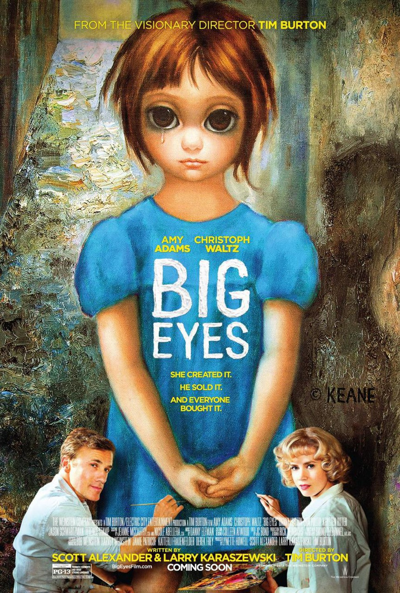

Before there was Thomas Kinkade, there was Margaret Keane. In many ways, she was the originator of kitschy garbage art sold to the mass public via posters, postcards and coffee mugs. But instead of saccharine cottage scenes, Keane’s commercial art empire was built on images of pitiful waifs with pancake-sized eyes. Her cutesy paintings of sad kids were, and still are, awful — but the story behind them, which is the subject of Tim Burton’s latest film Big Eyes, is irresistibly compelling and kind of insane.
Don’t be fooled, Big Eyes is not a film about the art world — or about art at all, really. It’s a film about fear and betrayal and redemption — normal stuff; the protagonist just happens to be an artist.
The movie tells the true story of Margaret Keane (played by Amy Adams) and her manipulative husband, Walter (played by Christoph Waltz), who takes all the credit for her famous “big-eye” paintings during the late 1950s and ’60s. He turns her into his one-woman painting factory, hiding her away in a home studio where she paints for years on end while he hobnobs and sells “his” artwork to the masses. By the late ’60s, Walter has become a monstrous success and, apparently, a full-blown sociopath. They eventually divorce, Margaret reveals herself as the true “big-eye” painter, sues Walter, takes credit for her work, and finally receives the recognition she so rightfully deserves.
Fun Fact: Within the first few minutes of the movie, Margaret tells a job interviewer that she studied at Watkins Art Institute in Nashville. As it turns out, the real Keane is indeed from our fair city and studied at Watkins in the late 1940s where her big-eye style began to develop.*
If you’re like me, perhaps you saw the trailer and groaned, “Why why why Margaret Keane?! Yack.” But of all the artists Burton might have chosen to make a film about, it makes sense that he chose her. For one, he is known for having an appreciation of “bad” art and the strange minds behind it. And two, Burton doesn’t have the authority to make a super-serious art film about a super-serious artist — that’s not his thing. What he can do is tell a stranger-than-fiction story about a creepy man who pretended to paint his wife’s creepy kid art. And he does it well. It’s a grown-up story told in his signature dark-and-playful style. Still, it bums me out to see terrible art get that kind of cinematic spotlight. C’est la vie.
Fortunately, the movie doesn’t attempt to vindicate Keane’s work; no one comes around to liking or acclaiming the paintings. Terence Stamp plays New York Times art critic John Canaday who derides the paintings onscreen, proclaiming, “It’s an infinity of Keane, which makes it an infinity of kitsch!” An uppity art dealer played by Jason Schwartzman rolls his eyes at her work from beginning to end. Even Walter, as their marriage begins to crumble, insists she “crossed over from sentimentality to kitsch.” In the end, the round-eyed waifs are never defended as being “good paintings,” just her paintings.
As for my recommendation: Wait to watch it on Netflix, but definitely watch it. Not because of its art-related value, of which there is little, but because it is a pretty good movie about adults with blinding fears of both failure and success. Also because Krysten Ritter, aka Jane from Breaking Bad, is in it and she’s a total fox.
*Don’t worry, Watkins now offers an excellent anti-kitsch course taught by art historian Tom Williams entitled “Kitsch: Democracy, Modernity and the Politics of Taste.”



