

Writer-director Scott Teems has seen his share of films made about the Southern experience by natives and outsiders, both during his time as a film student at Georgia State in Atlanta and during his professional career. While he's been encouraged by some of the films, many others he's found shallow, unconvincing and even embarrassing. When it came time for Teems to make his first feature, he was determined not to repeat the mistakes he'd seen in other productions.
On Friday, audiences can see for themselves whether he succeeded when his debut That Evening Sun opens in Nashville. The booking follows the movie's successful showing at last year's Nashville Film Festival, where its star Hal Holbrook also received a Lifetime Achievement Award. As if to settle any doubts, last month the Southeastern Film Critics Association gave the film its Gene Wyatt Award, named for the late Tennessean critic and awarded to the best film each year about the South.
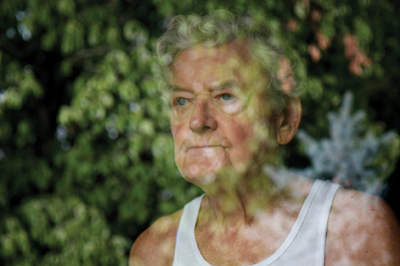
Teems adapted the work from a short story by Tennessee novelist William Gay, who took his title from the most famous blues tune in history, W.C. Handy's "St. Louis Blues." The film spotlights a battle of wills between edgily retired farmer Abner Meecham (Holbrook) and alcoholic, down-on-his-luck malcontent Lonzo Choat (Ray McKinnon), who now occupies the farm that Meecham once owned. Tricked out of the property by his son (The Shield's Walton Goggins), Meecham escapes from a nursing home, takes refuge in a shack on the property, and begins a systematic battle of wills with the hated Choat.
The resulting tussle between Meecham and Choat, played to the hilt by Holbrook and McKinnon, provides ample fireworks and drama. Yet the somewhat surprising conclusion also holds out the hope of redemption — a turn that's in itself a rebuke to Southern Gothic cliches. Teems credits the 84-year-old Holbrook with much of the film's credibility and authority.
"He's a genuine American treasure, someone whose life experiences alone bring so much weight to any role he takes," Teems says in a phone conversation. "I was determined that we were going to tell this story in a substantive way. It was important that these characters not be stereotypes or that anyone comes across all good or all bad.
"Hal has a way of seeing things in a script and then communicating them in so many different and unusual ways. Many times he would make little suggestions or do unexpected things in the filming that worked because he's got so much experience to draw from and utilize."
To tell this complicated story about aging, generational conflict and class issues, Teems says, he convened Holbrook, McKinnon and Goggins before filming. Their wide-ranging input concerned everything from the contours of the characters to their rural accents, the downfall of many a Southern saga.
"We had a lot of discussions about getting the language right, making sure that the accents didn't sound forced or exaggerated," Teems says. He explains that he wanted audiences to see Meecham and Choat in shades of gray rather than black or white — a move co-star McKinnon enthusiastically endorsed.
"I really wanted to bring some depth to a character whom it's easy to just dismiss as another white redneck," says McKinnon, himself a writer and director. "It's very easy in these times to go overboard in either direction. You try to be politically correct, and you strip away any sense of reality. You make him too one-dimensional, and then people just hate him without understanding anything about him."
McKinnon believes Teems and That Evening Sun are part of a groundswell of Southern artists in many disciplines who are bringing new artistic vitality — and veracity — to the region's representation.
"Scott was very careful not to strip away the quality and the integrity from Mr. Gay's story," McKinnon says. "It's part of what I feel is a whole new movement coming out of the South that involves writers, actors, poets and performers, and spotlights the experiences of everyone from African Americans to rural whites and even Native Americans. That Evening Sun to me represents that ethic, and all of us wanted to be sure that we were faithful to that feeling and that ethos."
Perhaps more important to Tennessee's film industry, the movie was shot in Knoxville with a regional crew whose members came not only from East Tennessee but also Nashville and Memphis. The credits include familiar local names such as second assistant camera Tracy Facelli — good news at a time Tennessee is scrambling to compete with fire-sale incentives packages in Michigan, Georgia and elsewhere.
"We also had to be very careful about what we spent and how we spent it," Teems says. "Virtually every penny that we got you see on that screen. We were determined to shoot it in Tennessee even though this state doesn't provide some of the tax incentives and other things that others do for filmmakers. But there's a natural quality to East Tennessee that was ideal for the movie, as well as the landscapes and the buildings. "
Teems, an Atlanta resident, says he has no desire to become a specialist in either Southern or family films. But he adds he's not opposed to doing more stories similar to That Evening Sun.
"I'm in the business of telling stories, and there are many great stories out there in today's South that can make great movies," Teems concluded. "The most important thing is having something to say and a great cast to work with, and I really think that's what makes That Evening Sun special. We're just hoping that people in Nashville and other places where it's opening wide will also enjoy it and help it reach the wide audience that I think it deserves."
Email arts@nashvillescene.com.



