


Beau Travail
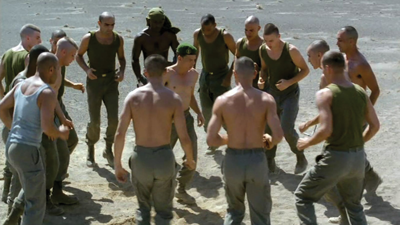
One of the Belcourt’s virtual offerings — opening Sept. 4 — is a new 4K restoration of Claire Denis’ 1999 film Beau Travail. It’s an exquisite ballet of flesh and fury that takes the foundation of Herman Melville’s Billy Budd and crafts a scintillating drama about social structure, military taxonomy and why men are like that sometimes. Seeing an opportunity to discuss the film with one its most passionate admirers, I decided to try something a little different for this week’s installment of my ongoing streaming-recommendation series: I contacted friend and colleague Dave White, co-host of the Linoleum Knife film podcast (linoleumknife.libsyn.com), to dig deep into this captivating and sweaty jewel.
For more streaming options, look back at the many scores of recommendations we’ve offered in this space over the past five months: March 26, April 2, April 9, April 16, April 23, April 30, May 7, May 14, May 21, May 28, June 4, June 11, June 18, June 25, July 2, July 9, July 16, July 23, July 30, Aug. 6, Aug. 13, Aug. 20, Aug. 27.
Jason Shawhan: I first encountered Billy Budd in high school English, and we watched the Ustinov film in class, and it was the first time I ever watched something and realized that even though we were watching the same thing, my straight classmates and I were not seeing the same thing. I loved the queer power of the story; it was the inverse of A Separate Peace.
Dave White: Oh God, A Separate Peace. The preppiest high school closet literature. We went straight into Moby Dick in my 11th-grade English class, so I didn’t read Billy Budd for the first time until about five years ago, after seeing this film several times and seeing the opera. Upon reading it I realized just what a loose, almost tangential adaptation Beau Travail really is. I think the queerness of Budd is actually more explicit than the camera’s gaze in Beau Travail, even though we’re still being served quite a bit of buttock flex and choreographed grapple-hugging. Once you’ve witnessed the sheer quantity of muscular, half-naked men in this film, and the homosocial world that’s been constructed for them, what you realize is that the conflict itself might very possibly contain the element of closeted queerness. But it’s also strongly about a man, in this case Sgt. Galoup (Denis Lavant), feeling abandoned, betrayed, by his chosen father, Cmdr. Forestier (Michel Subor), and needing to destroy the new object of that father’s affection, Sentain (Grégoire Colin).
JS: It’s the Wilde quote from “The Ballad of Reading Gaol” about each man having to kill the thing he loves writ across the sands. And Grégoire Colin as Sentain isn’t just respected by Forestier, it’s that he transcends the hierarchies Galoup defines his life by.
DW: And that’s the point. He’s quiet, which everyone always mistakes for mystery. More importantly, he is good, which I think is at odds with the traditional reputation of the French Foreign Legion. People think of it as a repository for the exiled, the last chance after doing something very wrong. When Galoup talks about there being a “trash can” inside everyone, it’s as though he was trying to find that in Sentain and couldn’t.
JS: Nobody does textures like Claire Denis. There’s something about when she and cinematographer Agnès Godard are working together that registers with the eyes and the soul differently than most other movies.
DW: She has a lot of gorgeous Djiboutian landscape to work with here — that juxtaposition of the desert and the ocean and these outpost ruins, populated by the stark human contrast of soldiers and then the people who live there just staring at them with detached curiosity, or even amusement. The colonizers and the colonized are also integral to this story, these men training, training, training to be on alert for a battle that’s already over. They’re inhabiting the shells of structures that used to mean something. And more than that, they’re all inhabiting a historical structure that affects everyone’s psychology and behavior.
JS: Denis having grown up in Cameroon, it makes sense that her films are always focused on the impact of colonization (see also: White Material, Chocolat ’88, Trouble Every Day, U.S. Go Home). This was my first of her films, and I found it fascinating how the critical discourse at the time was having to aerobicize its language into shape to address perceived homoeroticism as rendered through a woman’s vision.
DW: I remember that, and I remember at the time thinking that male film critics, most of whom are not queer, always think of the camera as male. And that would mean that this was a queer male gaze, very much like in Derek Jarman’s Sebastiane (streaming now on FlixFling and Kanopy), a film that shares a lot in common with this one and was explicitly gay. Beau Travail, though, is very much the vision of a team of women (whose sexual orientations I don’t know) who are presenting a highly aestheticized idea of the male body in motion and the political ramifications of those specific bodies in that specific space. At this point in history, post-Stonewall, now that many queer people are speaking freely about our lives in public, I think we see any male physical contact as homoerotic, and cisgender heterosexual men are often socialized to feel quite uncomfortable with that. It becomes the overriding takeaway.
JS: This new restoration is really something. I’ve seen this movie on 35mm film twice, but the majority of my viewings have been from an unfortunate home-video edition that was ... let’s just call it messy.
DW: Same. I’ve been fortunate enough here in Los Angeles to see it a few times on a big screen, always in that 35mm format, and that’s a wonderful privilege. But I agree this restoration is stunningly gorgeous and crisp, and it doesn’t feel like it’s been power-washed into something uncanny and difficult to look at. There’s a really perfect balance. But in every film they work on together, Denis’ and Godard’s collaboration — along with editor Nelly Quettier here and in several other Denis films — there’s a visual language that foregrounds itself. You remember images and human movements that feel powerful even more than you might remember spoken dialogue. I feel that way about filmmakers like Tsai Ming-liang as well. I’m thinking of the final scene in his film Vive L’Amour, where a woman simply cries uncontrollably for about five full minutes, or people dancing in Denis’ 35 Shots of Rum, or especially the final scene of this film, which is also entirely a dance.
JS: This was the movie that made it essential for film critics to understand the language of Eurodisco. In the intervening 20 years and change, I remain amazed by how often being a lifelong disco person has allowed me a way into some deliciously impenetrable art cinema. You wouldn’t think the greatest hits of Boney M. could be a denominator for rigorous and uncompromising work, but it is.
DW: I’ve read so many reviews of this film, even entire pieces solely about this final scene, where Corona’s “The Rhythm of the Night” is described as something unsettling or tacky — not only because it’s a sudden blast of upbeat music after a film of such dreamy quiet and rigid masculine sobriety, but because that’s how critics generally love to talk about any electronic dance music, whether it’s vintage disco or more recent house and techno. It’s dismissed: It’s pop music whose audience is largely women and gay men and that makes it worthless in the eyes and ears of so many … dudes. Of course the human movement in this film is very dance-like, even when people aren’t dancing. And the cues in this film are just really specific and meaningful: excerpts from Benjamin Britten’s opera Billy Budd, Neil Young’s “Safeway Cart,” and then “The Rhythm of the Night.” So we’re not talking about just carelessly throwing any old song into the action. This song functions as a hugely emotional moment. It’s Galoup’s final reward, his freedom, his release, even if we don’t explicitly know if he’s even still alive.
JS: I don’t think I’ve ever asked this before. But my favorite Denis is Friday Night. And sometimes Trouble Every Day, because I love that she helped define the New French Extremity. What’s yours?
DW: This one. I also love The Intruder because I’m a glutton for punishment.



