
Virtually from the beginning, I have actively despised the cinema of Todd Solondz. His 1996 Sundance winner Welcome to the Dollhouse struck me as an exercise in sadism, humiliating an adolescent misfit (Heather Matarazzo) for ostensible black comedy. Champions of Solondz's follow-up, 1998's Happiness, an ensemble piece following a roundelay of miserable, wounded, toxic characters, claimed that the film displayed humanistic sympathy for child molesters, obscene phone callers, and weak-willed, non-self-actualized "losers." For my money, however, Solondz offered little more than a parade of contempt. "Look at all the pervs," Solondz cried out, with the conviction of a bona fide truthteller, "lurking beneath the rooftops of New Jersey." But here's the thing: Solondz has become a major American auteur, garnering as many plaudits as detractors. Improbable as it may seem, Todd Solondz has a posse.
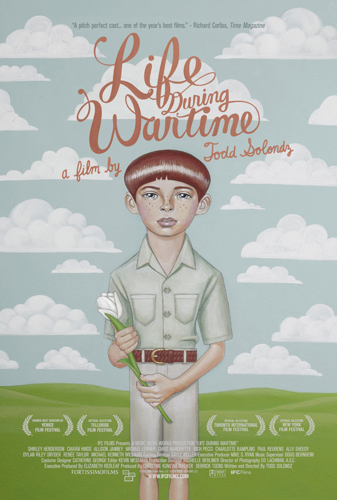
Which brings us to his latest. Overall, I did not like very much of Life During Wartime, but I think I have a new perspective on some of the things that Solondz is attempting as a filmmaker. I still don't find them altogether successful — in fact, some are flawed in the extreme. But they are more striking, and perhaps less misanthropic, than Solondz's most aggrieved detractors may care to admit.
Like his recent films Storytelling and Palindromes, Life During Wartime is a structural experiment. The new film is a follow-up to Happiness, but with all new actors. Unlike most sequels, it takes account of the actual time that has passed, in our world, between the two films. Wartime treats Happiness as its touchstone, an anchor point against which everything in the text has to be evaluated.
This goes beyond simple "doubling," because the connections frequently exceed the boundaries of both films. By casting Michael K. Williams as the "new" Allen, we're not just asked to compare him to Philip Seymour Hoffman playing the same sad-sack crank-caller in Happiness (although we certainly do). Solondz is also activating our intertextual knowledge of Williams as the character Omar from The Wire, a black gay outlaw defined by both his code of ethics and his inability to find a place within the social order. Replacing Jon Lovitz's jilted boyfriend from the earlier film, Paul Reubens is the "new" Andy, no doubt, because of everything Reubens represents: "Pee Wee Herman" and his sad, pointless fall from grace at the hands of a judgmental society. And so it goes. Rather than presenting a closed diegetic world in which all relationships are internally linked and any problems posed are solved within its own parameters, Life During Wartime is a film that consistently gestures outward.
Life During Wartime is in part a treatise on the meaning and possibility of forgiveness. By giving us examples from well beyond the pale — child molesters, or in a question posed by young Timmy (Dylan Riley Snyder), the 9/11 terrorists — Solondz asks whether real forgiveness can only be proffered in the face of the unforgivable. Sadly, Life During Wartime articulates this worthy question in the baldest, most philosophically naive terms imaginable. Timmy throws down a productive challenge as to whether terrorists and perverts are the same, but the characters in the film and Solondz himself are unprepared to tackle this conundrum. The ideas just come across as immature, and the obvious value in Wartime's overall project is pretty much scuttled by the cheap shots he almost reflexively takes at the easy targets he himself puts in place. It destroys Solondz's credibility.
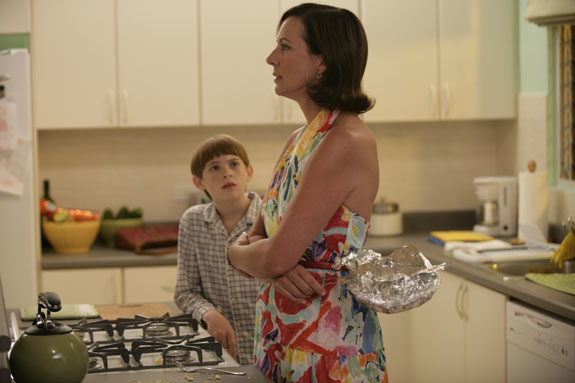
What's frustrating is that, even in the midst of his sneering at the suburban dimwits (now relocated to Florida), Solondz zeroes in on truth. Trish (Allison Janney), the ex-wife of a pedophile, has become so fearful of perversion, both sexual and sociopolitical, that she has made the status quo into a twisted fetish. As Trish enthuses about her new boyfriend, "We had sex and it was so . . . normal!" This messed-up state of affairs results in the film's best scene, in which a genuine act of tenderness — one of few — paradoxically becomes misread as something perverse. Which, during the "wartime" that encompasses Solondz's bleak view of the human lifespan, it quite possibly is.
Email arts@nashvillescene.com.



