


What’s black and white, speaks Hungarian, and is 37,204 feet long? Don’t look now, Nashville, but it will soon be in your midst.
It is a phantom, a behemoth that only a comparative few have ever glimpsed. People have driven hours to see it and emerged half a day later from its company, changed. Some compare its effect to a drug. Others say it has the power to stop time. The harder it has been to see, the more its legend has grown. Spoken aloud, its name practically arrives in a clap of thunder: Satantango!
OK, maybe that’s laying it on a bit thick. But for diehard cinephiles, the arrival this weekend of Hungarian filmmaker Béla Tarr’s 1994 magnum opus—a movie that’s never been shown within 500 miles of Nashville, regarded by seen-it-all moviegoers as a K2-like summit—amounts to the sighting of a blue moon. All but unseen in the U.S. outside a handful of major cities, the film is currently traveling the country in a print secured from Hungary. Its only stop in the entire Southeast will be this Friday through Sunday at the Belcourt.
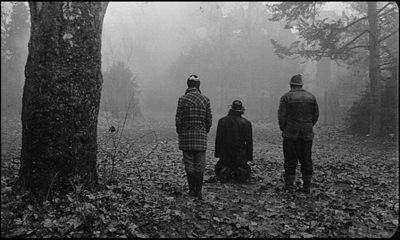
There is no way to describe Sátántangó that won’t make it sound like arthouse flagellation—at first, anyway. So let’s get the punishment out of the way. It is black-and-white (ouch!), subtitled (oof!), shot in glacial long takes (hit me again!) that might spend minutes on end surveying the movement of cows. Ooh, that smarts! Could it get any better? Oh yeah: it clocks in at approximately seven-and-a-half hours—a length guaranteed to scare most theaters away from booking it and most audiences away from seeing it.
And yet here’s Darren Hughes, a Knoxville-based contributor to the online film journal Senses of Cinema, writing at his blog Long Pauses “how excited I was to learn that I would get to see a film I’d resigned myself to never having the chance to see.” Hughes plans to make the three-hour drive east on Saturday, see all 435 minutes straight (plus 40 minutes of intermissions), then drive back Sunday.
Talking outside the New York Dolls show at City Hall last week, James Wilson, an ardent Nashville punk fan in his early 20s, said he hopes to see it twice. Belcourt booker Toby Leonard, who joined a veritable baton relay of film programmers passing the film from New York to Seattle, says he has fielded calls about ticket information from Winston-Salem, from Alabama, even from a New Yorker who missed its rare screening earlier this year at the Museum of Modern Art.
To people outside the few cities where it’s been shown—except those who managed to snag a four-tape set for $360, found an online bootleg or scored a dupe-of-a-dupe-of-a-dupe of the rental copy at Kim’s Video in New York—Sátántangó is known only by reputation. It’s the movie that changed the flight plan of Gus Van Sant’s career, the movie the late Susan Sontag said she’d be glad to see “every year for the rest of my life.” It takes place after the collapse of communism, in a crumbling farm collective populated by an alcoholic doctor, a morose 10-year-old girl and several couples. The return of Irimiás (Mihály Vig), a silver-tongued swindler, brings to a head the greed, betrayal and desperation of the neighbors.
Like Laszlo Krasnahorkai’s source novel, the film is divided into 12 sections whose looping, doubling movements in time are said to mimic the moves of the tango—six steps forward, six steps back. A YouTube clip on the Belcourt’s website gives the barest hint of what to expect: a nearly two-minute take of two men trudging through a bleak townscape, backs to the camera, while what seems to be God’s own leafblower scatters debris at their feet. Are such scenes intolerably self-indulgent, full of emptiness and ugly scenery with nothing happening—the technical term is “boring as ass”—or does their hypnotic, unbroken movement produce an immersive experience, a flow of life unlike anything else in movies?
“I don’t remember if I thought this phrase or if I read it (or dreamt it)...but every time I think of Sátántangó, I think of the idea that [it] isn’t a film, it’s a place you visit,” said Chris Stults, assistant film curator for the Wexner Center for the Arts in Columbus, Ohio. He first saw the film after driving from Columbus to Toronto in the dead of winter, then buying a ticket to a sold-out screening off a scalper. Over the course of the movie’s running time, he said, “you so feel like you’re existing alongside those characters that it’s almost a shock to be back in your normal environs. There’s an amazing section in the third, and final, section of the film where Tarr is able to stop time in a way that I’ve never seen a filmmaker do before. That’s something that you can’t say to entice people to go to the screening, but it’s a beautiful thing to live through.”
“Parts of it are interminable, but there are several hour-long sections in which ‘nothing happens’ that achieve a really mystifying (to me) force and power from the accretion of minute details,” said Mike D’Angelo, a New York-based critic for Esquire and Nerve.com who saw the movie first as a bootleg video, then decided he had to see it on the big screen. No fan of arty European miserabilism, he added, “In any case, a movie like this that I voluntarily saw twice isn’t something you need to be wary of.”
Sátántangó was briefly distributed in the U.S. by filmmaker Rob Tregenza’s imprint Cinema Parallel, but screenings remained few and far between. Over the years, it has become a kind of grail for movie lovers seeking the increasingly rare sensation of something they haven’t seen before. News that the film would be available in a DVD set from Facets triggered mixed emotions among the movie’s champions. As cinephile Zach Campbell argued in a widely read exchange on his blog Elusive Lucidity, DVD would reduce the movie to a collectible—an unopened brick looking cool on somebody’s shelf—instead of an unyielding work that demands (and rewards) engagement on a viewer’s part. What good is a grail you can grab anytime, between bathroom breaks and trips to the fridge?
The question seemed a lot different several months ago, back when there seemed no chance we would get a look any other way at a movie people have alternately described as devastating, enthralling, maddening, irritating and the best of its decade. DVD is a whole lot better than nothing, and the Netflix/GreenCine revolution has opened a world of opportunity to movie lovers between the coasts.
But for anyone reading this who’s remotely interested, the Nashville screenings of Sátántangó represent an unexpected windfall—a chance not to settle for the next best thing. It’s not every day a phantom appears in our midst.



