
Moviegoers who frequent arthouses expect a certain degree of narrative ambiguity. A viewer won't always come away knowing exactly what happened, and often it's enough just to leave the theater enveloped in a mood, or puzzling over mildly provocative questions. But this kind of experience, pleasurable as it is, tends toward polite, genteel reflection. There's a reason why so many art theaters now have in-house coffee bars. Gnaw gently over the film, as you would your biscotti.
But an equally rewarding experience — and one we just don't have nearly enough — is the mind-bending, utterly inscrutable bizarro-world film, the one you may not even be certain whether you love or hate. (Or you may go from one extreme to the other mid-film.) The Village Voice's J. Hoberman calls these films "UFOs," and I would sum up the viewing sensation as "WTF Cinema" — a film-to-spectator mental space where you let yourself go wherever this weird, unprecedented maybe-masterpiece wants to take you.
Some films of this ilk entail visionary ultraviolence, like Lars von Trier's recent work (Dogville, Antichrist); some involve submitting to a philosophy syllabus way above our heads (late Godard). Others are stylistically overwrought and in your face, formally and emotionally (the films of Abel Ferrara and Guy Maddin, a tag team that could exist only in this arena). So which of these is Wild Grass, the latest film by French master Alain Resnais, whose career predates the Nouvelle Vague? I feel confident only in saying that this is one WTF UFO.
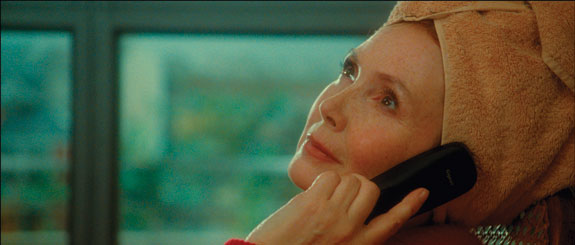
Resnais' 60-plus year oeuvre includes the definitive Holocaust documentary (Night and Fog), several 1960s high-art masterworks of scrambled-narrative slipperiness (Last Year at Marienbad, Hiroshima Mon Amour), and several more recent works that display a fondness for theatrical mannerism and a weakness for Woody Allen-style farce (Same Old Song, Private Fears in Public Places). The new film is, in part, about coincidence and chance, as a random purse-snatching sends an aging, frustrated man, Georges (André Dussollier) after the discarded wallet of an aging, frustrated woman, Marguerite (Sabine Azéma), a dentist and pilot.
Caution: Mild spoilers follow. Georges, we discover through a series of cryptic asides, has a shady, possibly dangerous past. He becomes obsessed with Marguerite, who rebuffs his advances in no uncertain terms. Until, suddenly, she doesn't.
Huh? On certain levels, Wild Grass indeed does not "make sense." Resnais does not provide convincing motivation that might explain Marguerite's change of heart. In fact, Georges — whom we get to know rather well from lengthy interior monologues — is something of a psycho. He sees two "provocatively" dressed teenage girls in the parking garage at the mall, for example, and offhandedly considers raping and killing them to teach them a lesson. (This comes early in the film.)
In this fashion, Wild Grass, for much of its running time, aligns itself rather unproblematically with Georges' point of view. This is deeply disturbing, and sure to be a deal breaker for many viewers. But hang with it. Resnais has a point to make.
At the height of Marguerite's passion for Georges, the man treats her horribly, and then she falls once more into his arms, as the 20th Century Fox fanfare plays obtrusively on the soundtrack. The word "FIN" (the end) blinks onscreen over their embrace (although the movie isn't over). This, together with the introduction of certain characters — Georges' "baxterette" wife (Anne Consigny), who is initially mistaken for a younger sister; Marguerite's best friend (Emmanuelle Devos), who serves no clear purpose until she serves her clear purpose — shows what Resnais is up to. Without being doctrinaire about it (and in fact being ambiguous enough to provoke genuine discomfort), Wild Grass displays the tropes of "romantic comedy" or "chick flick" mentality from an aggressive-male perspective, in order to indict them as deep pathology.
This interpretation, however, is only one path through an exceedingly strange movie. Resnais is also a formalist, and there are purely cinematic pleasures to be plucked from Wild Grass, such as his amplified use of light and color, the film's creative use of camera movement within confined space, and the director's decision to follow what could be considered an ultra-literal penultimate scene (Don't mock the phallus!) with a conclusion so out-of-left-field as to imply a thousand other films screening in parallel worlds. In the end, meanings proliferate, like weeds.
Email arts@nashvillescene.com.



Post a comment as anonymous
Report
Watch this discussion.
(0) comments
Welcome to the discussion.
Log In
Welcome to the discussion.
Keep it clean. Please avoid obscene, vulgar, lewd, racist or otherwise abusive language. Comments featuring hate speech or threatening or violent content will not be tolerated.
PLEASE TURN OFF YOUR CAPS LOCK.
Be truthful. Don't knowingly lie or mislead.
Be proactive. Use the “report” link on any comment that violates our comment policy.
Share with us. We'd love to hear your feedback.