
Heroes and friends: Miyazaki’s Spirited Away and My Neighbor Totoro
One of the pleasures a retrospective offers is the opportunity to take in a large body of work from a filmmaker or genre at once. In recent years The Belcourt has devoted this kind of attention to film noir, samurai movies, Chaplin, movies about the South, and most recently Robert Bresson. With "Castles in the Sky: Miyazaki, Takahata and the Masters of Studio Ghibli," starting Friday, the theater outdoes itself. This monumental retro accomplishes just what such a series should: It encourages comparisons among the animation studio's films, illuminates its entire body of work, and makes an airtight case why the spotlight is warranted.
Filmmaker and co-founder Hayao Miyazaki has been called the Walt Disney of Japan, beloved by both anime lovers and film aficionados in the West thanks to a distribution partnership with Disney. The Disney comparison was initially useful for lodging Miyazaki's name in stateside viewers' minds, but it's ultimately as inexact as calling Kurosawa the John Ford of the East.
That's what makes this retrospective so essential. Beginning this weekend, The Belcourt will unspool 13 days of both dubbed and subtitled versions of 16 Ghibli films, catering to both little ones looking for summer escape and older purists seeking immersion. What's more, it's offering two discounted ticket bundles for movie lovers wise enough to try to catch it all — which we can't recommend strongly enough. Ghibli is the greatest animation studio in the world, and now's your chance to find out why.
The 71-year-old Miyazaki and Ghibli's co-founder, Isao Takahata, have devoted their lives to building a dream factory with few equals. Miyazaki's films for Ghibli have taken their place among the greatest children's films of all time, revered for their exquisite hand-detailed visual aesthetic and for the director's trademark themes: coming of age, the sanctity of the environment, the optimism and resourcefulness children use to counter the ugliness and greed that threaten the adult world.
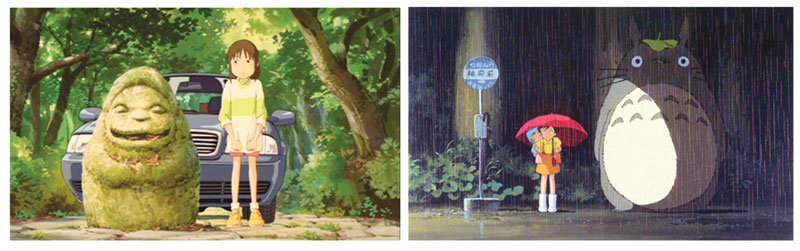
Miyazaki's most essential film, 1988's My Neighbor Totoro (first screening Friday, June 1), gave Ghibli its iconic mascot: a fuzzy, friendly forest spirit who lives nestled beneath a countryside shrine and is discovered by two young sisters. The sisters and their father have moved to the countryside to be closer to their mother, who is recovering in a rural hospital for reasons the children (and viewers) don't fully understand. The details are less important than the way the movie evokes how children feel their way through an unfamiliar landscape, whether it's a haunted forest or the realm of everyday adult worries.
The story originally centered on a young male protagonist and grew from Miyazaki's own childhood memories of his mother's illness. As in many children's films, a fantasy world reveals itself in the wake of something lost or missing, helping the young heroes cope. The spirit Totoro offers an emotional cushion for the sisters during an uncertain time (as well as a literal cushion in the plush interior of his friend the Cat Bus). In so doing, he shows them how seeds are planted, how things grow, how life works: There is no villain, no forced external conflict. It's the quintessential children's fantasy film, and it's magic.
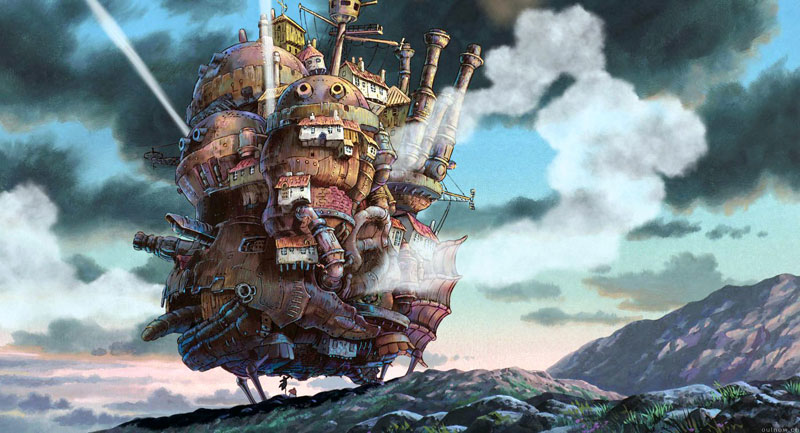
More familiar are Miyazaki's two most recent films, screening in dubbed versions only: 2010's Ponyo, (June 12-13), a beautiful Little Mermaid-inspired legend seemingly made to appeal most to toddlers (the lovable titular fish dons a cute aquatic onesie); and Howl's Moving Castle (June 6-8 and 10), a time-warping adaptation of a fantasy novel released stateside in 2004. These came after the international breakthrough of two of Miyazaki's most popular successes, 1999's Princess Mononoke (June 4-9) and 2002's Spirited Away (first screening Friday, June 1).
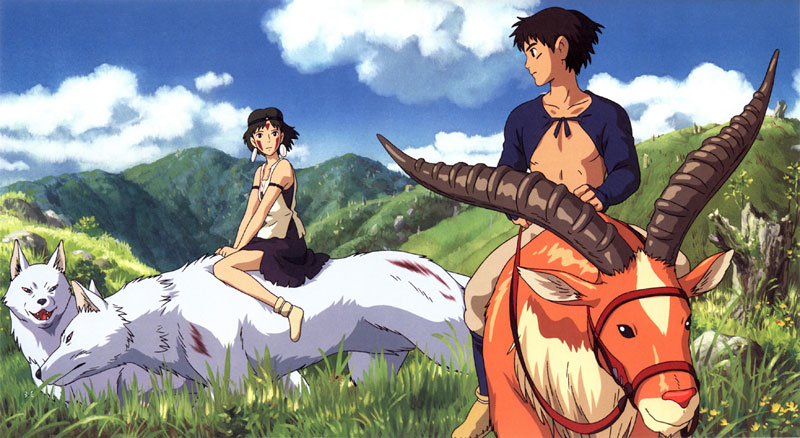
The latter is Miyazaki's Alice in Wonderland, a psychedelic mystery-adventure set in the spirit world; for many fans it rivals Totoro as his best film. Princess Mononoke, even more adult in tone, is a mythic parable of industrial encroachment upon the natural world. In addition to capturing many of Miyazaki's signature strokes, these two keystones fortify the archetype so central to his films: the young female hero.
A raw antidote to the perfect Disney princess waiting for her savior, Miyazaki's girls are complex, colored with determination, self-doubt, fear, strength and independence. All his films could be called Brave. Protagonists such as Spirited Away's Chihiro, seeking her missing parents in what an American movie would present as a nightmare universe, only start out timid: They quickly learn who they are and how to take responsibility, work, and earn respect. When we meet Princess Mononoke herself, raised by wolves, she's already the warrior that each Miyazaki girl will become.
The most delicately realized of all these characters is Kiki, the benevolent young witch at the center of 1989's Kiki's Delivery Service (June 1-3 and 6), a lesser-known Miyazaki classic that stands to be the festival's greatest discovery. In this fictional version of our world, developing witches leave home at age 13 to find their purpose and place — a new city in which to nurture their particular witch-gift. Supplied with her standard-issue gown and broomstick, Kiki brings along her black cat Jiji and a portable FM radio to provide a doo-wop soundtrack for her journey.
Miyazaki and his team studied the architecture and character of Stockholm, San Francisco and small Swedish island towns to create a European city of dreams where Kiki settles and wonders: What do I do know? How will I pay rent? What is special about me, and what can I offer to the world? As the story unfolds, the narrative and tone break from all movie conventions, and Kiki's journey, though set in an imaginary world, feels disarmingly true to life.
Another fan favorite waiting in the wings is 1992's Porco Rosso (June 2 and 4-6), Miyazaki's boyish WWI romp about a pilot cursed into a pig. It's the most literal and fetishistic manifestation of the auteur's favorite cinematic symbol, flight, which figures in two early features treasured by fans: 1986's Castle in the Sky (June 1-2 and 4-5), an epic adventure featuring one of the movies' most heartwarming robots; and 1984's Nausicaä of the Valley of the Wind (June 1-3), where Miyazaki again pairs thrilling adventure with a deeper, more cynical inquiry into humanity's moral relationship with nature.
Miyazaki's hand-painted storyboards evolve into vivid, impressionistic landscapes for fantastic journeys big and small. While a character's lip movements may be sparsely rendered (a characteristic common to Japanese animation), a subsequent insert shot may pause lovingly to focus on a dewdrop dangling from a blade of grass, or the wind blowing through a meadow at sunset. Ghibli's animators know how to express much in one face, one frame. Action and spectacle often cede to a tranquil stillness that feels distinctly Japanese.
Takahata, Ghibli's co-founder, isn't as well known in the U.S. as Miyazaki, nor has he directed a film in more than a decade. But his films are no less essential to the animation world and the spirit of Studio Ghibli. His early films are represented here, except for the glaring absence of his devastating nuclear-war masterpiece Grave of the Fireflies. A highlight of the festival is 1999's My Neighbors the Yamadas (June 10 and 12), an episodic family comedy told in a scribbly Sunday-comics style that exemplifies just how versatile Takahata is as a director. It's unlike any other film in the series, with a madcap and heartwarming sensibility that could be characterized as something like a Japanese The Simpsons.
Ghibli's films typically appeal to adults as well as children, but Takahata's tender 1991 Only Yesterday (June 2 and 4) was written mainly for young women, telling of a 27-year-old city dweller who reminisces about her childhood as she travels to visit her family in the country. Along with Tomomi Mochizuki's 1993 teenage romance Ocean Waves (June 10 and 12), it's one of the films in the series most prized by Ghibli completists, largely undiscovered by Western audiences.
Digging into more Ghibli deep cuts, the discoveries continue with Takahata's Pom Poko (June 9-11), an environmental allegory that gets much mileage from the tantalizing culture gap between America and Japan, that head-spinning high that Westerners find so addictive. The denizens of Pom Poko's animal society are tanukis — raccoon-dogs familiar from folklore in Japan and Super Mario's "tanuki suit" in America — and their military defense against the industrial machine is their all-powerful scrotalia, testicle sacks that double as parachutes and bombs.
Here, as in The Yamadas, it is evident some cultural tones and meanings get lost when Japanese is dubbed into English — although the humor is as innocent and universal as a kid looking in amusement at his body at tub time. The upside is that young viewers and families can enjoy this series as much as purists, and kids will enjoy hearing Disney star voices in the dubs. A great dubbed double feature for families with felines is 1995's Whisper of the Heart paired with its 2002 spin-off The Cat Returns (June 9 and 11), which whisk viewers away to a secret kingdom of cats with the help of Disney Channel mainstays Ashley Tisdale and Daveigh Chase.
Closing the festival is Ghibli's newest feature The Secret World of Arrietty (June 13), back for a victory lap. The studio's interpretation of an English-language children's classic (Mary Norton's The Borrowers), it's the highest-grossing Ghibli movie yet at the U.S. box office. It's also a fitting finale to the series in that it encapsulates everything that makes Studio Ghibli such a jewel: an emphasis on wonder and contemplation over dazzle and distraction; a belief in the power of storytelling to shape, engage and explain the world; and an ability to create characters who will tag along in the imagination for summers to come. "Castles in the Sky" provides a revelatory journey into another world — one in which the creator's hand is always in evidence, and never in doubt.
Email arts@nashvillescene.com.



Post a comment as anonymous
Report
Watch this discussion.
(0) comments
Welcome to the discussion.
Log In
Welcome to the discussion.
Keep it clean. Please avoid obscene, vulgar, lewd, racist or otherwise abusive language. Comments featuring hate speech or threatening or violent content will not be tolerated.
PLEASE TURN OFF YOUR CAPS LOCK.
Be truthful. Don't knowingly lie or mislead.
Be proactive. Use the “report” link on any comment that violates our comment policy.
Share with us. We'd love to hear your feedback.