

What can I say about Federico Fellini? To experience his films is to become a denizen in the Italian maestro’s phantasmagoric world — where streetwalkers are poets, goddesses spring from fountains and vaudeville acts are granted more reverence than religious spectacles. The grotesque and sublime share equal footing in Fellini’s world. It’s a place where sky-high fantasies mingle with earthly delights and vices — and a master puppeteer controls both the beautiful and the damned.
A portal into this world is opening in Nashville. From June 25 to July 15, the Belcourt’s Essential Fellini series will include 11 of his films, some of them in gorgeous 4K restorations that were released by The Criterion Collection last year to mark the centenary of Fellini’s birth. The theater has invited Vanderbilt University’s Iggy Cortez, who will deliver “Nostalgic Exuberance: A Seminar on Federico Fellini’s Magical Cinema” at 11 a.m. Saturday, June 26.
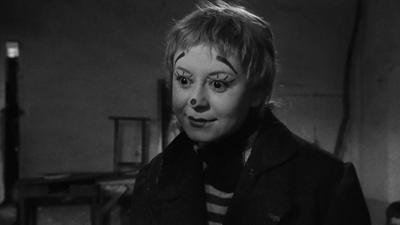
It is impossible to say what Fellini’s career would have been like without the actress who defined his early films. Standing 5-foot-2, Giulietta Masina was sometimes called “the female Charlie Chaplain.” She had big, expressive eyes, and she moved through the films as if dancing to music that only she could hear. For half a century, she also happened to be Fellini’s wife. In 1954’s La Strada (June 25-29), Masina stars as Gelsomina, a young woman of limited intellect and very limited means who is sold to Zampanò, a traveling carny played by Anthony Quinn. The downtrodden Gelsomina soon warms to circus life, playing the trumpet and snare drum as Zampanò enacts the same strongman gag from town to town. A drunkard and brute, he can’t bear Gelsomina’s goodness — yet she’s drawn to him, with wrenching results. Not yet a decade after the death of Mussolini, La Strada — like its neorealist cousins Rome, Open City and Bicycle Thieves — shows the terrible personal consequences of fascism. But Fellini and Masina also showed that beauty and kindness can be weapons against tyranny.
Their partnership continued with the 1957 odyssey Nights of Cabiria (July 1-3), in which Masina plays a street-smart sex worker. What Masina’s titular Cabiria lacks in grace she makes up for in confidence. So much of the actor’s talent is physical — her jerky walk and dance moves convey Cabiria’s irrepressible spirit, as well as her habit of masking pain with comedy. She has the best excuses to be cynical and chooses hope instead. Despite her difficulties working in the underbelly of Rome, with all of its threats and loneliness, Cabiria reaches for something more — moderate wealth, romance, family. When a suitor appears, Cabiria is thrilled — but Fellini’s men are predictably disappointing, and Cabiria will need to rely on her own instincts to survive.
The film that made Fellini internationally famous is not among my favorites of his work — but 1961’s La Dolce Vita (July 7-10) is required viewing for culture mavens. It’s a technical marvel in which Fellini re-created Rome within Cinecittà Studios, in some cases just blocks from the places the film depicts. Marcello Mastroianni stars as a jaded journalist (also named Marcello) who joylessly floats through Rome’s nightlife. He has plenty of women to choose from — the devoted but unstable Emma (Yvonne Furneaux), whom he abandons on the side of a highway one night; the noncommittal heiress Maddalena (Anouk Aimée); and, of course, the bodacious movie star Sylvia (Anita Ekberg), who invites him to wade into the Trevi Fountain at dawn. (Marcello manages not to enjoy that either, but this scene alone makes the film worth seeing.) The Italian public was horrified by La Dolce Vita — the excesses and cruelty of the Roman glitterati did not match up to the way the city’s inhabitants saw themselves. (And perhaps they were dismayed by the three-hour run time.) But it’s thanks to La Dolce Vita and the drama it caused that Fellini made his next marvel, the autobiographical 8 ½ (July 8-9).
Here, Mastroianni plays film director Guido Anselmi as he flounders through the conception of his next film. As Guido navigates the circus of his present — including a seemingly endless parade of characters — 8 ½ flits between reality and illusion, memory and fantasy. His producers harangue him, his women judge him, his film eludes him, but he finds solace in his vivacious dreams. With a pioneering stream-of-consciousness style, 8 ½ is a visual feast that never leaves you feeling like you’ve overeaten. And Sandra Milo is hilarious.
Fellini got weirder still, with the fantastical Juliet of the Spirits (July 9-14), the fable-like high seas adventure And the Ship Sails On (July 11 & 15) and other films that are part of the series. For me, it all comes home with Amarcord (July 10 & 14), Fellini’s love letter to a small village filled with eccentric characters doing their best under Mussolini’s tyrannically dull Fascist regime. The film’s protagonist is a teen boy who I imagine was much like Fellini himself — a desperately horny prankster who is beset by raging parents, indifferent teachers and a repressive church. What happens when a boy comes of age under such circumstances? Maybe he becomes a brute. Maybe he enters politics. Maybe he joins the circus.
Or maybe he creates one. The Big Top opens in Hillsboro Village on Friday, and everyone’s invited.



