
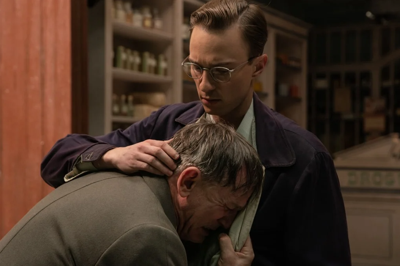

As befits a story of literary exile and sexual rondelay, Queer, based on William S. Burroughs’ unpublished-until-1985 novella, is a film that remains nimble on its toes, never staying too long in any one mode or timespace lest authority be drawn near or boredom find purchase. Bill Lee (Daniel Craig) is an American writer tooling around the Americas — Mexico at first, but soon throughout South America — trying to finish some publishable work and find a way through temptation into something approaching true liberation. He’s got a loose-knit circle of fellow expatriates and dueling senses of adventure and shame, and as to where he’s going to end up, your guess is as good as mine.
Thanks to director Luca Guadagnino and screenwriter Justin Kuritzkes — who just this summer teamed up to make tennis and bisexuality into the hot topic with the sensual epic Challengers — you’ll encounter all manner of characters and sexualities in Queer. Special props are due to Jason Schwartzman (who’ll drink for free in every bear bar he sets foot in for the rest of society) and Drew Droege (as the most vicious queen you’ve ever seen), as well as to singer Omar Apollo for his ribald turn here. There are also important appearances from ayahuasca in its ingenue period, the mercenary twink Allerton (Drew Starkey, certainly making an impression), and a sloth whose mellow and adorable lethargy feel like a potential approach to the psychosexual minefield that is getting by when society despises you.
Craig is spectacular in this, putting his all into a story of addiction that isn’t another one of those recovery-porn narratives. He’s got his booze, and his junk, and his cigarettes, and a hole that can’t be filled with anything except trying to be a better person for someone else. There are lots of drugs here, heaps of them in fact, but the most dangerous one is the idea of love — because lots of people would traipse off into the jungle looking for a transformative high, but only love has you doing that to chase the possibility of making a connection with another person so deep and profound that you transcend this whole realm of existence. That sloth knows what’s up. Rather than guarding these biochemical secrets like a Brechtian CG sentry snake, it’s just hanging out. Our human natures are going to lead us down our paths, and if we were meant to make it through to something new, something else, we will.

Luca Guadagnino's new Zendaya-starring feature opens wide this week
There’s a cosmic horniness at play here, where rampant desire, drug-addled excess and consciousness expanded beyond this realm all sort of end up in an expressive pile-on. As the viewer, you have to find your own way out. Queer is a weird film, easily Guadagnino’s strangest offering yet, but its refusal to be tied down by genre or expectation is incredibly liberating. If you can’t accept its narrative fugues and caesurae, you’re not exactly going to be in the best position to vibe on what it’s saying about queer sexuality — which is, to paraphrase Oscar Wilde, that gutter desire can lead to stellar transcendence. Or at least that’s the hope. The possibility. The best-case scenario, in which human beings make all manner of sketchy decisions because one of them just might be The Way.
There’s a willingness to get a little loosey-goosey with the source material (same as with the 1991 adaptation of Burroughs’ Naked Lunch). But that’s not a hindrance. In fact, it allows the material to become truer to itself. A literal Burroughs adaptation would not be inherently cinematic, and it’s in the process of adaptation that these flinty, filthy slices of experience can evolve and flourish into something more. You’ll know early on if you’re on the film’s vibe or not — Sinéad O’Connor’s take on Nirvana’s “All Apologies” brings us in (over one of those exceptional opening-credit collages that Guadagnino’s films do so well) with a soothing melancholy, setting the tone for a film that puts its heart and soul into mapping out the shifty continuum between lust and love. To quote the great philosophers Wendy and Lisa, “They both have four letters, but they’re entirely different words.” The refreshingly anachronistic approach to the song score even lets Prince himself pop into the proceedings, a contrast that unlocks all manner of emotional cubbyholes.
There’s a discussion going on in this film — with Burroughs’ oeuvre and the history of gay life in the ’50s — but also with two very specific films: David Cronenberg’s 1991 version of Naked Lunch (easily the best adaptation of Burroughs that a straight man could make) and Wong Kar-wai’s 2004 epic 2046. Both are films about writers and the way they process and metabolize their sundry foibles, peccadilloes and weaknesses, but the former allows these texts — these first-person omniscient remixes, if you will — to warp and re-form the actual space of the film itself like a body-horror freakout, whereas the latter maintains the Cathar boundary between the corporeal real and the abstractions that the word can offer, the author buffeted between the two in an inescapable and ongoing indictment of the self.
It can be a lot, and audiences and critics certainly have had a multitude of responses to its spell (as opposed to the rapturously horny consensus about Challengers). But there’s nothing else quite like this beast in theaters at the moment, and in addition to that, at this current historical moment, Queer is a work of radical theory and intent that, while it’s still legal, enriches the medium and cranks up all the conflicted emotional responses.



Post a comment as anonymous
Report
Watch this discussion.
(0) comments
Welcome to the discussion.
Log In
Welcome to the discussion.
Keep it clean. Please avoid obscene, vulgar, lewd, racist or otherwise abusive language. Comments featuring hate speech or threatening or violent content will not be tolerated.
PLEASE TURN OFF YOUR CAPS LOCK.
Be truthful. Don't knowingly lie or mislead.
Be proactive. Use the “report” link on any comment that violates our comment policy.
Share with us. We'd love to hear your feedback.