
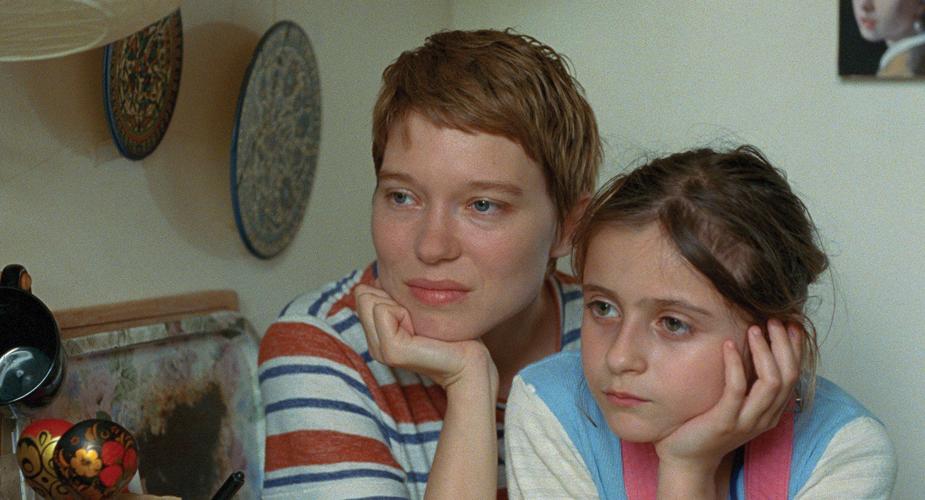
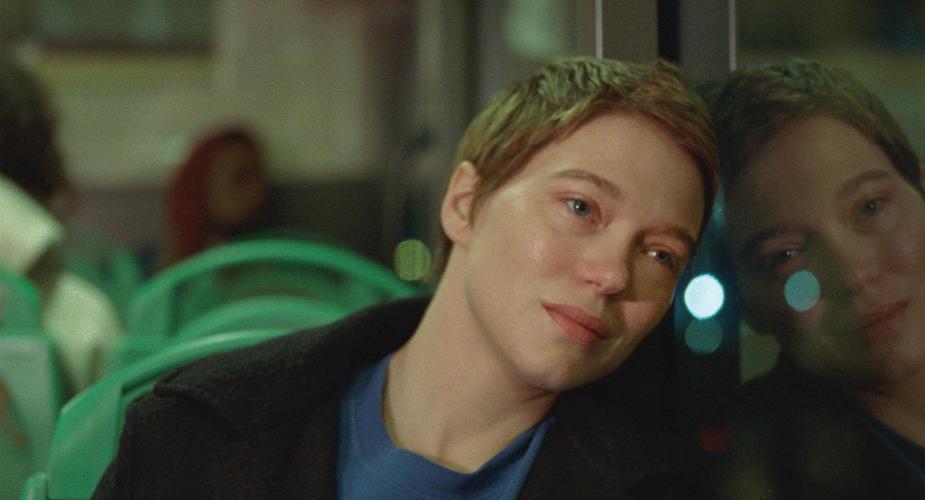

Léa Seydoux is a sought-after woman with some sad eyes.
That’s the thing I got most out of One Fine Morning, the latest film from French writer-director Mia Hansen-Løve. Although Seydoux has mastered the art of playing exotic/erotic temptresses, ready to get butt-bald-naked at the drop of a beret if a role calls for it, this film has Seydoux playing a modern-day woman who’s struggling — and trying not to break into tears because of it. Sure, she gets butt-bald-naked a couple of times. But when she’s at her most naked and vulnerable, it’s usually when she’s clothed.
In this picture, we follow Seydoux’s Sandra, a pixie-haired Parisian woman raising a young daughter (Camille Leban Martins) by herself and earning a living as a translator, taking such gigs as guiding American vets through a Normandy trip or interpreting conference talks. She also makes time to check in on her father Georg (Pascal Greggory). The old man unfortunately has Benson’s syndrome, a rare form of dementia that keeps him blind, disoriented and hunched over. Sandra finds solace in Clément (Melvil Poupaud), a friend who eventually becomes something more — even though he’s married with a child. (And their kids are chums!) Nevertheless, they have a torrid, on-again/off-again affair.
Morning has Hansen-Løve continuing her journey of making pragmatic, neo-realistic films about women quietly going through it — women who serve as stand-ins for Hansen-Løve herself. Her short-lived relationship with significant other Olivier Assayas served as fodder for her last film, the sneakily meta Bergman Island. That scenic hall of mirrors starred Vicky Krieps as a filmmaker, with a more-successful filmmaker partner (Tim Roth), trying to write a movie about a woman (played by another Mia — Mia Wasikowska) having an affair with an old friend.

Léa Seydoux in One Fine Morning
This time around, Hansen-Løve practically takes that same story and weaves in her experiences looking after her ailing father. As Sandra spends a lot of fleeting-but-still-tender moments with Georg (Greggory does devastating work as a man trying to stay cognitive even when it’s a futile endeavor), she also has to constantly confer with her family on putting him in a proper home and determining what to do with his belongings. For these scenes, it almost feels like Hansen-Løve got inspiration from her ex’s brilliant film Summer Hours (aka the most unsentimental film about the importance of sentimental value ever made), which is also about a family figuring out what to do with a parent’s stuff.
In a movie in which several characters could easily be the bad guy, Hansen-Løve refuses to cast judgment on these flawed souls. Yeah, Sandra could be seen as a homewrecker, but the woman is clearly lonely — a bit lost, even. And as much as you may want to despise Clément for making her a side piece, it does appear that dude can’t stand to be away from her. Hansen-Løve even has sympathy for the health care workers who do what they can for Georg and other senior citizens who wander out of their rooms.
Morning is yet another melancholic, mature, beautifully constructed feather in the cap of Hansen-Løve, one of the most personal (and most human) filmmakers out there. By once again using her own life as source material, she gives us an unabashedly moving portrait of a woman holding on to her loved ones and — as Seydoux’s sad eyes often show — shedding some tears when she has to let them go.



