
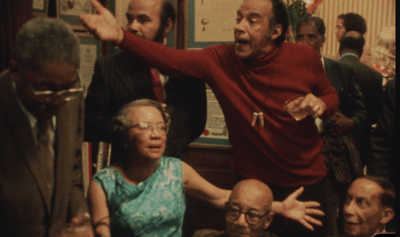

Once Upon a Time in Harlem is a bougie paradise — and I mean that as a compliment.
Yet another stunning, fascinating doc in a year that’s been swarming with them, Harlem was filmed way back in 1972. All this unearthed footage comes courtesy of David Greaves, the son of late African American filmmaker William Greaves. One sunny Sunday in August, the elder Greaves gathered a bunch of Harlem Renaissance legends for a cocktail party in Duke Ellington’s Manhattan townhouse (now a National Historic Landmark). Writers, artists, actors, musicians, photographers, thinkers — they all reunite and reminisce while Greaves gets every moment on 16 mm.
Before he passed away in 2014 at age 87, Greaves specialized in capturing thriving Black folk on camera. Even though his best-known work is the experimental 1971 mindfuck Symbiopsychotaxiplasm: Take One — in which he assumes the role of a manipulative filmmaker looking to separate what’s real from what’s not (Nathan Fielder must be a fan of that one) — the Actors Studio alum turned Emmy winner mostly did films on Black figures and gatherings that uplifted the whole African diaspora.
As he explains in voice-over, Greaves wanted to make great films about great people — “creations of the godhead,” as he puts it. He certainly rounds up some outstanding men and women for the Harlem party, surviving members of the New Negro Movement that gave us trailblazing authors (Hughes! Hurston!), influential musicians (Louis Armstrong was practically the movement’s Pied Piper), fashion and culture that would inevitably be appropriated by white America.
Greaves has one-on-one time with the guests, each and every one of them dropping amazing stories and memories from that bustling era. Poet Arna Bontemps and librarian Regina Anderson reminisce about hanging out with writers at the 135th Street Library. Songwriter Eubie Blake recalls bringing jazz to Broadway with his groundbreaking 1921 musical Shuffle Along. Photographer James Van Der Zee’s impromptu piano playing at the party is even used to underscore a montage of Van Der Zee’s immaculate photos of early-20th-century Black life.
Greaves goes into moderator mode in the second half of the film, getting all the guests in the same room to discuss the Renaissance and its legacy. You can practically smell the aromatic pipe tobacco as Greaves keeps several cameras rolling during this straight-up salon. (The younger Greaves uses split screens for dual angles of the partygoers.) But even when most of them appear to be guzzling beverages, it’s still a passionate but respectable session, with some attendees encouraging their more elderly colleagues to chime in. My favorite is when out-and-proud poet/painter Richard Bruce Nugent calls for Negro Actors Guild of America co-founder Leigh Whipper to add his two cents during his rapturous remarks. (“Leigh, I’m pausing so you can say something.”)
These days, it’s almost jarring watching a roomful of people debate and disagree without descending into a screaming match. (Ida Mae Cullen, widow of poet Countee Cullen, does exhibit some performative pushiness whenever she gets the chance to speak.) But that’s what makes Harlem such a compelling artifact. Along with being an enjoyable portrait of Black intellectuals, sage and sharp even in their AARP years (they may have been old, but they could still recite poems and monologues upon request!), the film takes you back to when voicing one’s opinion in a public setting didn’t seem like fighting words.
“Any denial of historical people is a denial of self,” Greaves says, once again off camera. With Once Upon a Time in Harlem, Greaves not only gives these brothas and sistas their long-overdue flowers — he also posthumously gives current and future generations a sophisticated, essential time capsule, starring the most dapper and erudite bunch of old-timers to ever live through a major moment in African American history.



Post a comment as anonymous
Report
Watch this discussion.
(0) comments
Welcome to the discussion.
Log In
Welcome to the discussion.
Keep it clean. Please avoid obscene, vulgar, lewd, racist or otherwise abusive language. Comments featuring hate speech or threatening or violent content will not be tolerated.
PLEASE TURN OFF YOUR CAPS LOCK.
Be truthful. Don't knowingly lie or mislead.
Be proactive. Use the “report” link on any comment that violates our comment policy.
Share with us. We'd love to hear your feedback.