
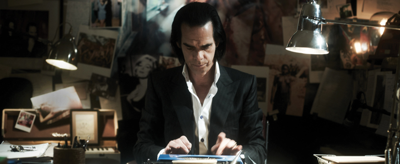

What makes a music documentary great usually involves the capturing of significant unguarded moments, and the insight they open into the subject's creative process. Their effectiveness is limited by an artistic variation on Heisenberg's uncertainty principle: The more intrusive the camera is, the less truthful, natural material it's able to capture. There's a balance to strike between art and journalism, a certain objective distance to be kept so as not to prompt the artists to act for the camera.
By that standard, the new Nick Cave film 20,000 Days on Earth is a total failure. But that's the wrong yardstick.
20,000 Days is ostensibly a day in the life of the notoriously interview-shy Cave, and it offers all the fundamental elements of a garden-variety rock doc, from performing onstage to swapping war stories, to working in the studio (in this case, on what would become Push the Sky Away, his phenomenal 2013 album with The Bad Seeds). That's where the semblance of a documentary ends. It's more accurate to call the film an autobiography adapted by talented screenwriters, starring Cave in the lead role.
Filmmakers Iain Forsyth and Jane Pollard use ingenious and well-suited conceits to evade the formal interview format, and in the process remove all traces of themselves. Instead of asking Cave directly why he writes and performs songs, his day includes a visit to a psychiatrist — not his own, but a real psychiatrist nonetheless, the perfect vehicle for addressing uncomfortable yet pertinent questions about sex, religion and Cave's relationship with his father. These unfold naturally into a manifesto about his work. Rather than corralling Cave and Kylie Minogue on a soundstage to reminisce about their 1996 hit duet "Where the Wild Roses Grow," she materializes like a distant memory in the back seat of his somewhat ominous-looking black Jaguar.
Though staging so much of the action might diminish the film's journalistic integrity, it puts you right in the middle of his artistic process — a constant struggle to crystallize ephemeral moments of transcendent beauty and terror — in a way that even the best traditional documentary struggles to accomplish. "Who knows their own story?" says Cave, as he visits a place that may or may not actually be his archive, but whose secret-laboratory ambiance is perfect for uncovering the origin stories hidden in old photos. "Certainly it makes no sense when we are living in the midst of it. It's all just clamor and confusion. It only becomes a story when we tell it and retell it — our small, precious recollections that we speak again and again to ourselves."
Filmed in a crisp, contemplative style that recalls contemporary Scandinavian thrillers, 20,000 Days deserves the honors for directing and editing it took at Sundance 2014. The film is serious but doesn't take itself too seriously; Cave's expression when longtime collaborator Warren Ellis offers him a plate of eel pasta is worth the price of admission alone. The intimate studio and concert footage are a treat for fans, but the incredibly smart treatment makes Cave's complex philosophy of storytelling appealing to any audience.
Email arts@nashvillescene.com.



