

Last weekend, The Belcourt showed Wes Anderson's first feature, the 1996 caper comedy Bottle Rocket. It's the movie that introduced one of the great comic archetypes: Owen Wilson's Dignan, a fidgety idea man who pours his inspiration into low-yield robberies that he micro-manages as if he were tunneling into Fort Knox. But it also introduced the worldview Anderson would refine and elaborate over his next six films — the folly of thinking you can control your life if you just map it out obsessively enough.
The heroes of Anderson's subsequent movies — Rushmore's adolescent go-getter Max Fischer, The Life Aquatic's scuffling Cousteau stand-in Steve Zissou, the fantastic Mr. Fox — are whizzes at elaborate planning. Over the years, Anderson has developed a visual style to match their fussiness: tidily composed frames that look like shoebox dioramas, every detail fitted into place with a New Yorker cartoonist's eye for sight-gag arrangement. The compulsive order becomes the joke: There's no way anything so maniacally organized can hold, like an Eiffel Tower of toothpicks awaiting just one big sneeze. If a spirit animal haunts this realm, it's not suave Mr. Fox but hapless Wile E. Coyote.
And if knocking down these characters' matchstick houses were all Anderson cared about doing, his movies would be exercises in twee sadism. But the elements that disrupt his heroes' best-laid plans — other people, the stray bottle rockets whose path nobody can predict — tend to produce something better by demanding to be acknowledged. And so it is with Anderson's seventh movie, Moonrise Kingdom — which in some ways is exactly what you expect if you've been following his career, and yet still the loveliest surprise you're likely to get at the movies this summer.
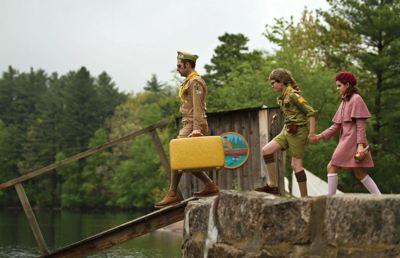
Scripted with unflagging comic invention by the director and Roman Coppola, Moonrise Kingdom is the outright romance Anderson's movies seemed to be leading up to, child protagonists and all. It begins with the discovery that a 12-year-old Khaki Scout, Sam, has gone AWOL and vanished from under the nose of his doggedly earnest scoutmaster (Edward Norton, born to wear an Eagle Scout's garb). On the other side of their coastal community is Suzy, the girl Sam plans to run away with once she escapes the angular house of her morose lawyer parents (Bill Murray and Frances McDormand). Since the orphaned Sam is an Anderson hero, this entails lots of maps, a stash of artfully arranged provisions and exact proto-GPS instructions about where to meet.
In a movie where precision of tone counts for everything, the casting of Sam and Suzy carries an extra burden. Somehow the filmmakers found two newcomers, Jared Gilman and Kara Hayward, who slip into their roles without a false or contrived move. The scene where Sam and Suzy come face to face, across a grassy cliché of a movie meadow, typifies the empathetic balancing act Anderson pulls off, a recognition that however affected the kids may act, the passions they feel are no less sharp, or real. It's a moment that could've been played for an easy joke — a goof on the ancient lovers-running-in-slow-motion wheeze. Instead, Sam clamps down on a pipe and affects a look as world-weary as Jude Law returning to Cold Mountain. It still gets a laugh — there's not a shot of him sagely puffing on that silly pipe that doesn't — but in a way that lets the character be seen as he sees himself, with the gentlest of deadpan ribbing.
As they set up a beachside idyll — their underwear-clad dance and awkward wooing to a Françoise Hardy chanson, like so much of the movie, is at once hilarious and curiously haunting — their flight disrupts the clockwork rituals of the surrounding adults: the lonesome patrols of the town sheriff (Bruce Willis, all hangdog decency), who's concealing his own furtive stab at romance; the watchful rounds of the scoutmaster, who dispatches a platoon of kid troops to track down the young lovers. No less than the runaways, these kids see themselves as participants in a movie adventure. The incongruity of their mouthing war-movie palaver ("If we find him, I'm not going to be the one who forgot to bring a weapon," one pint-size Private Ryan grouses) is all the funnier, and more unsettling, for how seriously they take it.
A second viewing of Moonrise Kingdom is essential, if only because the movie keeps the sight gags and marginalia coming so fast you can barely register every joke in the frame. (The breathless pace of Jules and Jim's early scenes seems a key reference point.) Set in a storybook mid-1960s that suggests the Nouvelle Vague, the British Invasion and Saturday-morning TV of the period stirred together in a dreamy kid's noggin, Moonrise Kingdom is stylized even by Anderson's standards. In the early scenes, the camera scoots and sidles from one tableau to the next, as if sets were rotating past a fixed gaze. At the same time, Anderson's longtime cinematographer Robert Yeoman shoots in Super 16, and the result has a muted, autumnal palette like a home movie on the verge of dissolving into a sepia fog. The effect it triggers is immediately wistful, recognizable if you've ever picked up a faded old book you loved as a kid.
"Salinger-esque" is the label that's sometimes plastered on Anderson's movies: Taken as a pejorative, it's calling the director a preppy dilettante preoccupied with upper-crust ennui. But while his Moonrise Kingdom is a realm of precocious adolescents dimly perceiving the dissatisfaction and disappointment of the adult world, there's no judgmental posturing about "phonies." Everybody in Moonrise Kingdom wears a costume of some kind, whether it's a grown-up's work uniform or a kid's church-play outfit. Yet it's only by trying on these wardrobes that the characters arrive at workable lives. Anderson's generosity toward his characters slips just once, in the scenes with Tilda Swinton as an officious social worker. She's one of the only figures Anderson can't work up any empathy for, and it's a measure of her failure to come alive as a character that she has no name beyond her function, "Social Services."
But that's the merest of quibbles about a movie that still leaves me grinning every time some remembered detail comes back — the clever use of Benjamin Britten's "The Young Person's Guide to the Orchestra" (and its inspired bookending over the closing credits using Alexandre Desplat's twinkling enchanted-forest score), or the brilliant throwaway gag of Sam's Shawshank Redemption escape from his scout tent. As a big finish, Anderson resolves his many complications with a series of epic flourishes. The tidiness that governs Anderson's frame represents our fondest hopes, always imperiled; the restoration of order, in plot as well as composition, creates a euphoric effect, like the blizzard of best-of-all-possible-worlds reconciliations that ends Rushmore. It's the giddy, transparent contrivance of a Shakespearean comedy — the benediction of a creator who wants to send his characters home as happy as his audience. If that was Wes Anderson's intent with Moonrise Kingdom, score one for solid planning.
Email arts@nashvillescene.com.



