
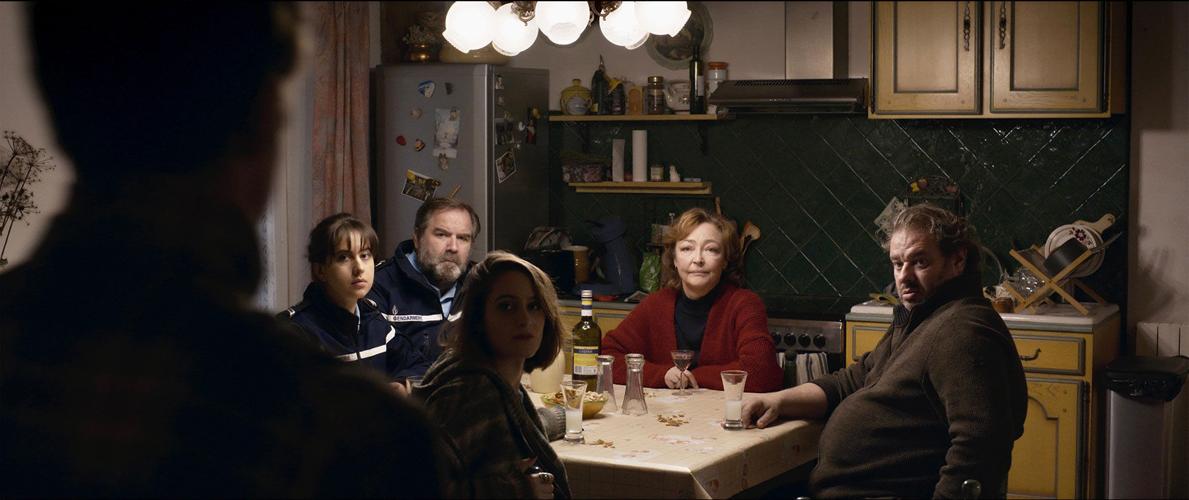
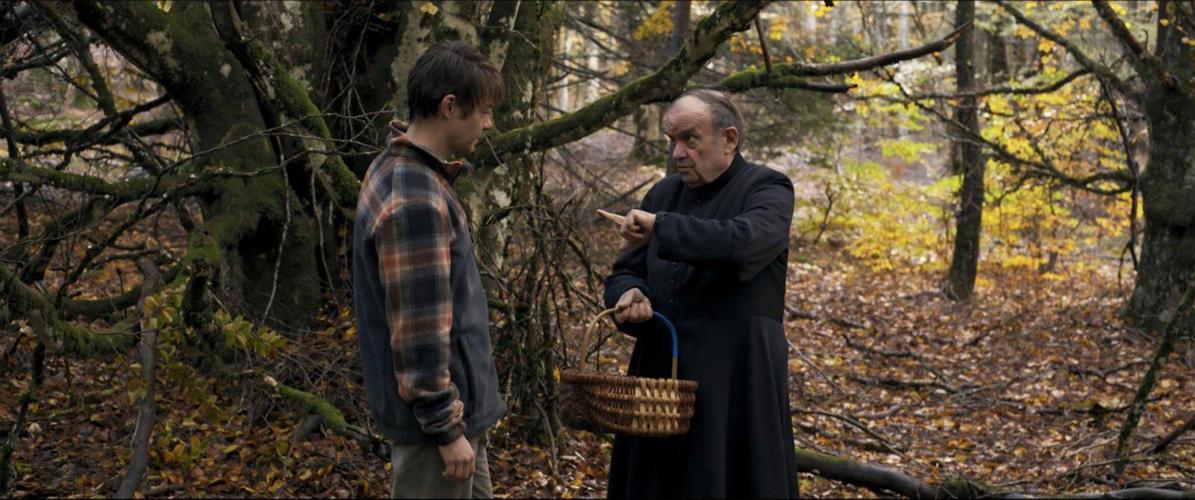


Jérémie (Félix Kysyl) is an interesting fellow. He’s got one of those faces that seems reminiscent of several different people at the same time (in this case, young Edward Furlong, Rainer Werner Fassbinder and Snakeman), and he has the very relatable condition of not being able to access or express exactly what it is he wants from life and others. He responds to kindness and loss, and he has some degree of moral study or experience that has stuck with him throughout his life. But to be fair, he’s also just squirrelly enough that you never really know exactly where you stand with him.
French writer-director Alain Guiraudie (Stranger by the Lake, Staying Vertical) has a gift for films that understand how complicated it is just being alive and trying to interact with other people. And Misericordia digs deep into that milieu, dropping us into the village of Saint-Martial, where Jérémie has returned for the first time in years to attend the funeral of his former employer and mentor, Jean-Pierre. And the situation gets … heightened. Because it feels like no drama ever truly gets settled. And as we are all very familiar with, men really love to destroy. There’s rejection, a mystery and a killing, all amid that bucolic French vibe where lovers and incredible meals abound.
Is it boredom that keeps men from ever leaving behind schoolyard-style violence? In some instances, it’s absolutely a form of sublimation of emotions that go against The Self they perceive themselves as, but that’s not even what Guiraudie is exploring here. There’s something about the modes of survival that imprint upon us at an early age and how they ripple throughout adult life, about how we process everything that made a deep and profound impression in the early stages of figuring out who we are. And that’s what makes Misericordia such a captivating film — it’s a steel cage match between playground and church, and how the reaction instilled by each philosophy unfolds in a world where everyone is just a bit adrift.
This village is a Jenga of horniness where a couple of deaths manage to throw everyone into disarray. Unrequited desire is one of those things that can be a load-bearing wall in enduring construction, but it also can never be relied upon to stay exactly the same: To be very foundational with a metaphor, Misericordia is a game of Musical Chairs of Longing, where removing one chair is the process by which life has always worked, but the removal of an extra chair has pushed the interpersonal relationships of the entire village of Saint-Martial to the breaking point. On the whole, most people do not support murder. But we reserve a little space for crimes of passion — not even so much to make excuses, but to allow for context, which adjusts our perception of circumstances.
When I saw the film the first time back in September, it felt of a piece with the slyer oeuvre of Éric Rohmer, or Crimes and Misdemeanors-era Woody Allen — a perceptive and rigorous collection of character studies buoyed by exceptional performances that work as both archetype and incarnation. And now, half a year later, it’s shaken out into something even more impressive. The plot — the central mystery and the “who wants what from who” of all involved parties — is smart, expertly constructed and very effective. But once you know the points on the graph where all that unfolds, Guiraudie and his cast are able to do something nearly alchemical.

Misericordia
As Martine, the recent widow around whose house much of the film’s goings-on originate, Catherine Frot gets the most challenging (and rewarding) role in the film. The rest of the cast gets to play with ambiguities (both the concept and the Melvillian sort), letting the viewer assemble their lives in a pointillist fashion. But Martine is a rock, a pragmatic foundation for the community — she’s always listening, she’s always observing, and she adapts to whatever the world throws her way with elegance and the kind of quick thinking that sketches in the story of a woman who has led a most extraordinary life.
Rough-hewn subtlety is not the kind of thing that makes for dynamic pull quotes. It can be difficult to pull in an audience with a statement like, “David Ayala confounds traditional hierarchies of desire as well as the police with a genial earthiness that none of the other characters know how to process.” But that’s exactly what this film excels at. As soon as the opening credits are done, we think we know what’s going on in Saint-Martial, and yet we never fully get there when traversing that path. It’s not even accurate to say the film is an example of delayed gratification, because it’s got a lot more on its mind. (And it also seems to be having a bit of a laugh at the expense of how often “global art cinema” is just shorthand for “being honest about sex.”)
Aesthetics are not universal. But you have to summon a very specific kind of respect for a film that understands that a fresh mushroom omelette can be a refreshing treat and a taste of the grave at the same time, and a film that gets that perspective across without anyone at the kitchen table saying a word. And Misericordia is a sly, smart peek into the messy realities lurking just behind every half-swallowed sigh and resentful recollection — mercilessly funny and deeply profound.



