

Courtesy of NEON
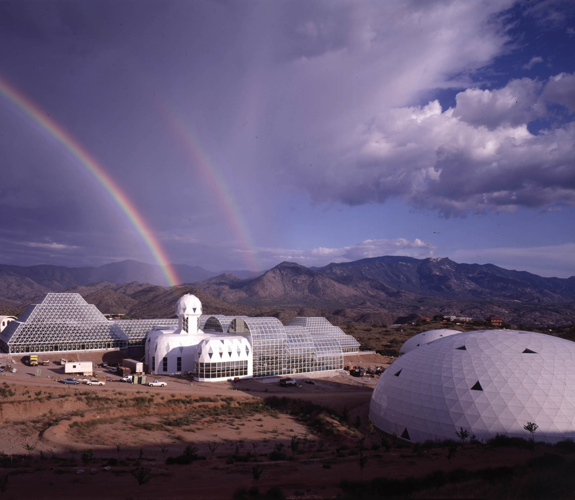
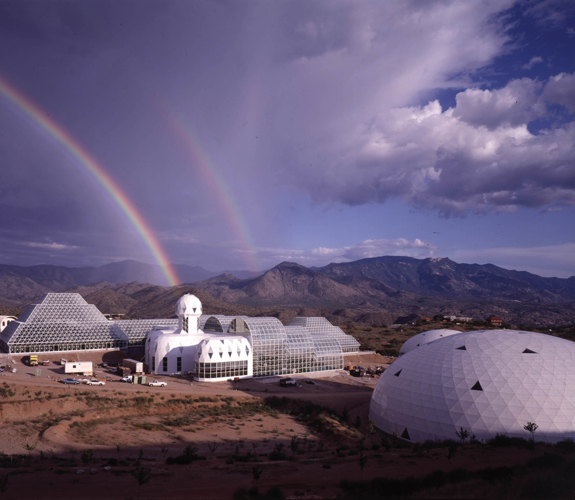
In 1991, the World Wide Web opened to the public, Nirvana released Nevermind, and Silence of the Lambs took a bite out of the box office — and eight artists, adventurers and ecologists visited another world without leaving the Arizona desert. If you’ve ever wondered what would happen if a back-to-the-land hippie commune partnered with a Texas oil tycoon, the answer is Biosphere 2: a man-made ecosystem, meant to be self-sustaining, contained in a massive complex of greenhouses built in the appropriately New Age-sounding Oracle, Ariz. Matt Wolf’s new documentary Spaceship Earth takes viewers back to the age of the post-Manson hippie diaspora to introduce a group of intrepid voyagers — the ones who became the first “biospherians” — before public perceptions of their IRL world-building changed from environmentally inspirational to scientifically suspect.
Wolf’s previous films have illuminated insular subcultures (2014’s Teenage) and spotlighted creative outliers (2018’s Wild Combination: A Portrait of Arthur Russell, and 2019’s Recorder: The Marion Stokes Project). Spaceship Earth’s documenting of an ambitious community of restless creatives and determined scientists finds a welcome home in his filmography. Wolf has a great sense for balance, whether he’s weighing archival footage against contemporary interviews or finding just the right mix of detailing projects and fleshing out personalities. As a result, Spaceship Earth feels like the definitive excavation of the Biosphere 2 story — thorough and complete, but not quite exhaustively exhausting.
Wolf does a great job of profiling his protagonists, who mostly connected in San Francisco in the late 1960s, just before flower power wilted in the shadow of Helter Skelter and many in the counterculture decided to drop out of straight society in hopes of creating personal utopias. The back-to-the-land movement of this era took the Whole Earth Catalog as its bible and eco-architectural visionary Buckminster Fuller as its patron saint. Most of those who would later become self-proclaimed biospherians united at New Mexico’s Synergia Ranch under the leadership of the charismatic John P. Allen. The ranch became a communal eco-village and the headquarters of an avant-garde theater troupe. Allen and his cohorts brought various artistic, scientific and activist bona fides to the group, but they all shared big ambitions for making a lasting impact in the real world: They built a massive ocean-going sailboat from scratch and taught themselves to voyage around the globe. They opened an art gallery in London and funded their travels with theater performances, before Allen created a partnership with oil tycoon Ed Bass to fund their endeavors. Wolf utilizes the group’s own archival footage to depict this backstory and the Biosphere 2 experience, and that footage alone makes Spaceship Earth a valuable record. It puts viewers at the communal dinner table, landing at exotic ports of call, and inside the Biosphere itself.
Wolf also examines the controversies surrounding the Biosphere 2 project: Some scientists insisted that Biosphere 2 was more of an ecological PR stunt than a legitimate experiment. Others pointed to use of outside supplies and a carbon dioxide scrubber, thus undermining the project. That said, there were medical doctors, engineers and successful inventors among the biospherians, and Spaceship Earth makes some of the criticisms about the not-so-closed nature of the project read more like misunderstandings resulting from a lack of transparency than pseudoscientific shenanigans.
Spaceship Earth’s biggest weakness is that there isn’t actually much controversy — or drama — at all. Biosphere 2 wasn’t a total success, but it wasn’t a complete failure. John Allen comes off as a bit of a caricature of a cult leader, but if that’s what he is, he’s extremely benign and his group is outrageously creative, productive and lasting. In fact, many of the biospherians still live at Allen’s Synergia Ranch. The biggest challenges the group faced under the dome were failed crops and rising carbon dioxide levels. Everyone agrees that starvation and suffocation are absolutely life-threatening, but nobody would argue that lethargy and irritability are intrinsically cinematic.
Spaceship Earth, like its subject, is best viewed as a capsule of a time and a place, and a group of all-too-human visionaries. It’s got a lot to say about the state of our planetary ecology and the psychology of creative dreamers, and it’s also a superbly well-timed release as a study of life in isolation.