
A number of recent films, such as The Great Beauty, Gravity, The Grandmaster, Upstream Color and Spring Breakers, have gone quite some distance in setting plot aside in order to exemplify what the camera can do to describe the sumptuousness of the world's surfaces. If those purely painterly pleasures have any capacity to thrill you, you owe it to yourself to see the films of Bruce Baillie, the subject of a screening Thursday night at Third Man Records as part of its series The Light and Sound Machine.
It's a different world than it was even as recently as 10 years ago. Where avant-garde cinema was once hopelessly inaccessible (and thus mischaracterized as "elitist" and "obscure"), one can now get to a lot of the canonical works through DVD, streaming services, Vimeo and YouTube. While this can never compare with the vibrancy of 16mm celluloid (as the LSM is screening Baillie on Thursday), at least the curious can familiarize themselves with this critical part of film history. Maya Deren, Stan Brakhage or Kenneth Anger will never be household names, but they are now as well-known as Bresson, Fassbinder or Pasolini.
Bruce Baillie is another matter, even though he is every inch the equal of the aforementioned masters. An axiom of the San Francisco experimental-film scene, Baillie was one of the original founders of both the Canyon Cinema distribution cooperative and the screening series that evolved into the San Francisco Cinematheque. He has influenced the lyrical cine-poets as well as the structural formalists, the hippies and the critical leftists, without ever producing imitators or disciples. Like Brakhage, Baillie generated his own form of cinematic meaning.
At the same time, Baillie seems to devise new working methods and stylistic textures with each and every film, which has paradoxically made him a victim of his own originality. Inasmuch as Baillie has a signature style, it has to do less with any particular technique — associative editing, sound / image relations, superimpositions, etc. — and more to do with a tactile engagement with the objects before his camera, a loving, caressing gaze. He certainly employs many formal devices like those listed above, creating visions that only cinema can provide. But he does so only in response to the material at hand. The heart of Baillie's film work, its consistent thread, is attentiveness to beauty's ability to break through the dour veil of the mundane.
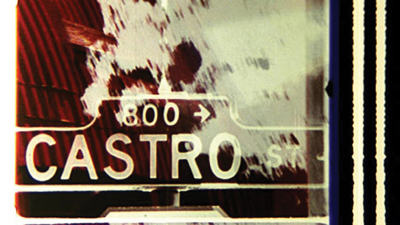
We see this explicitly in Baillie's most famous film, "Castro Street" (1966), composed of two unbroken tracking shots moving in opposite directions along opposite sides of the titular street in Richmond, Calif. As Baillie moves alongside a rail yard and a Chevron refinery, we glimpse natural forms (weeds, clouds, sunbeams) in a mechanized setting, along with the human and mechanical traces of heavy industry. The two colliding views (one color, one black-and-white) describe new, impossible forms, intersecting and Rorschaching, while at the same time imbuing the working men caught by Baillie's camera/gaze with an almost feminine aesthetic potency, shining forth in brilliant crimsons and cobalt blues. The audio track is a musique concrete cacophony of train noise, half-heard brakemen's orders, the Young Rascals on the radio. It's an ordinary day, transfigured.
Or consider one of Baillie's earliest films, "Here I Am" (1962), made when he was undertaking a nonfiction newsreel program for Canyon Cinema. It is a documentary portrait of a school in Oakland for children who had experienced abuse or neglect. Baillie stands at a remove, with the intention of explaining nothing. Instead, he observes individual children at play, sharing brief moments of cooperation and tenderness. There is no voiceover, no rhetorical editing. Baillie's method is to let the camera assist in generating moments of fleeting radiance, when these introverted young people emerge from their bureaucratic circumstance and become free beings.
Likewise, Baillie's "Valentin de las Sierras" (1971) is a film that adopts what the Western viewer may expect to be an "ethnographic" subject (a man and his family in Jalisco, Mexico) and refutes all formal expectation that accompanies the anthropological gaze. Through light and shadow, extreme close-ups on eyes, hands and other body fragments, the animals, the labor and the road, Baillie produces a work of genuine portraiture. Every tiny piece of "Valentin" is so isolated from a larger context, so radically specific in its color, shape, and framing, that no grand knowledge can be generalized from it.
One of Baillie's most straightforward films is also his best. "All My Life" (1966) perhaps best reflects the filmmaker's uncanny ability to home in on the poetic simplicity of the world's interstices and successfully transmit them to his viewership. The film is a mere three minutes long. It is a single take, consisting of a right-to-left tracking shot along an old picket fence. The daylight sky is a textbook blue; there are roses growing along the fence. The film is synced to Ella Fitzgerald's song "All My Life," as sincere a love song as anyone has ever penned. "All My Life" seems to slowly unwind before the viewer, like the scroll in a player piano.
The final film on the LSM program, "Quick Billy" (1970), is one of Baillie's longest and most complex, set in four distinct movements. As if intuitively plunging into the tumultuous conceptual landscape of late '60s/early '70s avant-garde film, Baillie opens "Quick Billy" with pure, searing light, which, it soon becomes apparent, is the sun itself. Like the poetic/spiritual tradition of cine-visionaries Brakhage and Anger, Baillie overwhelms us with the self-destructive quest for enlightenment; but like the structural-materialists, so concerned with the film medium itself — think Hollis Frampton or Michael Snow — Baillie also gives us pure light on film, absolute particles on screen.
I won't spoil "Quick Billy's" many surprises, except to say that the four parts are not intended to fit together. Rather, they point to the multiple possibilities that the cinema can offer: experimentation, desire, myth — and perhaps finally, a mix of confusion and astonishment.
Email arts@nashvillescene.com.



