
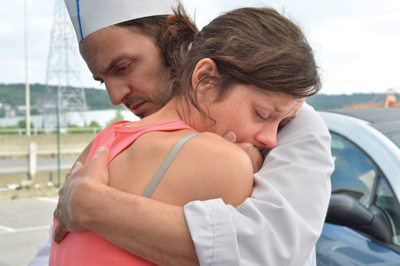
Belgium's Luc and Jean-Pierre Dardenne have built up one of the most acclaimed bodies of work in modern cinema with their gritty, lived-in tales of marginalized figures caught at the edges of European capitalism — broken people, junkies, immigrants, criminals. So their latest, Two Days, One Night, feels at first like a departure, with its seemingly mundane middle-class set-up.
Marion Cotillard plays Sandra, a young mother working for a solar energy company who's taken an extended sick leave. When she returns, she finds out that her co-workers have been given a stark choice: Now that management knows the company can function with one fewer position, they can each either receive a 1,000 Euro bonus, or Sandra can keep her job; the company can't afford both. The co-workers have voted, and Sandra learns she is about to be terminated.
When the boss agrees to take a re-vote after the weekend, she seems to get a brief reprieve. If she can go to each of her co-workers and convince a majority of them to vote in her favor — thereby giving up their bonuses — then she might be able to save her job, and keep her family from going on the dole. And so Sandra — worried, tired, overwhelmed and enormously fragile due to a recent bout of depression — has to visit each one of her fellow workers and effectively beg for her job back.
Cotillard is remarkable in the part. It's rare for a star of her magnitude to act for the Dardennes, who generally prefer nonprofessionals and unknowns, but she's impressively shed anything resembling glamour, or affect. We can't take our eyes off her, in part because she feels like she's on a psychic edge, constantly in danger of falling off. This is the most vulnerable performance she's ever given — watching her at times feels like watching an exposed nerve.
Two Days, One Night isn't nearly as touched by violence or desperation as the Dardennes' previous films, but it has a beautifully suspenseful premise. It is, effectively, a ticking-clock thriller, only in this case our hero isn't trying to track down a killer or stop a bomb. And while the threat of violence isn't entirely absent — at one point, two co-workers briefly come to blows — the filmmakers still manage to find remarkable urgency and tension as Sandra goes from co-worker to co-worker.
There's a keen, subtle visual intelligence at work here. The Dardennes are known for the immediacy of their camera — close by, hand-held, often following characters behind their heads. But they also manage to find real suspense and urgency in Sandra's otherwise static exchanges with her co-workers, placing obstacles and creating distinct visual fields to underline the distance and alienation between these characters.
But perhaps what's most remarkable in the Dardennes' approach — beyond the suspense, beyond the provocative portrait of people caught in the capitalist machine — is their humanity. We're with Sandra throughout Two Days, One Night, but each exchange feels like another window being opened into the world. Her co-workers, we come to understand, need this money too — and many of them know what it is to be desperate and poor. Sandra's quest, as a result, becomes not just a quest for her own survival, but also a journey into these other people's lives. The surface details may be different from some of their previous films, but Two Days, One Night might be the Dardennes' masterpiece.
Email arts@nashvillescene.com



